

216
Applied island biogeography
Wilcove et al . (1986) suggest that reserves of less
than 100 ha cannot support viable populations of
forest songbirds due to high densities of nest predators
such as blue jay ( Cyanocitta cristata ), weasel ( Mustela
erminea ) and racoon ( Procyon lotor ) around forest
edges. Laurance (2000) suggests that edge effects can
occur on even large spatial scales. For example, Curran
et al . (1999) found that recruitment of canopy trees in
the 90,000 ha Gunung Palung National Park in
western Borneo collapsed because vertebrate seed
predators fl ooded into the park from surrounding
degraded areas. A core - area model proposed by
Laurance (2000) illustrates the impacts of edge effects
on nature reserves ranging from 1,000 to 100,000 ha
(Figure 8.12 ).
These examples illustrate that the relationship
between a reserve and its surrounding matrix is not
subject to easy generalization. There are species that
share both zones and, just as there are matrix species
that may impact negatively upon core reserve species,
there may also be reserve species which exploit
resources in the matrix. Therefore, the heterogeneous
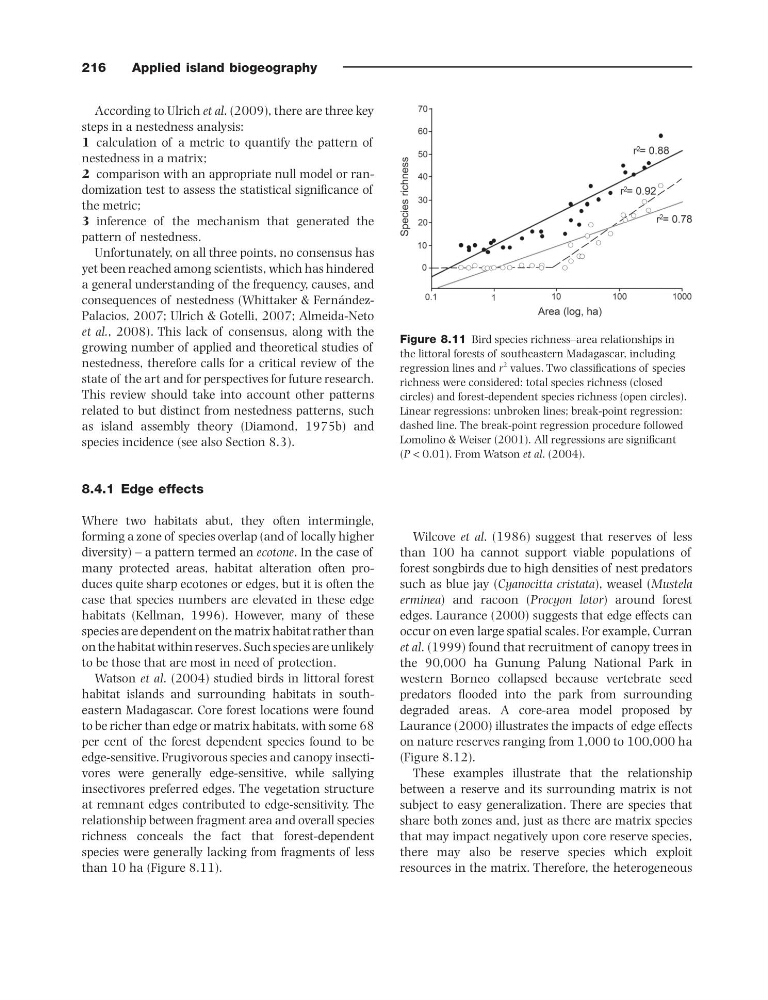
Figure 8.11 Bird species richness – area relationships in
the littoral forests of southeastern Madagascar, including
regression lines and r
2 values. Two classifi cations of species
richness were considered: total species richness (closed
circles) and forest - dependent species richness (open circles).
Linear regressions: unbroken lines; break - point regression:
dashed line. The break - point regression procedure followed
Lomolino & Weiser (2001) . All regressions are signifi cant
( P < 0.01). From Watson et al . (2004) .
According to Ulrich et al . (2009) , there are three key
steps in a nestedness analysis:
1 calculation of a metric to quantify the pattern of
nestedness in a matrix;
2 comparison with an appropriate null model or randomization test to assess the statistical signifi cance of
the metric;
3 inference of the mechanism that generated the
pattern of nestedness.
Unfortunately, on all three points, no consensus has
yet been reached among scientists, which has hindered
a general understanding of the frequency, causes, and
consequences of nestedness (Whittaker & Fern á ndez -
Palacios, 2007 ; Ulrich & Gotelli, 2007 ; Almeida - Neto
et al. , 2008 ). This lack of consensus, along with the
growing number of applied and theoretical studies of
nestedness, therefore calls for a critical review of the
state of the art and for perspectives for future research.
This review should take into account other patterns
related to but distinct from nestedness patterns, such
as island assembly theory (Diamond, 1975b ) and
species incidence (see also Section 8.3 ).
8.4.1 Edge e ffects
Where two habitats abut, they often intermingle,
forming a zone of species overlap (and of locally higher
diversity) – a pattern termed an ecotone . In the case of
many protected areas, habitat alteration often produces quite sharp ecotones or edges, but it is often the
case that species numbers are elevated in these edge
habitats (Kellman, 1996 ). However, many of these
species are dependent on the matrix habitat rather than
on the habitat within reserves. Such species are unlikely
to be those that are most in need of protection.
Watson et al . (2004) studied birds in littoral forest
habitat islands and surrounding habitats in south -
eastern Madagascar. Core forest locations were found
to be richer than edge or matrix habitats, with some 68
per cent of the forest dependent species found to be
edge - sensitive. Frugivorous species and canopy insectivores were generally edge - sensitive, while sallying
insectivores preferred edges. The vegetation structure
at remnant edges contributed to edge - sensitivity. The
relationship between fragment area and overall species
richness conceals the fact that forest - dependent
species were generally lacking from fragments of less
than 10 ha (Figure 8.11 ).
Applied island biogeography
Wilcove et al . (1986) suggest that reserves of less
than 100 ha cannot support viable populations of
forest songbirds due to high densities of nest predators
such as blue jay ( Cyanocitta cristata ), weasel ( Mustela
erminea ) and racoon ( Procyon lotor ) around forest
edges. Laurance (2000) suggests that edge effects can
occur on even large spatial scales. For example, Curran
et al . (1999) found that recruitment of canopy trees in
the 90,000 ha Gunung Palung National Park in
western Borneo collapsed because vertebrate seed
predators fl ooded into the park from surrounding
degraded areas. A core - area model proposed by
Laurance (2000) illustrates the impacts of edge effects
on nature reserves ranging from 1,000 to 100,000 ha
(Figure 8.12 ).
These examples illustrate that the relationship
between a reserve and its surrounding matrix is not
subject to easy generalization. There are species that
share both zones and, just as there are matrix species
that may impact negatively upon core reserve species,
there may also be reserve species which exploit
resources in the matrix. Therefore, the heterogeneous
Figure 8.11 Bird species richness – area relationships in
the littoral forests of southeastern Madagascar, including
regression lines and r
2 values. Two classifi cations of species
richness were considered: total species richness (closed
circles) and forest - dependent species richness (open circles).
Linear regressions: unbroken lines; break - point regression:
dashed line. The break - point regression procedure followed
Lomolino & Weiser (2001) . All regressions are signifi cant
( P < 0.01). From Watson et al . (2004) .
According to Ulrich et al . (2009) , there are three key
steps in a nestedness analysis:
1 calculation of a metric to quantify the pattern of
nestedness in a matrix;
2 comparison with an appropriate null model or randomization test to assess the statistical signifi cance of
the metric;
3 inference of the mechanism that generated the
pattern of nestedness.
Unfortunately, on all three points, no consensus has
yet been reached among scientists, which has hindered
a general understanding of the frequency, causes, and
consequences of nestedness (Whittaker & Fern á ndez -
Palacios, 2007 ; Ulrich & Gotelli, 2007 ; Almeida - Neto
et al. , 2008 ). This lack of consensus, along with the
growing number of applied and theoretical studies of
nestedness, therefore calls for a critical review of the
state of the art and for perspectives for future research.
This review should take into account other patterns
related to but distinct from nestedness patterns, such
as island assembly theory (Diamond, 1975b ) and
species incidence (see also Section 8.3 ).
8.4.1 Edge e ffects
Where two habitats abut, they often intermingle,
forming a zone of species overlap (and of locally higher
diversity) – a pattern termed an ecotone . In the case of
many protected areas, habitat alteration often produces quite sharp ecotones or edges, but it is often the
case that species numbers are elevated in these edge
habitats (Kellman, 1996 ). However, many of these
species are dependent on the matrix habitat rather than
on the habitat within reserves. Such species are unlikely
to be those that are most in need of protection.
Watson et al . (2004) studied birds in littoral forest
habitat islands and surrounding habitats in south -
eastern Madagascar. Core forest locations were found
to be richer than edge or matrix habitats, with some 68
per cent of the forest dependent species found to be
edge - sensitive. Frugivorous species and canopy insectivores were generally edge - sensitive, while sallying
insectivores preferred edges. The vegetation structure
at remnant edges contributed to edge - sensitivity. The
relationship between fragment area and overall species
richness conceals the fact that forest - dependent
species were generally lacking from fragments of less
than 10 ha (Figure 8.11 ).