

Conservation planning in a changing world
207
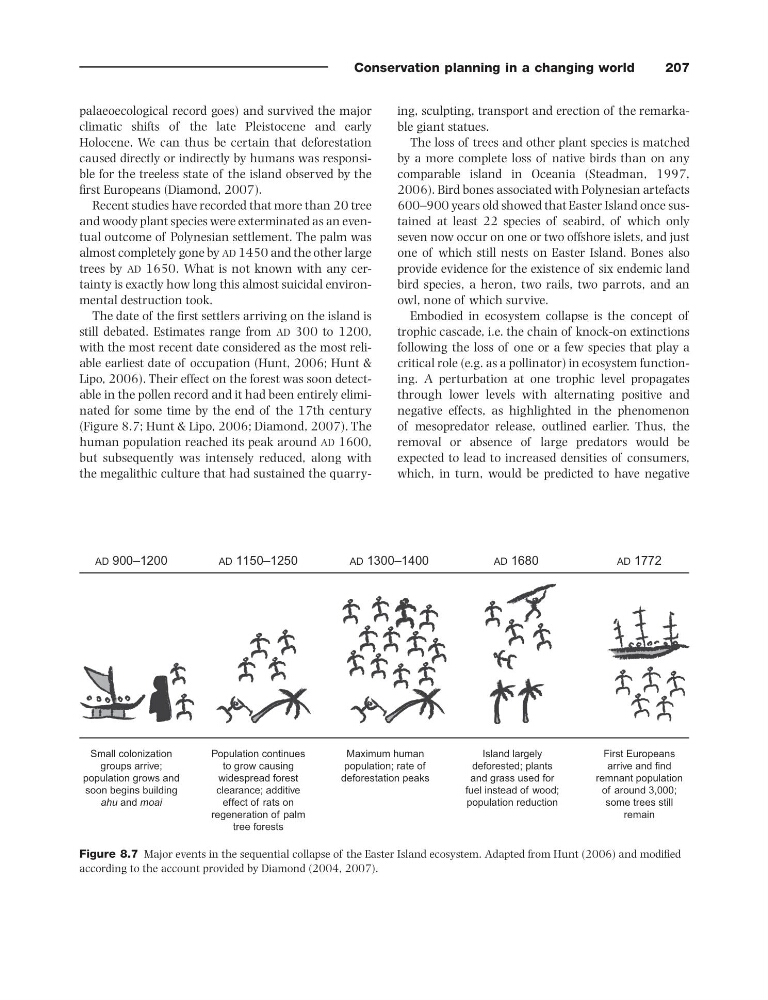
Figure 8.7 Major events in the sequential collapse of the Easter Island ecosystem. Adapted from Hunt (2006) and modifi ed
according to the account provided by Diamond ( 2004 , 2007 ).
AD 900–1200
AD 1150–1250
AD 1300–1400
AD 1680
AD 1772
Maximum human
population; rate of
deforestation peaks
Small colonization
groups arrive;
population grows and
soon begins building
ahu and moai
Population continues
to grow causing
widespread forest
clearance; additive
effect of rats on
regeneration of palm
tree forests
Island largely
deforested; plants
and grass used for
fuel instead of wood;
population reduction
First Europeans
arrive and find
remnant population
of around 3,000;
some trees still
remain
ing, sculpting, transport and erection of the remarkable giant statues.
The loss of trees and other plant species is matched
by a more complete loss of native birds than on any
comparable island in Oceania (Steadman, 1997,
2006 ). Bird bones associated with Polynesian artefacts
600 – 900 years old showed that Easter Island once sustained at least 22 species of seabird, of which only
seven now occur on one or two offshore islets, and just
one of which still nests on Easter Island. Bones also
provide evidence for the existence of six endemic land
bird species, a heron, two rails, two parrots, and an
owl, none of which survive.
Embodied in ecosystem collapse is the concept of
trophic cascade, i.e. the chain of knock - on extinctions
following the loss of one or a few species that play a
critical role (e.g. as a pollinator) in ecosystem functioning. A perturbation at one trophic level propagates
through lower levels with alternating positive and
negative effects, as highlighted in the phenomenon
of mesopredator release, outlined earlier. Thus, the
removal or absence of large predators would be
expected to lead to increased densities of consumers,
which, in turn, would be predicted to have negative
palaeoecological record goes) and survived the major
climatic shifts of the late Pleistocene and early
Holocene. We can thus be certain that deforestation
caused directly or indirectly by humans was responsible for the treeless state of the island observed by the
fi rst Europeans (Diamond, 2007 ).
Recent studies have recorded that more than 20 tree
and woody plant species were exterminated as an eventual outcome of Polynesian settlement. The palm was
almost completely gone by AD 1450 and the other large
trees by AD 1650. What is not known with any certainty is exactly how long this almost suicidal environmental destruction took.
The date of the fi rst settlers arriving on the island is
still debated. Estimates range from AD 300 to 1200,
with the most recent date considered as the most reliable earliest date of occupation (Hunt, 2006 ; Hunt &
Lipo, 2006 ). Their effect on the forest was soon detectable in the pollen record and it had been entirely eliminated for some time by the end of the 17th century
(Figure 8.7 ; Hunt & Lipo, 2006 ; Diamond, 2007 ). The
human population reached its peak around AD 1600,
but subsequently was intensely reduced, along with
the megalithic culture that had sustained the quarry-
207
Figure 8.7 Major events in the sequential collapse of the Easter Island ecosystem. Adapted from Hunt (2006) and modifi ed
according to the account provided by Diamond ( 2004 , 2007 ).
AD 900–1200
AD 1150–1250
AD 1300–1400
AD 1680
AD 1772
Maximum human
population; rate of
deforestation peaks
Small colonization
groups arrive;
population grows and
soon begins building
ahu and moai
Population continues
to grow causing
widespread forest
clearance; additive
effect of rats on
regeneration of palm
tree forests
Island largely
deforested; plants
and grass used for
fuel instead of wood;
population reduction
First Europeans
arrive and find
remnant population
of around 3,000;
some trees still
remain
ing, sculpting, transport and erection of the remarkable giant statues.
The loss of trees and other plant species is matched
by a more complete loss of native birds than on any
comparable island in Oceania (Steadman, 1997,
2006 ). Bird bones associated with Polynesian artefacts
600 – 900 years old showed that Easter Island once sustained at least 22 species of seabird, of which only
seven now occur on one or two offshore islets, and just
one of which still nests on Easter Island. Bones also
provide evidence for the existence of six endemic land
bird species, a heron, two rails, two parrots, and an
owl, none of which survive.
Embodied in ecosystem collapse is the concept of
trophic cascade, i.e. the chain of knock - on extinctions
following the loss of one or a few species that play a
critical role (e.g. as a pollinator) in ecosystem functioning. A perturbation at one trophic level propagates
through lower levels with alternating positive and
negative effects, as highlighted in the phenomenon
of mesopredator release, outlined earlier. Thus, the
removal or absence of large predators would be
expected to lead to increased densities of consumers,
which, in turn, would be predicted to have negative
palaeoecological record goes) and survived the major
climatic shifts of the late Pleistocene and early
Holocene. We can thus be certain that deforestation
caused directly or indirectly by humans was responsible for the treeless state of the island observed by the
fi rst Europeans (Diamond, 2007 ).
Recent studies have recorded that more than 20 tree
and woody plant species were exterminated as an eventual outcome of Polynesian settlement. The palm was
almost completely gone by AD 1450 and the other large
trees by AD 1650. What is not known with any certainty is exactly how long this almost suicidal environmental destruction took.
The date of the fi rst settlers arriving on the island is
still debated. Estimates range from AD 300 to 1200,
with the most recent date considered as the most reliable earliest date of occupation (Hunt, 2006 ; Hunt &
Lipo, 2006 ). Their effect on the forest was soon detectable in the pollen record and it had been entirely eliminated for some time by the end of the 17th century
(Figure 8.7 ; Hunt & Lipo, 2006 ; Diamond, 2007 ). The
human population reached its peak around AD 1600,
but subsequently was intensely reduced, along with
the megalithic culture that had sustained the quarry-