

Conservation planning in a changing world
205
For the total island area and the habitat area above 300 m, the species – area – time model applied was signifi cant
(P < 0.05) for the arthropod taxa considered, with most of the explained variance attributable to area. However,
for the area above 500 m and the present area covered by native forest, neither the species – area – time relationships nor the respective species – area relationships were statistically signifi cant. We thus used the fi rst two
benchmark relationships, for total area ( ≈ AD 1440) and area above 300 m ( ≈ AD 1700), to represent the baseline
conditions for estimation of current extinction debt. Hence, we used the parameters estimated for the total area
of the islands (Prediction 1 in Table B8.2a ) and that of the area above 300 m (Prediction 2 in Table B8.2a ) to
estimate the number of endemic forest arthropods that ‘ should ’ be present and, by direct comparison with the
number of extant species, to derive the number of future extinctions (i.e. the extinction debt) (Table B8.2a ).
For the arthropod taxa considered, our results clearly indicate that the majority of the endemic forest - inhabiting
species ( > 50 per cent) are expected to go extinct in time, especially on those islands on which the native forest
has been restricted to small areas or has been totally removed. Terceira, the island with the largest remnants of
native forest, has the smallest number of predicted future extinctions.
At face value, these fi gures constitute a powerful warning to island conservationists that the worst of the
extinction crisis is by no means over. Furthermore, in spite of the fact that some archipelagic endemic species
may benefi t from a degree of population reinforcement between habitat fragments or islands, the parallel reduction of the native forest across all islands in the last 600 years has greatly diminished the probability of such
source - sink dynamics rescuing species from global extinction. Hence, we would also anticipate a correspondingly large number of archipelagic - scale species extinctions for Azorean endemic arthropods in the future as the
extinction debt is settled. In point of fact, at least fi ve SIE species of beetles recorded early in the 20th century
have not been recorded since 1965 and might therefore be considered extinct .
In the paper, we argued that the fi gures reported above are likely to be more accurate than previous
predictions because we have focused our attention on endemic forest species that have evolved in,
Log Area
AD 1440
AD 1700
AD 1850
Present
Time
T 1
T 1
T 2
T 2
T 3
T 3
T 4
T 4
Log Species
b)
a)
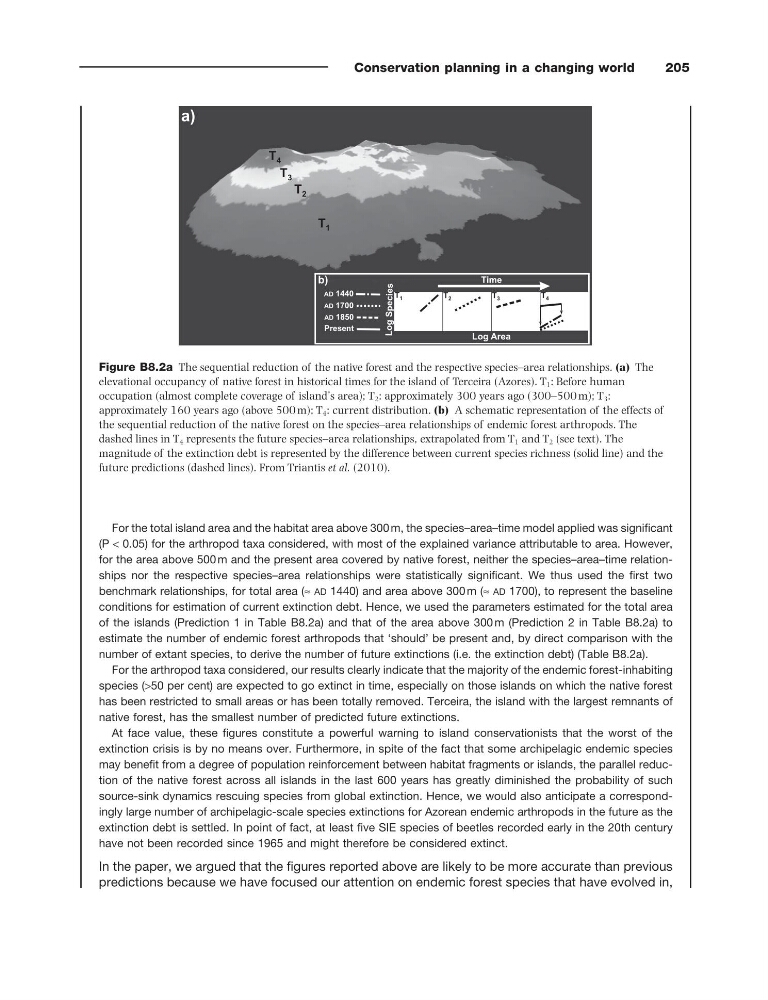
Figure B8.2a The sequential reduction of the native forest and the respective species – area relationships. (a) The
elevational occupancy of native forest in historical times for the island of Terceira (Azores). T 1 : Before human
occupation (almost complete coverage of island ’ s area); T 2 : approximately 300 years ago (300 – 500 m); T 3 :
approximately 160 years ago (above 500 m); T 4 : current distribution. (b) A schematic representation of the effects of
the sequential reduction of the native forest on the species – area relationships of endemic forest arthropods. The
dashed lines in T 4 represents the future species – area relationships, extrapolated from T 1 and T 2 (see text). The
magnitude of the extinction debt is represented by the difference between current species richness (solid line) and the
future predictions (dashed lines). From Triantis et al. (2010) .
205
For the total island area and the habitat area above 300 m, the species – area – time model applied was signifi cant
(P < 0.05) for the arthropod taxa considered, with most of the explained variance attributable to area. However,
for the area above 500 m and the present area covered by native forest, neither the species – area – time relationships nor the respective species – area relationships were statistically signifi cant. We thus used the fi rst two
benchmark relationships, for total area ( ≈ AD 1440) and area above 300 m ( ≈ AD 1700), to represent the baseline
conditions for estimation of current extinction debt. Hence, we used the parameters estimated for the total area
of the islands (Prediction 1 in Table B8.2a ) and that of the area above 300 m (Prediction 2 in Table B8.2a ) to
estimate the number of endemic forest arthropods that ‘ should ’ be present and, by direct comparison with the
number of extant species, to derive the number of future extinctions (i.e. the extinction debt) (Table B8.2a ).
For the arthropod taxa considered, our results clearly indicate that the majority of the endemic forest - inhabiting
species ( > 50 per cent) are expected to go extinct in time, especially on those islands on which the native forest
has been restricted to small areas or has been totally removed. Terceira, the island with the largest remnants of
native forest, has the smallest number of predicted future extinctions.
At face value, these fi gures constitute a powerful warning to island conservationists that the worst of the
extinction crisis is by no means over. Furthermore, in spite of the fact that some archipelagic endemic species
may benefi t from a degree of population reinforcement between habitat fragments or islands, the parallel reduction of the native forest across all islands in the last 600 years has greatly diminished the probability of such
source - sink dynamics rescuing species from global extinction. Hence, we would also anticipate a correspondingly large number of archipelagic - scale species extinctions for Azorean endemic arthropods in the future as the
extinction debt is settled. In point of fact, at least fi ve SIE species of beetles recorded early in the 20th century
have not been recorded since 1965 and might therefore be considered extinct .
In the paper, we argued that the fi gures reported above are likely to be more accurate than previous
predictions because we have focused our attention on endemic forest species that have evolved in,
Log Area
AD 1440
AD 1700
AD 1850
Present
Time
T 1
T 1
T 2
T 2
T 3
T 3
T 4
T 4
Log Species
b)
a)
Figure B8.2a The sequential reduction of the native forest and the respective species – area relationships. (a) The
elevational occupancy of native forest in historical times for the island of Terceira (Azores). T 1 : Before human
occupation (almost complete coverage of island ’ s area); T 2 : approximately 300 years ago (300 – 500 m); T 3 :
approximately 160 years ago (above 500 m); T 4 : current distribution. (b) A schematic representation of the effects of
the sequential reduction of the native forest on the species – area relationships of endemic forest arthropods. The
dashed lines in T 4 represents the future species – area relationships, extrapolated from T 1 and T 2 (see text). The
magnitude of the extinction debt is represented by the difference between current species richness (solid line) and the
future predictions (dashed lines). From Triantis et al. (2010) .