

192
Applied island biogeography
reserve is surrounded by a non - woodland matrix (see
Diamond, 1975a ; Wilson & Willis, 1975 ; Diamond &
May, 1981 ).
Many of these ETIB - derived ‘ principles ’ have been the
subject of intense debate. For example, while corridors
between reserves (increased connectivity) certainly
may increase immigration, facilitate gene fl ow and
reduce local extinctions through the rescue effect, they
may also facilitate the spread of disease, fi res and exotic
• when two or more reserves are inevitable for some
specifi c habitat or species, the inter - reserve distance
should be as short as possible;
• corridors between reserves are recommended to
increase inter - reserve migration/dispersal;
• a circular reserve is superior to a linear one because
of the potential problems created by biotic and abiotic
edge effects, i.e. the changes in biological and physical
conditions that occur when for example a woodland
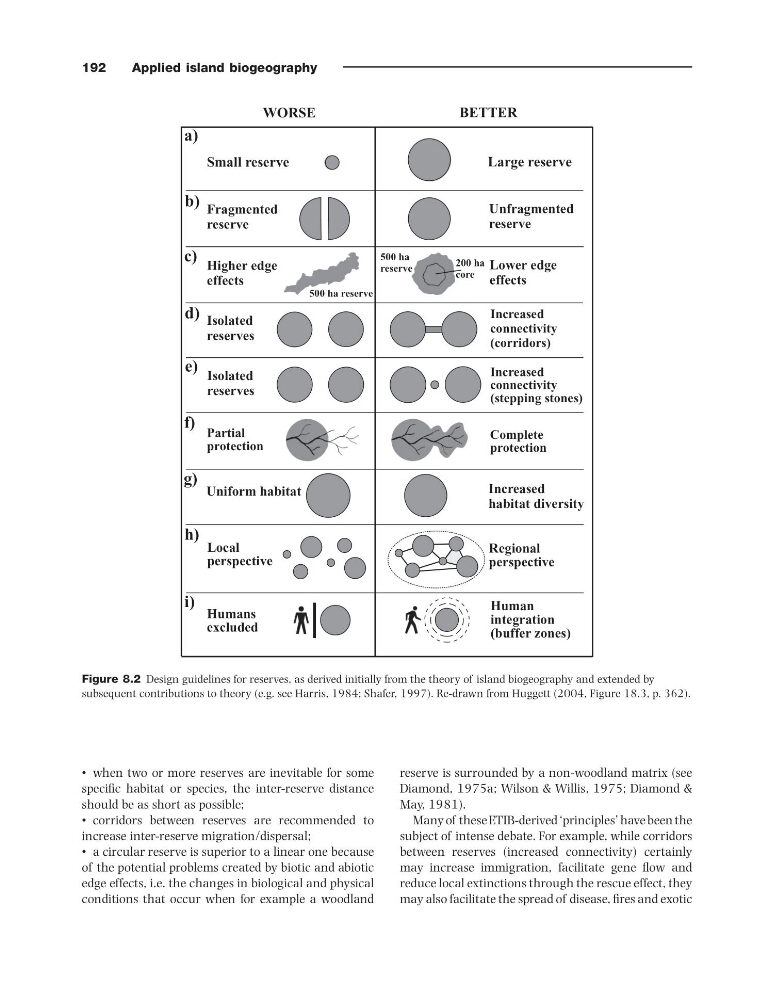
Figure 8.2 Design guidelines for reserves, as derived initially from the theory of island biogeography and extended by
subsequent contributions to theory (e.g. see Harris, 1984 ; Shafer, 1997 ). Re - drawn from Huggett ( 2004 , Figure 18.3, p. 362).
b)
c)
d)
e)
f)
g)
h)
i)
Uniform habitat
Local
perspective
Humans
excluded
Human
integration
(buffer zones)
Regional
perspective
Partial
protection
Complete
protection
Isolated
reserves
Higher edge
effects
Fragmented
reserve
Unfragmented
reserve
Lower edge
effects
Isolated
reserves
Increased
connectivity
(corridors)
Increased
connectivity
(stepping stones)
Increased
habitat diversity
500 ha reserve
500 ha
reserve
200 ha
core
a)
Small reserve
Large reserve
WORSE
BETTER
Applied island biogeography
reserve is surrounded by a non - woodland matrix (see
Diamond, 1975a ; Wilson & Willis, 1975 ; Diamond &
May, 1981 ).
Many of these ETIB - derived ‘ principles ’ have been the
subject of intense debate. For example, while corridors
between reserves (increased connectivity) certainly
may increase immigration, facilitate gene fl ow and
reduce local extinctions through the rescue effect, they
may also facilitate the spread of disease, fi res and exotic
• when two or more reserves are inevitable for some
specifi c habitat or species, the inter - reserve distance
should be as short as possible;
• corridors between reserves are recommended to
increase inter - reserve migration/dispersal;
• a circular reserve is superior to a linear one because
of the potential problems created by biotic and abiotic
edge effects, i.e. the changes in biological and physical
conditions that occur when for example a woodland
Figure 8.2 Design guidelines for reserves, as derived initially from the theory of island biogeography and extended by
subsequent contributions to theory (e.g. see Harris, 1984 ; Shafer, 1997 ). Re - drawn from Huggett ( 2004 , Figure 18.3, p. 362).
b)
c)
d)
e)
f)
g)
h)
i)
Uniform habitat
Local
perspective
Humans
excluded
Human
integration
(buffer zones)
Regional
perspective
Partial
protection
Complete
protection
Isolated
reserves
Higher edge
effects
Fragmented
reserve
Unfragmented
reserve
Lower edge
effects
Isolated
reserves
Increased
connectivity
(corridors)
Increased
connectivity
(stepping stones)
Increased
habitat diversity
500 ha reserve
500 ha
reserve
200 ha
core
a)
Small reserve
Large reserve
WORSE
BETTER