

Conservation planning in a changing world
191
they must also make decisions about reserve size, connectivity, replication and the alignment of boundaries
(Margules & Pressey, 2000 ; Whittaker et al. , 2005 ). All
of this needs to be done while conforming to budgetary
constraints and, typically, strong political and socio -
economic constraints on the size and location of
reserves.
Island biogeography theory provides the theoretical
framework for much fragmentation research and has
been invoked as the source of general principles of
reserve network design (Diamond, 1975a ; Wilson &
Willis, 1975 ; Haila, 2002 ; see Figure 8.2 ). Examples
include:
• a large reserve is superior to a small one;
• a single large reserve is better than several small
reserves with the same total area;
separate this biodiversity from processes that threaten
its persistence. The extent to which protected areas
fulfi l this role depends on how well they meet two
objectives of reserve design.
The fi rst is representation , a long - established goal
referring to the need for reserves to incorporate the full
variety of biodiversity in the region, ideally at all levels
of organization (Chapters 2 , 5 , 6 ).
The second is persistence . Reserves, once established,
should promote the long - term survival of the species
and other elements of biodiversity that they contain by
maintaining natural processes and viable populations,
and by excluding threats (Chapter 7 ).
To meet these objectives, conservation planners
must not only design systems of reserves that take into
consideration natural physical and biological patterns,
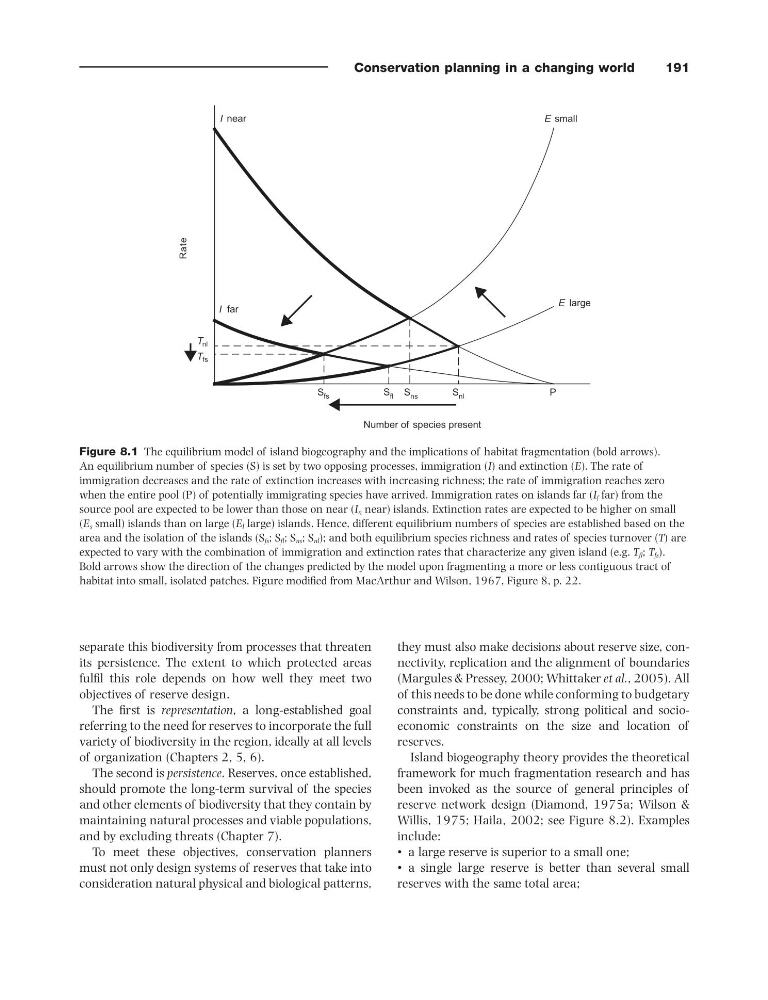
Figure 8.1 The equilibrium model of island biogeography and the implications of habitat fragmentation (bold arrows).
An equilibrium number of species (S) is set by two opposing processes, immigration ( I ) and extinction ( E ). The rate of
immigration decreases and the rate of extinction increases with increasing richness; the rate of immigration reaches zero
when the entire pool (P) of potentially immigrating species have arrived. Immigration rates on islands far ( I f far) from the
source pool are expected to be lower than those on near ( I n near) islands. Extinction rates are expected to be higher on small
( E s small) islands than on large ( E l large) islands. Hence, different equilibrium numbers of species are established based on the
area and the isolation of the islands (S fs ; S fl ; S ns ; S nl ); and both equilibrium species richness and rates of species turnover ( T ) are
expected to vary with the combination of immigration and extinction rates that characterize any given island (e.g. T fl ; T fs ).
Bold arrows show the direction of the changes predicted by the model upon fragmenting a more or less contiguous tract of
habitat into small, isolated patches. Figure modifi ed from MacArthur and Wilson, 1967 , Figure 8, p. 22.
E large
E small
I near
I far
Rate
T nl
T fs
S fs
S fl S ns
S nl
P
Number of species present
191
they must also make decisions about reserve size, connectivity, replication and the alignment of boundaries
(Margules & Pressey, 2000 ; Whittaker et al. , 2005 ). All
of this needs to be done while conforming to budgetary
constraints and, typically, strong political and socio -
economic constraints on the size and location of
reserves.
Island biogeography theory provides the theoretical
framework for much fragmentation research and has
been invoked as the source of general principles of
reserve network design (Diamond, 1975a ; Wilson &
Willis, 1975 ; Haila, 2002 ; see Figure 8.2 ). Examples
include:
• a large reserve is superior to a small one;
• a single large reserve is better than several small
reserves with the same total area;
separate this biodiversity from processes that threaten
its persistence. The extent to which protected areas
fulfi l this role depends on how well they meet two
objectives of reserve design.
The fi rst is representation , a long - established goal
referring to the need for reserves to incorporate the full
variety of biodiversity in the region, ideally at all levels
of organization (Chapters 2 , 5 , 6 ).
The second is persistence . Reserves, once established,
should promote the long - term survival of the species
and other elements of biodiversity that they contain by
maintaining natural processes and viable populations,
and by excluding threats (Chapter 7 ).
To meet these objectives, conservation planners
must not only design systems of reserves that take into
consideration natural physical and biological patterns,
Figure 8.1 The equilibrium model of island biogeography and the implications of habitat fragmentation (bold arrows).
An equilibrium number of species (S) is set by two opposing processes, immigration ( I ) and extinction ( E ). The rate of
immigration decreases and the rate of extinction increases with increasing richness; the rate of immigration reaches zero
when the entire pool (P) of potentially immigrating species have arrived. Immigration rates on islands far ( I f far) from the
source pool are expected to be lower than those on near ( I n near) islands. Extinction rates are expected to be higher on small
( E s small) islands than on large ( E l large) islands. Hence, different equilibrium numbers of species are established based on the
area and the isolation of the islands (S fs ; S fl ; S ns ; S nl ); and both equilibrium species richness and rates of species turnover ( T ) are
expected to vary with the combination of immigration and extinction rates that characterize any given island (e.g. T fl ; T fs ).
Bold arrows show the direction of the changes predicted by the model upon fragmenting a more or less contiguous tract of
habitat into small, isolated patches. Figure modifi ed from MacArthur and Wilson, 1967 , Figure 8, p. 22.
E large
E small
I near
I far
Rate
T nl
T fs
S fs
S fl S ns
S nl
P
Number of species present