

174
Planning for persistence in a changing world
envelope that is related to water and energy regimes (a
pretty general scenario), such that it has a northern
(mostly cold - related) and southern (mostly heat -
related and/or drought - related) margin. To the west,
the distribution is limited by the hard barrier of the
sea, and to the east the species is constrained by a combination of thermal and moisture conditions and
between the core and periphery might be the area to
which ranges most frequently collapse – that being the
region where selection favours genotypes with the
greatest ability to adapt to changing conditions.
The general scenario can be visualized by the following hypothetical example. Imagine a temperate northern hemisphere species which has an environmental
Based on these assumptions, it is predicted that ranges should implode, with the fi nal population
or sub - populations of a species persisting near the centre of the historical range (Brown, 1995 ;
Lawton, 1995 ; Mehlman, 1997 ).
The contagion hypothesis (Figure B7.2a , panel b ) emphasizes the geographical dynamics of the
extinction process(es) in determining where populations should persist. It posits that those populations which are last impacted by the implicated extinction force will persist longer. In this hypothetical
scenario, Lomolino & Channell (1995) envisaged extinction factors spreading across the landscape
like a contagion – hence the name. They argued that, regardless of where the contagion begins, the
fi nal region to be impacted will be the most isolated from the initial position of the contagion. Hence,
although the process may well often begin at a range margin, it will spread most readily through
the centre of the range, so that the fi nal populations persist in isolated pockets somewhere along
an edge of the historical range.
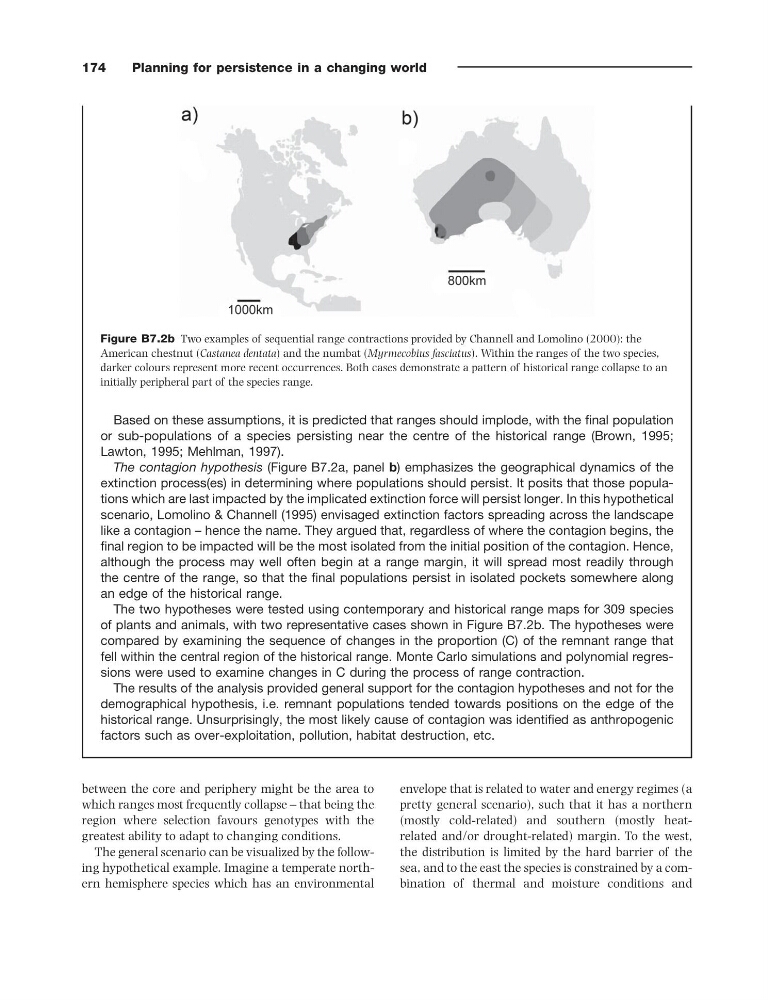
The two hypotheses were tested using contemporary and historical range maps for 309 species
of plants and animals, with two representative cases shown in Figure B7.2b . The hypotheses were
compared by examining the sequence of changes in the proportion (C) of the remnant range that
fell within the central region of the historical range. Monte Carlo simulations and polynomial regressions were used to examine changes in C during the process of range contraction.
The results of the analysis provided general support for the contagion hypotheses and not for the
demographical hypothesis, i.e. remnant populations tended towards positions on the edge of the
historical range. Unsurprisingly, the most likely cause of contagion was identifi ed as anthropogenic
factors such as over - exploitation, pollution, habitat destruction, etc.
Figure B7.2b Two examples of sequential range contractions provided by Channell and Lomolino (2000) : the
American chestnut ( Castanea dentata ) and the numbat ( Myrmecobius fasciatus ). Within the ranges of the two species,
darker colours represent more recent occurrences. Both cases demonstrate a pattern of historical range collapse to an
initially peripheral part of the species range.
Planning for persistence in a changing world
envelope that is related to water and energy regimes (a
pretty general scenario), such that it has a northern
(mostly cold - related) and southern (mostly heat -
related and/or drought - related) margin. To the west,
the distribution is limited by the hard barrier of the
sea, and to the east the species is constrained by a combination of thermal and moisture conditions and
between the core and periphery might be the area to
which ranges most frequently collapse – that being the
region where selection favours genotypes with the
greatest ability to adapt to changing conditions.
The general scenario can be visualized by the following hypothetical example. Imagine a temperate northern hemisphere species which has an environmental
Based on these assumptions, it is predicted that ranges should implode, with the fi nal population
or sub - populations of a species persisting near the centre of the historical range (Brown, 1995 ;
Lawton, 1995 ; Mehlman, 1997 ).
The contagion hypothesis (Figure B7.2a , panel b ) emphasizes the geographical dynamics of the
extinction process(es) in determining where populations should persist. It posits that those populations which are last impacted by the implicated extinction force will persist longer. In this hypothetical
scenario, Lomolino & Channell (1995) envisaged extinction factors spreading across the landscape
like a contagion – hence the name. They argued that, regardless of where the contagion begins, the
fi nal region to be impacted will be the most isolated from the initial position of the contagion. Hence,
although the process may well often begin at a range margin, it will spread most readily through
the centre of the range, so that the fi nal populations persist in isolated pockets somewhere along
an edge of the historical range.
The two hypotheses were tested using contemporary and historical range maps for 309 species
of plants and animals, with two representative cases shown in Figure B7.2b . The hypotheses were
compared by examining the sequence of changes in the proportion (C) of the remnant range that
fell within the central region of the historical range. Monte Carlo simulations and polynomial regressions were used to examine changes in C during the process of range contraction.
The results of the analysis provided general support for the contagion hypotheses and not for the
demographical hypothesis, i.e. remnant populations tended towards positions on the edge of the
historical range. Unsurprisingly, the most likely cause of contagion was identifi ed as anthropogenic
factors such as over - exploitation, pollution, habitat destruction, etc.
Figure B7.2b Two examples of sequential range contractions provided by Channell and Lomolino (2000) : the
American chestnut ( Castanea dentata ) and the numbat ( Myrmecobius fasciatus ). Within the ranges of the two species,
darker colours represent more recent occurrences. Both cases demonstrate a pattern of historical range collapse to an
initially peripheral part of the species range.