

The distribution of diversity: challenges and applications
145
Box 6.2 Conducting systematic conservation planning in the terrestrial
environment: a Maputaland case study
Written by Robert J. Smith, Durrell Institute of Conservation and Ecology, University of Kent, drawing
on Smith et al. (2008) .
The Maputaland Centre of Endemism is a region of high conservation value that falls within the
countries of Mozambique, South Africa and Swaziland (Figure B6.2 a). Its climate and soils have played
a large role in maintaining high levels of species richness and endemism (Steenkamp et al ., 2004 ), but
they have also infl uenced the conservation of this biodiversity, because much of the land has little
agricultural value and so has not been cleared by commercial farmers. Instead, most people rely on
small - scale farming and harvesting natural resources for their livelihoods. This, together with an
increasing human population and a history of political marginalization, has led to widespread poverty.
The governments of the region are keen to reduce these poverty levels and have recognized that
ecotourism and game ranching are the most profi table forms of land use. Consequently, they have
developed the Lubombo Transfrontier Conservation Area (TFCA) initiative, which seeks to conserve
the region ’ s biodiversity and reconnect important large mammal populations while creating jobs by
developing new conservation areas, both privately and communally managed.
The TFCA initiative is guided by the Maputaland conservation planning system, which is based
on systematic conservation planning principles (Margules & Pressey, 2000 ). This approach involves
producing a list of important conservation features, setting targets for each feature and then identifying priority areas for meeting these targets.
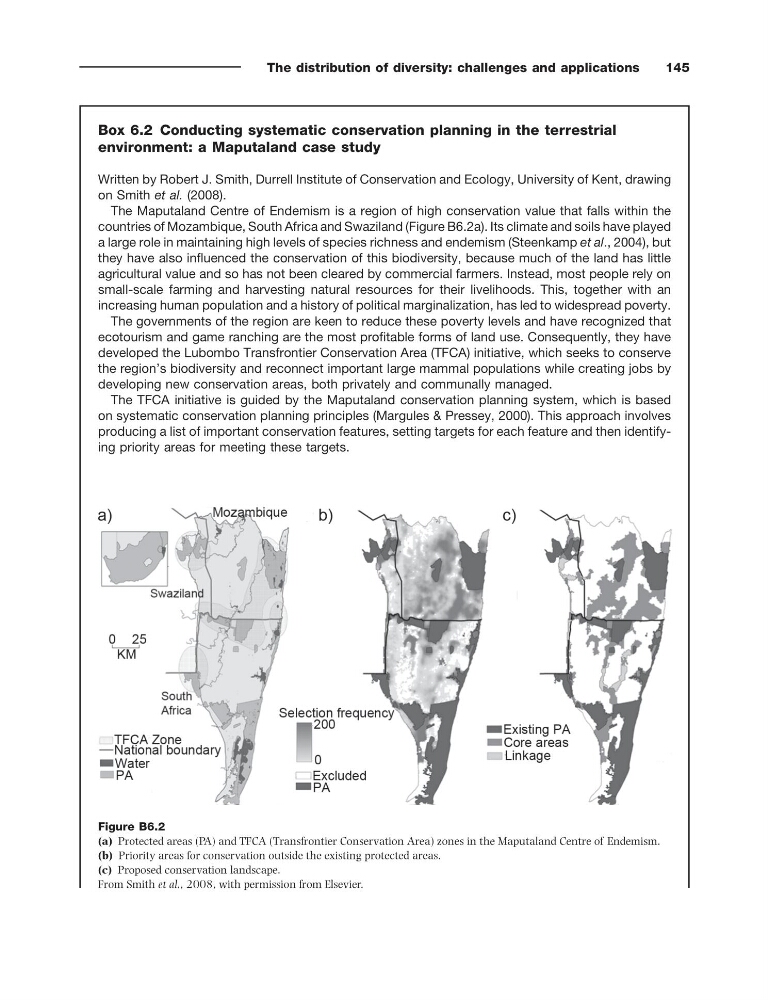
Figure B6.2
(a) Protected areas (PA) and TFCA (Transfrontier Conservation Area) zones in the Maputaland Centre of Endemism.
(b) Priority areas for conservation outside the existing protected areas.
(c) Proposed conservation landscape.
From Smith et al. , 2008 , with permission from Elsevier.
145
Box 6.2 Conducting systematic conservation planning in the terrestrial
environment: a Maputaland case study
Written by Robert J. Smith, Durrell Institute of Conservation and Ecology, University of Kent, drawing
on Smith et al. (2008) .
The Maputaland Centre of Endemism is a region of high conservation value that falls within the
countries of Mozambique, South Africa and Swaziland (Figure B6.2 a). Its climate and soils have played
a large role in maintaining high levels of species richness and endemism (Steenkamp et al ., 2004 ), but
they have also infl uenced the conservation of this biodiversity, because much of the land has little
agricultural value and so has not been cleared by commercial farmers. Instead, most people rely on
small - scale farming and harvesting natural resources for their livelihoods. This, together with an
increasing human population and a history of political marginalization, has led to widespread poverty.
The governments of the region are keen to reduce these poverty levels and have recognized that
ecotourism and game ranching are the most profi table forms of land use. Consequently, they have
developed the Lubombo Transfrontier Conservation Area (TFCA) initiative, which seeks to conserve
the region ’ s biodiversity and reconnect important large mammal populations while creating jobs by
developing new conservation areas, both privately and communally managed.
The TFCA initiative is guided by the Maputaland conservation planning system, which is based
on systematic conservation planning principles (Margules & Pressey, 2000 ). This approach involves
producing a list of important conservation features, setting targets for each feature and then identifying priority areas for meeting these targets.
Figure B6.2
(a) Protected areas (PA) and TFCA (Transfrontier Conservation Area) zones in the Maputaland Centre of Endemism.
(b) Priority areas for conservation outside the existing protected areas.
(c) Proposed conservation landscape.
From Smith et al. , 2008 , with permission from Elsevier.