

The distribution of diversity: challenges and applications
129
Initiative
Areas of
coverage
Current status
(as of 2009)
Biogeographical
information used (code
and selected examples)
a
Decision - making
methods, tools,
planning units
b
Reference
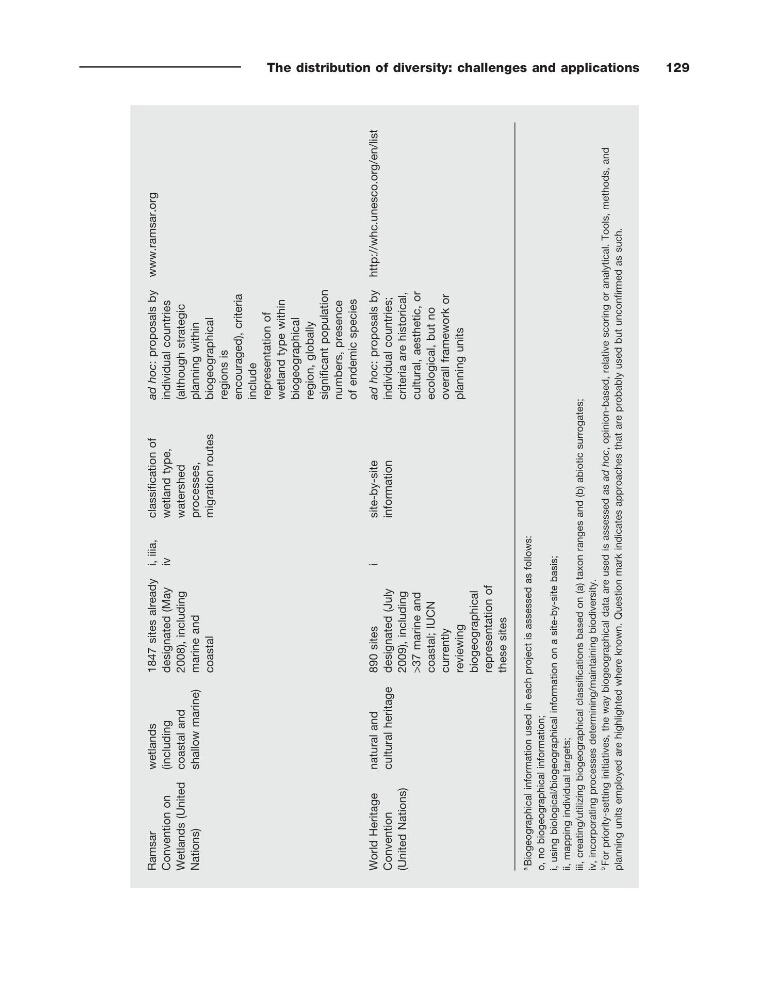
Ramsar
Convention on
Wetlands (United
Nations)
wetlands
(including
coastal and
shallow marine)
1847 sites already
designated (May
2008), including
marine and
coastal
i, iiia,
iv
classifi cation of
wetland type,
watershed
processes,
migration routes
ad hoc : proposals by
individual countries
(although strategic
planning within
biogeographical
regions is
encouraged), criteria
include
representation of
wetland type within
biogeographical
region, globally
signifi cant population
numbers, presence
of endemic species
www.ramsar.org
World Heritage
Convention
(United Nations)
natural and
cultural heritage
890 sites
designated (July
2009), including
> 37 marine and
coastal; IUCN
currently
reviewing
biogeographical
representation of
these sites
i
site - by - site
information
ad hoc : proposals by
individual countries;
criteria are historical,
cultural, aesthetic, or
ecological, but no
overall framework or
planning units
http://whc.unesco.org/en/list
a
Biogeographical information used in each project is assessed as follows:
o, no biogeographical information;
i, using biological/biogeographical information on a site - by - site basis;
ii, mapping individual targets;
iii, creating/utilizing biogeographical classifi cations based on (a) taxon ranges and (b) abiotic surrogates;
iv, incorporating processes determining/maintaining biodiversity.
b
For priority - setting initiatives, the way biogeographical data are used is assessed as ad hoc , opinion - based, relative scoring or analytical. Tools, methods, and
planning units employed are highlighted where known. Question mark indicates approaches that are probably used but unconfi rmed as such.
129
Initiative
Areas of
coverage
Current status
(as of 2009)
Biogeographical
information used (code
and selected examples)
a
Decision - making
methods, tools,
planning units
b
Reference
Ramsar
Convention on
Wetlands (United
Nations)
wetlands
(including
coastal and
shallow marine)
1847 sites already
designated (May
2008), including
marine and
coastal
i, iiia,
iv
classifi cation of
wetland type,
watershed
processes,
migration routes
ad hoc : proposals by
individual countries
(although strategic
planning within
biogeographical
regions is
encouraged), criteria
include
representation of
wetland type within
biogeographical
region, globally
signifi cant population
numbers, presence
of endemic species
www.ramsar.org
World Heritage
Convention
(United Nations)
natural and
cultural heritage
890 sites
designated (July
2009), including
> 37 marine and
coastal; IUCN
currently
reviewing
biogeographical
representation of
these sites
i
site - by - site
information
ad hoc : proposals by
individual countries;
criteria are historical,
cultural, aesthetic, or
ecological, but no
overall framework or
planning units
http://whc.unesco.org/en/list
a
Biogeographical information used in each project is assessed as follows:
o, no biogeographical information;
i, using biological/biogeographical information on a site - by - site basis;
ii, mapping individual targets;
iii, creating/utilizing biogeographical classifi cations based on (a) taxon ranges and (b) abiotic surrogates;
iv, incorporating processes determining/maintaining biodiversity.
b
For priority - setting initiatives, the way biogeographical data are used is assessed as ad hoc , opinion - based, relative scoring or analytical. Tools, methods, and
planning units employed are highlighted where known. Question mark indicates approaches that are probably used but unconfi rmed as such.