

The distribution of diversity: challenges and applications
117
of conservation concern and is a distinct azonal
approach to reserve selection (Figure 5.1 ) of growing
infl uence (e.g. see Box 5.1 ). The impetus for its foundation lay in the desire for the European Commission (the
executive arm of the European Union) to exert its infl uence over member states in the area of the environment. In the late 1970s, the chair of the International
Council for Bird Preservation ’ s (ICBP) Continental
Section also happened to be a lawyer within the EC. He
secured the support of a commissioner for a directive
on wild birds, developed in consultation with the
ICBP.
The Directive on the Conservation of Wild Birds,
better known as the Birds Directive, came into being in
1979. Among other things, it required EU member
states to designate protected areas (known as Special
Protection Areas or SPAs) for the protection of rare and
endangered species.
Subsequently, the EC wanted to monitor whether or
not member countries were fulfi lling their conservation
obligations. To enable them to do this, they contracted
the ICBP secretariat in Cambridge to prepare an EU wide
inventory of sites – subsequently termed Important Bird
Areas. ICBP cleverly converted the Directive ’ s list of four
types of species needing protection (Article 4) into a set
Sumatran rhinoceros and orang - utans, while simultaneously saving forests that are rich in lesser - known
endemic birds, other animals and plants. A key pragmatic reason for focusing on the area is the huge pressure on remaining forest areas arising from rampant
deforestation in Sumatra (see www.panda.org/about_
our_earth/ecoregions/ ).
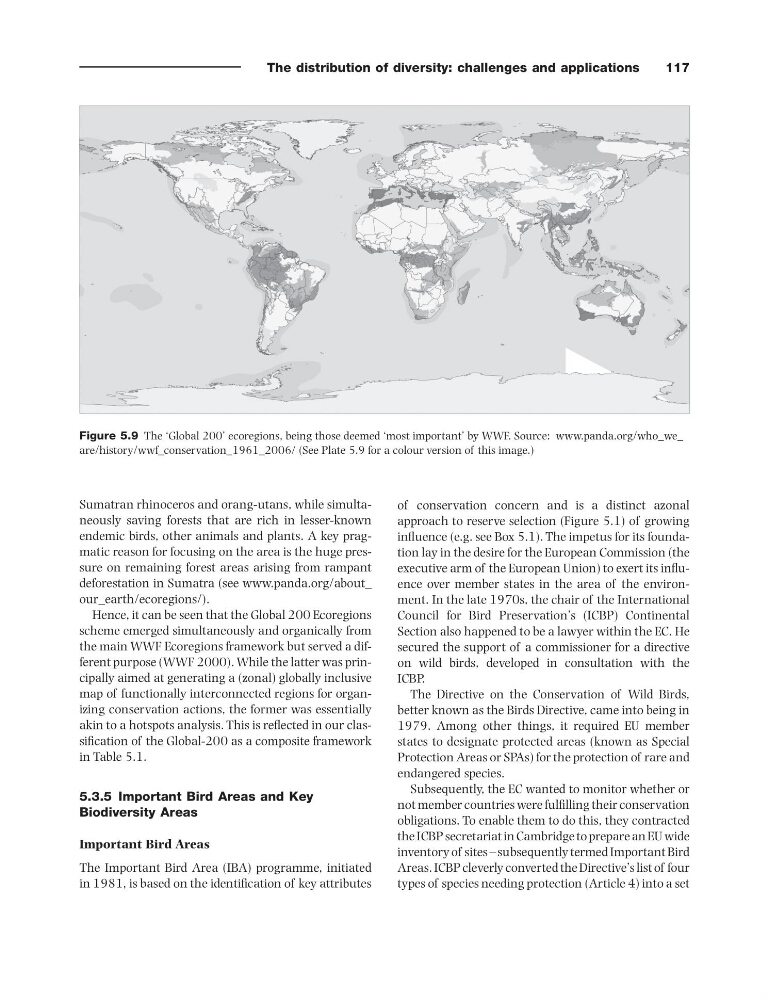
Hence, it can be seen that the Global 200 Ecoregions
scheme emerged simultaneously and organically from
the main WWF Ecoregions framework but served a different purpose (WWF 2000 ). While the latter was principally aimed at generating a (zonal) globally inclusive
map of functionally interconnected regions for organizing conservation actions, the former was essentially
akin to a hotspots analysis. This is refl ected in our classifi cation of the Global - 200 as a composite framework
in Table 5.1 .
5.3.5 Important Bird Areas and Key
Biodiversity Areas
Important Bird Areas
The Important Bird Area (IBA) programme, initiated
in 1981, is based on the identifi cation of key attributes
Figure 5.9 The ‘ Global 200 ’ ecoregions, being those deemed ‘ most important ’ by WWF. Source: www.panda.org/who_we_
are/history/wwf_conservation_1961_2006/ (See Plate 5.9 for a colour version of this image.)
117
of conservation concern and is a distinct azonal
approach to reserve selection (Figure 5.1 ) of growing
infl uence (e.g. see Box 5.1 ). The impetus for its foundation lay in the desire for the European Commission (the
executive arm of the European Union) to exert its infl uence over member states in the area of the environment. In the late 1970s, the chair of the International
Council for Bird Preservation ’ s (ICBP) Continental
Section also happened to be a lawyer within the EC. He
secured the support of a commissioner for a directive
on wild birds, developed in consultation with the
ICBP.
The Directive on the Conservation of Wild Birds,
better known as the Birds Directive, came into being in
1979. Among other things, it required EU member
states to designate protected areas (known as Special
Protection Areas or SPAs) for the protection of rare and
endangered species.
Subsequently, the EC wanted to monitor whether or
not member countries were fulfi lling their conservation
obligations. To enable them to do this, they contracted
the ICBP secretariat in Cambridge to prepare an EU wide
inventory of sites – subsequently termed Important Bird
Areas. ICBP cleverly converted the Directive ’ s list of four
types of species needing protection (Article 4) into a set
Sumatran rhinoceros and orang - utans, while simultaneously saving forests that are rich in lesser - known
endemic birds, other animals and plants. A key pragmatic reason for focusing on the area is the huge pressure on remaining forest areas arising from rampant
deforestation in Sumatra (see www.panda.org/about_
our_earth/ecoregions/ ).
Hence, it can be seen that the Global 200 Ecoregions
scheme emerged simultaneously and organically from
the main WWF Ecoregions framework but served a different purpose (WWF 2000 ). While the latter was principally aimed at generating a (zonal) globally inclusive
map of functionally interconnected regions for organizing conservation actions, the former was essentially
akin to a hotspots analysis. This is refl ected in our classifi cation of the Global - 200 as a composite framework
in Table 5.1 .
5.3.5 Important Bird Areas and Key
Biodiversity Areas
Important Bird Areas
The Important Bird Area (IBA) programme, initiated
in 1981, is based on the identifi cation of key attributes
Figure 5.9 The ‘ Global 200 ’ ecoregions, being those deemed ‘ most important ’ by WWF. Source: www.panda.org/who_we_
are/history/wwf_conservation_1961_2006/ (See Plate 5.9 for a colour version of this image.)