

The distribution of diversity: challenges and applications
105
The fi rst implementation of the Dasmann – Udvardy
scheme on a national scale was in Indonesia, in conjunction with FAO and WWF projects and the drafting
of a National Conservation Plan (NCP). In practice, the
biogeographical provinces were found to be too coarse
a scale to capture the biogeographical variation within
Indonesia, particularly in the transitional island region
of Wallacea (bridging the Oriental and Australasian
faunal realms). Therefore, MacKinnon and Wind
(1981) applied the Dasmann – Udvardy 65 per cent
similarity threshold once again, using data for birds,
but based on smaller geographical units, to distinguish
between provinces within the larger islands and island
groups. This created a third tier in the hierarchy, termed
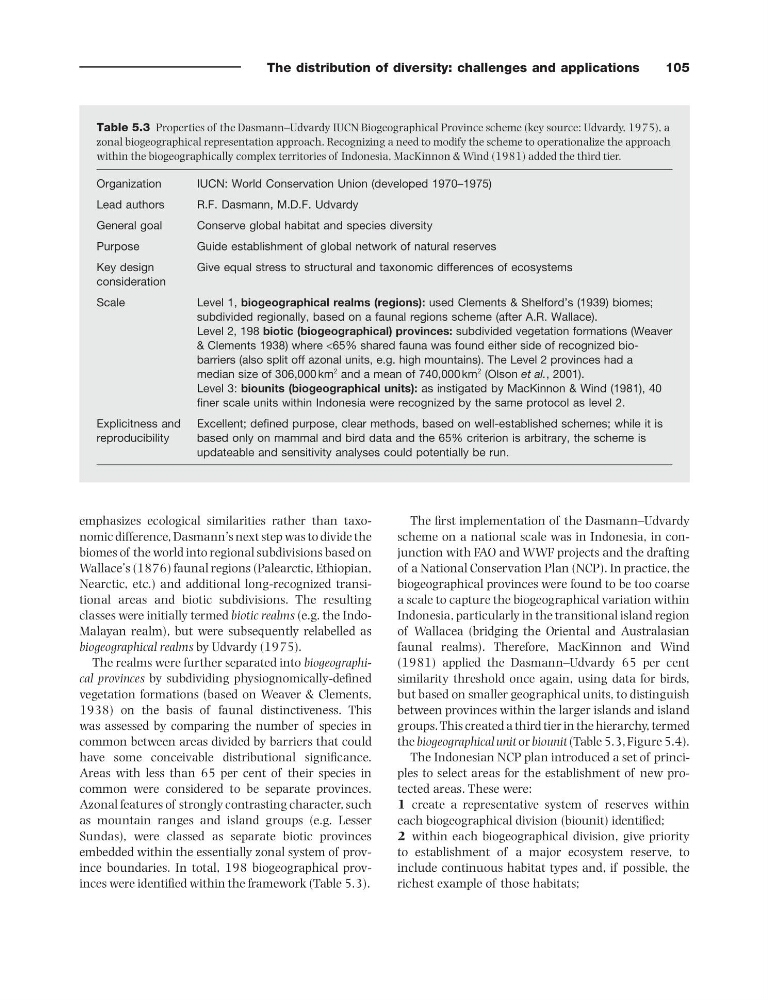
the biogeographical unit or biounit (Table 5.3 , Figure 5.4 ).
The Indonesian NCP plan introduced a set of principles to select areas for the establishment of new protected areas. These were:
1 create a representative system of reserves within
each biogeographical division (biounit) identifi ed;
2 within each biogeographical division, give priority
to establishment of a major ecosystem reserve, to
include continuous habitat types and, if possible, the
richest example of those habitats;
emphasizes ecological similarities rather than taxonomic difference, Dasmann ’ s next step was to divide the
biomes of the world into regional subdivisions based on
Wallace ’ s (1876) faunal regions (Palearctic, Ethiopian,
Nearctic, etc.) and additional long - recognized transitional areas and biotic subdivisions. The resulting
classes were initially termed biotic realms (e.g. the Indo -
Malayan realm), but were subsequently relabelled as
biogeographical realms by Udvardy (1975) .
The realms were further separated into biogeographical provinces by subdividing physiognomically - defi ned
vegetation formations (based on Weaver & Clements,
1938 ) on the basis of faunal distinctiveness. This
was assessed by comparing the number of species in
common between areas divided by barriers that could
have some conceivable distributional signifi cance.
Areas with less than 65 per cent of their species in
common were considered to be separate provinces.
Azonal features of strongly contrasting character, such
as mountain ranges and island groups (e.g. Lesser
Sundas), were classed as separate biotic provinces
embedded within the essentially zonal system of province boundaries. In total, 198 biogeographical provinces were identifi ed within the framework (Table 5.3 ).
Table 5.3 Properties of the Dasmann – Udvardy IUCN Biogeographical Province scheme (key source: Udvardy, 1975 ) , a
zonal biogeographical representation approach. Recognizing a need to modify the scheme to operationalize the approach
within the biogeographically complex territories of Indonesia, MacKinnon & Wind (1981) added the third tier.
Organization
IUCN: World Conservation Union (developed 1970 – 1975)
Lead authors
R.F. Dasmann, M.D.F. Udvardy
General goal
Conserve global habitat and species diversity
Purpose
Guide establishment of global network of natural reserves
Key design
consideration
Give equal stress to structural and taxonomic differences of ecosystems
Scale
Level 1, biogeographical realms (regions): used Clements & Shelford ’ s (1939) biomes;
subdivided regionally, based on a faunal regions scheme (after A.R. Wallace).
Level 2, 198 biotic (biogeographical) provinces: subdivided vegetation formations (Weaver
& Clements 1938 ) where < 65% shared fauna was found either side of recognized bio -
barriers (also split off azonal units, e.g. high mountains). The Level 2 provinces had a
median size of 306,000 km
2 and a mean of 740,000 km
2 (Olson et al. , 2001 ).
Level 3: biounits (biogeographical units): as instigated by MacKinnon & Wind (1981) , 40
fi ner scale units within Indonesia were recognized by the same protocol as level 2.
Explicitness and
reproducibility
Excellent; defi ned purpose, clear methods, based on well - established schemes; while it is
based only on mammal and bird data and the 65% criterion is arbitrary, the scheme is
updateable and sensitivity analyses could potentially be run.
105
The fi rst implementation of the Dasmann – Udvardy
scheme on a national scale was in Indonesia, in conjunction with FAO and WWF projects and the drafting
of a National Conservation Plan (NCP). In practice, the
biogeographical provinces were found to be too coarse
a scale to capture the biogeographical variation within
Indonesia, particularly in the transitional island region
of Wallacea (bridging the Oriental and Australasian
faunal realms). Therefore, MacKinnon and Wind
(1981) applied the Dasmann – Udvardy 65 per cent
similarity threshold once again, using data for birds,
but based on smaller geographical units, to distinguish
between provinces within the larger islands and island
groups. This created a third tier in the hierarchy, termed
the biogeographical unit or biounit (Table 5.3 , Figure 5.4 ).
The Indonesian NCP plan introduced a set of principles to select areas for the establishment of new protected areas. These were:
1 create a representative system of reserves within
each biogeographical division (biounit) identifi ed;
2 within each biogeographical division, give priority
to establishment of a major ecosystem reserve, to
include continuous habitat types and, if possible, the
richest example of those habitats;
emphasizes ecological similarities rather than taxonomic difference, Dasmann ’ s next step was to divide the
biomes of the world into regional subdivisions based on
Wallace ’ s (1876) faunal regions (Palearctic, Ethiopian,
Nearctic, etc.) and additional long - recognized transitional areas and biotic subdivisions. The resulting
classes were initially termed biotic realms (e.g. the Indo -
Malayan realm), but were subsequently relabelled as
biogeographical realms by Udvardy (1975) .
The realms were further separated into biogeographical provinces by subdividing physiognomically - defi ned
vegetation formations (based on Weaver & Clements,
1938 ) on the basis of faunal distinctiveness. This
was assessed by comparing the number of species in
common between areas divided by barriers that could
have some conceivable distributional signifi cance.
Areas with less than 65 per cent of their species in
common were considered to be separate provinces.
Azonal features of strongly contrasting character, such
as mountain ranges and island groups (e.g. Lesser
Sundas), were classed as separate biotic provinces
embedded within the essentially zonal system of province boundaries. In total, 198 biogeographical provinces were identifi ed within the framework (Table 5.3 ).
Table 5.3 Properties of the Dasmann – Udvardy IUCN Biogeographical Province scheme (key source: Udvardy, 1975 ) , a
zonal biogeographical representation approach. Recognizing a need to modify the scheme to operationalize the approach
within the biogeographically complex territories of Indonesia, MacKinnon & Wind (1981) added the third tier.
Organization
IUCN: World Conservation Union (developed 1970 – 1975)
Lead authors
R.F. Dasmann, M.D.F. Udvardy
General goal
Conserve global habitat and species diversity
Purpose
Guide establishment of global network of natural reserves
Key design
consideration
Give equal stress to structural and taxonomic differences of ecosystems
Scale
Level 1, biogeographical realms (regions): used Clements & Shelford ’ s (1939) biomes;
subdivided regionally, based on a faunal regions scheme (after A.R. Wallace).
Level 2, 198 biotic (biogeographical) provinces: subdivided vegetation formations (Weaver
& Clements 1938 ) where < 65% shared fauna was found either side of recognized bio -
barriers (also split off azonal units, e.g. high mountains). The Level 2 provinces had a
median size of 306,000 km
2 and a mean of 740,000 km
2 (Olson et al. , 2001 ).
Level 3: biounits (biogeographical units): as instigated by MacKinnon & Wind (1981) , 40
fi ner scale units within Indonesia were recognized by the same protocol as level 2.
Explicitness and
reproducibility
Excellent; defi ned purpose, clear methods, based on well - established schemes; while it is
based only on mammal and bird data and the 65% criterion is arbitrary, the scheme is
updateable and sensitivity analyses could potentially be run.