

102
The shaping of the global protected area estate
5.2.3 Strategic g oals – c omposition,
f unction, n umbers and a ttributes
A third way of looking at protected area schemes is in
terms of their strategic goals and the practices of
putting these into operation. In Figure 5.1 and Table
5.1 , we identify four broad key strategic goals which
align with the zonal/azonal and composition/function
distinctions above.
The fi rst strategic goal, of representation (to protect
an example of each), requires compositional classes to
be determined (Chapter 4 ). Having done so, the means
to determine how to locate protected areas within each
class differs. For instance, some schemes focus on
conservation planning is the WWF Ecoregions scheme,
which aims to identify ecological areas that function
together effectively as a biological unit at a global or
regional scale.
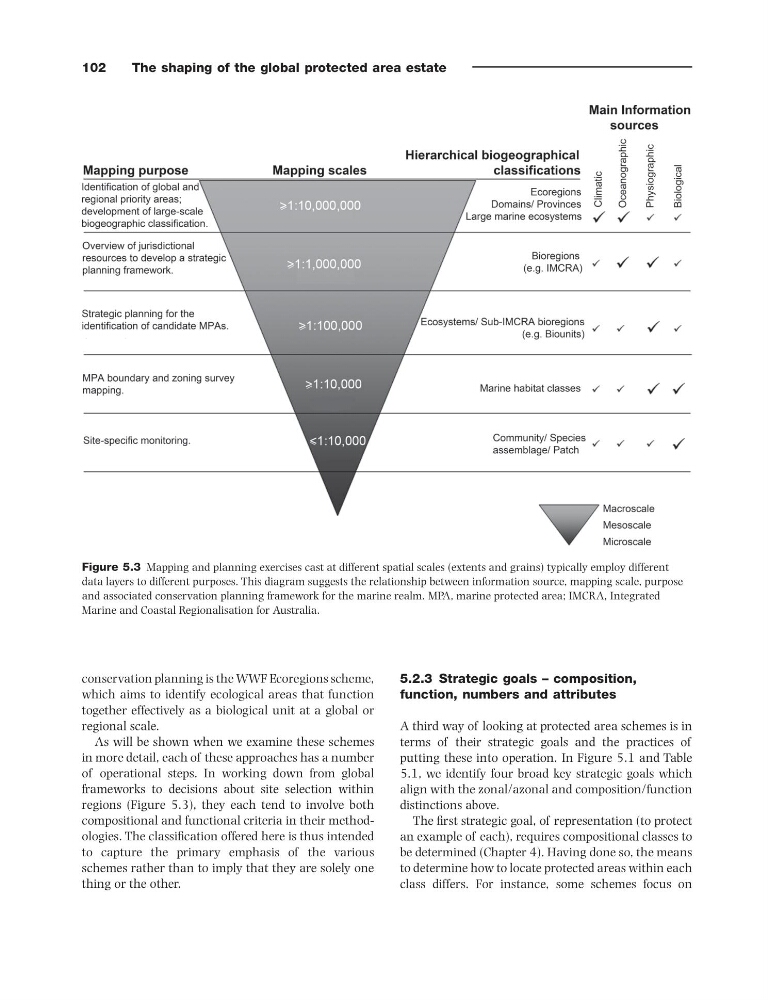
As will be shown when we examine these schemes
in more detail, each of these approaches has a number
of operational steps. In working down from global
frameworks to decisions about site selection within
regions (Figure 5.3 ), they each tend to involve both
compositional and functional criteria in their methodologies. The classifi cation offered here is thus intended
to capture the primary emphasis of the various
schemes rather than to imply that they are solely one
thing or the other.
Figure 5.3 Mapping and planning exercises cast at different spatial scales (extents and grains) typically employ different
data layers to different purposes. This diagram suggests the relationship between information source, mapping scale, purpose
and associated conservation planning framework for the marine realm. MPA, marine protected area; IMCRA, Integrated
Marine and Coastal Regionalisation for Australia.
The shaping of the global protected area estate
5.2.3 Strategic g oals – c omposition,
f unction, n umbers and a ttributes
A third way of looking at protected area schemes is in
terms of their strategic goals and the practices of
putting these into operation. In Figure 5.1 and Table
5.1 , we identify four broad key strategic goals which
align with the zonal/azonal and composition/function
distinctions above.
The fi rst strategic goal, of representation (to protect
an example of each), requires compositional classes to
be determined (Chapter 4 ). Having done so, the means
to determine how to locate protected areas within each
class differs. For instance, some schemes focus on
conservation planning is the WWF Ecoregions scheme,
which aims to identify ecological areas that function
together effectively as a biological unit at a global or
regional scale.
As will be shown when we examine these schemes
in more detail, each of these approaches has a number
of operational steps. In working down from global
frameworks to decisions about site selection within
regions (Figure 5.3 ), they each tend to involve both
compositional and functional criteria in their methodologies. The classifi cation offered here is thus intended
to capture the primary emphasis of the various
schemes rather than to imply that they are solely one
thing or the other.
Figure 5.3 Mapping and planning exercises cast at different spatial scales (extents and grains) typically employ different
data layers to different purposes. This diagram suggests the relationship between information source, mapping scale, purpose
and associated conservation planning framework for the marine realm. MPA, marine protected area; IMCRA, Integrated
Marine and Coastal Regionalisation for Australia.