

The distribution of diversity: challenges and applications
101
Hence, the argument goes, a focus solely on compositional patterns may result in the selection of sites for
conservation that are incapable of standing alone as
secure places for the long - term persistence of the biodiversity for which they may initially have been targeted (cf. Orians, 1993 ).
At fi ne scales of analysis, such fl ows and linkages
may be infl uenced by habitat connectivity via corridors
(see Chapter 8 ) or by the separation of otherwise
favourable sites by hostile agricultural practices or
urban and industrial areas. Beginning from a much
coarser resolution, the American forester R.G. Bailey
developed the ecoregional approach, intended as a tool
for land managers concerned with the optimal management of resources (Bailey, 1983 ). The approach
recognizes the importance of how different ecosystems
connect with and exchange information with adjacent
ecosystems. It focuses on ecosystem structure, using
controlling factors rather than biotic composition as
the means of identifying the units. At its coarsest it is
a climatic classifi cation, but it increasingly employs
other data layers at fi ner levels of resolution. The
most prominent application of this approach in
European - scale conservation schemes (e.g. Special
Areas of Conservation – see www.jncc.gov.uk/page -
23 ), the scale of analysis is the local vegetation
community or assemblage. By contrast, for the IUCN
Dasmann – Udvardy scheme of the 1970s (see below),
the units were coarse - scale biogeographical regions of
roughly 10
4
– 10
8 km
2
. The biogeographical approach
to mapping out units is generally a step in developing
zonal schemes emphasizing the representation
principle.
A widely promoted alternative to emphasizing
pattern as a basis for conservation prioritization is to
focus on function. This is because ecological systems
are dynamic, and interconnected, so that, for example:
1 animals migrate between different habitats, ecosystems and biogeographical regions on an annual
basis;
2 animals move between different types of habitat on
a daily basis, feeding in one habitat and returning to
another to rest or care for young;
3 ecosystems in different parts of landscapes are connected not only biotically but also through abiotic
fl ows (e.g. of water, nutrients).
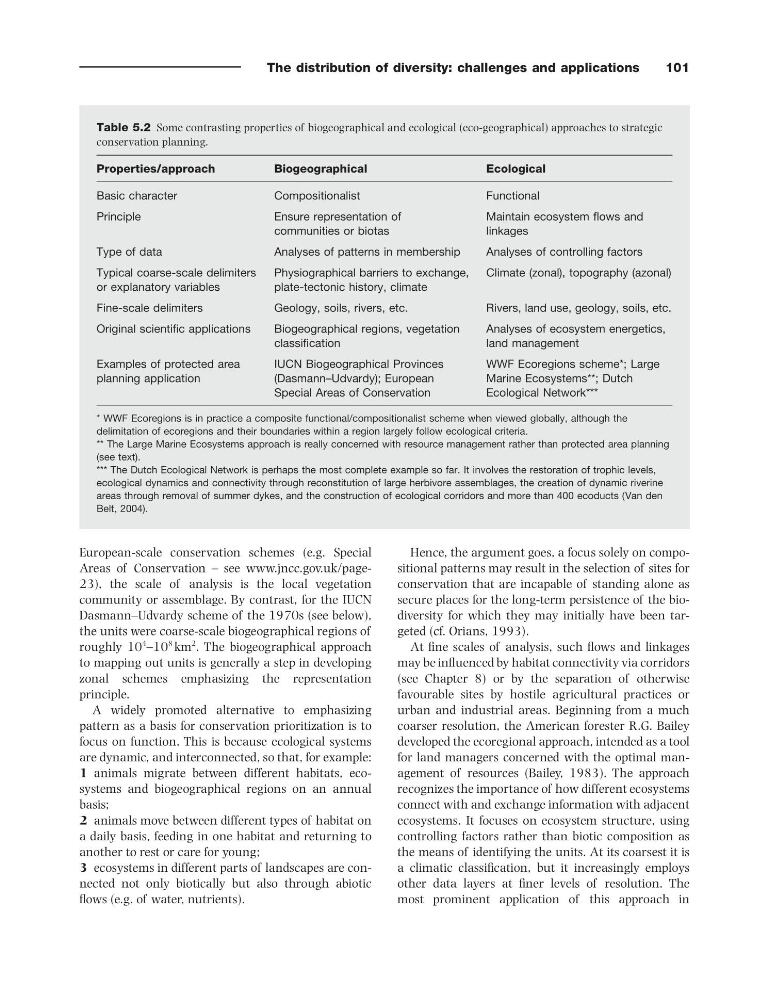
Table 5.2 Some contrasting properties of biogeographical and ecological (eco - geographical) approaches to strategic
conservation planning.
Properties/approach
Biogeographical
Ecological
Basic character
Compositionalist
Functional
Principle
Ensure representation of
communities or biotas
Maintain ecosystem fl ows and
linkages
Type of data
Analyses of patterns in membership
Analyses of controlling factors
Typical coarse - scale delimiters
or explanatory variables
Physiographical barriers to exchange,
plate - tectonic history, climate
Climate (zonal), topography (azonal)
Fine - scale delimiters
Geology, soils, rivers, etc.
Rivers, land use, geology, soils, etc.
Original scientifi c applications
Biogeographical regions, vegetation
classifi cation
Analyses of ecosystem energetics,
land management
Examples of protected area
planning application
IUCN Biogeographical Provinces
(Dasmann – Udvardy); European
Special Areas of Conservation
WWF Ecoregions scheme * ; Large
Marine Ecosystems * * ; Dutch
Ecological Network * * *
* WWF Ecoregions is in practice a composite functional/compositionalist scheme when viewed globally, although the
delimitation of ecoregions and their boundaries within a region largely follow ecological criteria.
* * The Large Marine Ecosystems approach is really concerned with resource management rather than protected area planning
(see text).
* * * The Dutch Ecological Network is perhaps the most complete example so far. It involves the restoration of trophic levels,
ecological dynamics and connectivity through reconstitution of large herbivore assemblages, the creation of dynamic riverine
areas through removal of summer dykes, and the construction of ecological corridors and more than 400 ecoducts (Van den
Belt, 2004 ).
101
Hence, the argument goes, a focus solely on compositional patterns may result in the selection of sites for
conservation that are incapable of standing alone as
secure places for the long - term persistence of the biodiversity for which they may initially have been targeted (cf. Orians, 1993 ).
At fi ne scales of analysis, such fl ows and linkages
may be infl uenced by habitat connectivity via corridors
(see Chapter 8 ) or by the separation of otherwise
favourable sites by hostile agricultural practices or
urban and industrial areas. Beginning from a much
coarser resolution, the American forester R.G. Bailey
developed the ecoregional approach, intended as a tool
for land managers concerned with the optimal management of resources (Bailey, 1983 ). The approach
recognizes the importance of how different ecosystems
connect with and exchange information with adjacent
ecosystems. It focuses on ecosystem structure, using
controlling factors rather than biotic composition as
the means of identifying the units. At its coarsest it is
a climatic classifi cation, but it increasingly employs
other data layers at fi ner levels of resolution. The
most prominent application of this approach in
European - scale conservation schemes (e.g. Special
Areas of Conservation – see www.jncc.gov.uk/page -
23 ), the scale of analysis is the local vegetation
community or assemblage. By contrast, for the IUCN
Dasmann – Udvardy scheme of the 1970s (see below),
the units were coarse - scale biogeographical regions of
roughly 10
4
– 10
8 km
2
. The biogeographical approach
to mapping out units is generally a step in developing
zonal schemes emphasizing the representation
principle.
A widely promoted alternative to emphasizing
pattern as a basis for conservation prioritization is to
focus on function. This is because ecological systems
are dynamic, and interconnected, so that, for example:
1 animals migrate between different habitats, ecosystems and biogeographical regions on an annual
basis;
2 animals move between different types of habitat on
a daily basis, feeding in one habitat and returning to
another to rest or care for young;
3 ecosystems in different parts of landscapes are connected not only biotically but also through abiotic
fl ows (e.g. of water, nutrients).
Table 5.2 Some contrasting properties of biogeographical and ecological (eco - geographical) approaches to strategic
conservation planning.
Properties/approach
Biogeographical
Ecological
Basic character
Compositionalist
Functional
Principle
Ensure representation of
communities or biotas
Maintain ecosystem fl ows and
linkages
Type of data
Analyses of patterns in membership
Analyses of controlling factors
Typical coarse - scale delimiters
or explanatory variables
Physiographical barriers to exchange,
plate - tectonic history, climate
Climate (zonal), topography (azonal)
Fine - scale delimiters
Geology, soils, rivers, etc.
Rivers, land use, geology, soils, etc.
Original scientifi c applications
Biogeographical regions, vegetation
classifi cation
Analyses of ecosystem energetics,
land management
Examples of protected area
planning application
IUCN Biogeographical Provinces
(Dasmann – Udvardy); European
Special Areas of Conservation
WWF Ecoregions scheme * ; Large
Marine Ecosystems * * ; Dutch
Ecological Network * * *
* WWF Ecoregions is in practice a composite functional/compositionalist scheme when viewed globally, although the
delimitation of ecoregions and their boundaries within a region largely follow ecological criteria.
* * The Large Marine Ecosystems approach is really concerned with resource management rather than protected area planning
(see text).
* * * The Dutch Ecological Network is perhaps the most complete example so far. It involves the restoration of trophic levels,
ecological dynamics and connectivity through reconstitution of large herbivore assemblages, the creation of dynamic riverine
areas through removal of summer dykes, and the construction of ecological corridors and more than 400 ecoducts (Van den
Belt, 2004 ).