

REDUCING ENVIRONMENTS OF THE DEEP-SEA FLOOR
85
Table 4.1
An illustrative sampling of better-known cold seeps
Site 1
Depth (m)
Setting
Seepage
Major biota
Gulf of Mexico
400–2200
Faulted slope; salt diapirs
[intrusive structures]
CH 4 , other hydrocarbons,
natural gas, H 2 S
Tube worms, clams,
mussels, grazers
Florida Escarpment
3270
Faulted carbonate platform
CH 4 , NH 4 in brines
Mussels, tube worms
Barbados Prism
1000–5000
Mud volcanoes, faults, ridges on
subduction zone
CH 4 , H 2 S in porewater
Clams, mussels
Laurentian Fan
3800
Seismic disrupted turbidite on
passive margin
?H 2 S, CH 4 in porewater
Clams
Japan Trench
3800–6000
Eroding prism on subduction
margin
CH 4 , ?H 2 S in porewater
Clams
Oregon Margin
600–2000
Carbonates in accretionary prism
on subduction zone
CH 4 , H 2 S in gas hydrates Clams, tube worms,
grazers
Peruvian Margin
2600–5600
Accreting prism on subduction
margin
Reduced fluids –
continental origin
Clams
1 Sites are indicated in Fig. 4.1.
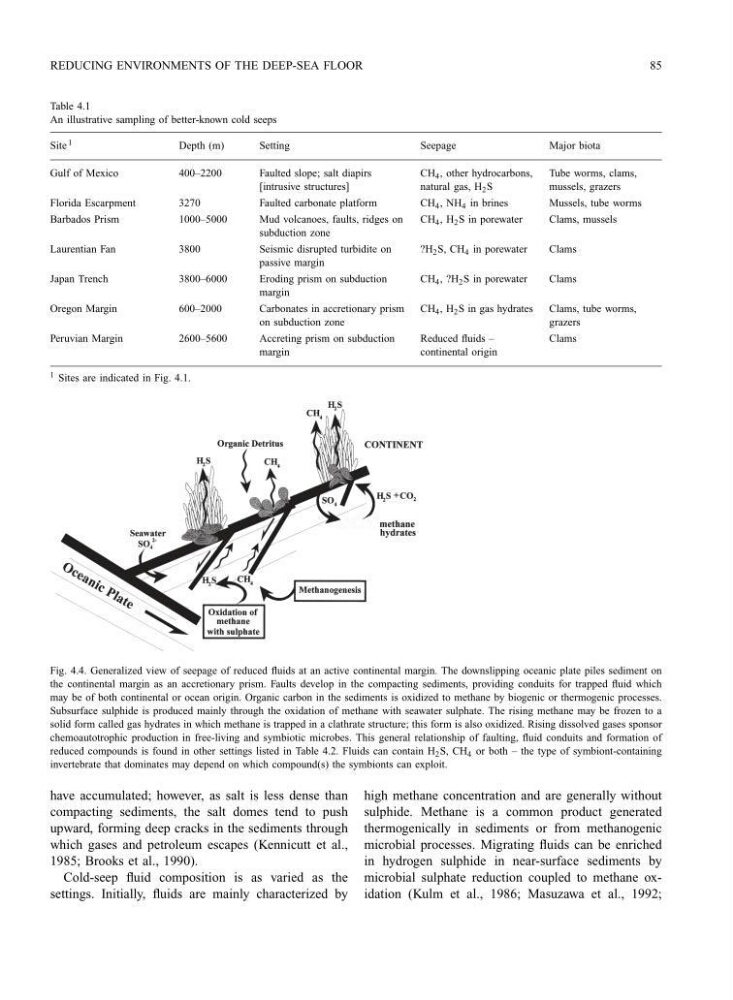
Fig. 4.4. Generalized view of seepage of reduced fluids at an active continental margin. The downslipping oceanic plate piles sediment on
the continental margin as an accretionary prism. Faults develop in the compacting sediments, providing conduits for trapped fluid which
may be of both continental or ocean origin. Organic carbon in the sediments is oxidized to methane by biogenic or thermogenic processes.
Subsurface sulphide is produced mainly through the oxidation of methane with seawater sulphate. The rising methane may be frozen to a
solid form called gas hydrates in which methane is trapped in a clathrate structure; this form is also oxidized. Rising dissolved gases sponsor
chemoautotrophic production in free-living and symbiotic microbes. This general relationship of faulting, fluid conduits and formation of
reduced compounds is found in other settings listed in Table 4.2. Fluids can contain H 2 S, CH 4 or both – the type of symbiont-containing
invertebrate that dominates may depend on which compound(s) the symbionts can exploit.
have accumulated; however, as salt is less dense than
compacting sediments, the salt domes tend to push
upward, forming deep cracks in the sediments through
which gases and petroleum escapes (Kennicutt et al.,
1985; Brooks et al., 1990).
Cold-seep fluid composition is as varied as the
settings. Initially, fluids are mainly characterized by
high methane concentration and are generally without
sulphide. Methane is a common product generated
thermogenically in sediments or from methanogenic
microbial processes. Migrating fluids can be enriched
in hydrogen sulphide in near-surface sediments by
microbial sulphate reduction coupled to methane oxidation (Kulm et al., 1986; Masuzawa et al., 1992;
85
Table 4.1
An illustrative sampling of better-known cold seeps
Site 1
Depth (m)
Setting
Seepage
Major biota
Gulf of Mexico
400–2200
Faulted slope; salt diapirs
[intrusive structures]
CH 4 , other hydrocarbons,
natural gas, H 2 S
Tube worms, clams,
mussels, grazers
Florida Escarpment
3270
Faulted carbonate platform
CH 4 , NH 4 in brines
Mussels, tube worms
Barbados Prism
1000–5000
Mud volcanoes, faults, ridges on
subduction zone
CH 4 , H 2 S in porewater
Clams, mussels
Laurentian Fan
3800
Seismic disrupted turbidite on
passive margin
?H 2 S, CH 4 in porewater
Clams
Japan Trench
3800–6000
Eroding prism on subduction
margin
CH 4 , ?H 2 S in porewater
Clams
Oregon Margin
600–2000
Carbonates in accretionary prism
on subduction zone
CH 4 , H 2 S in gas hydrates Clams, tube worms,
grazers
Peruvian Margin
2600–5600
Accreting prism on subduction
margin
Reduced fluids –
continental origin
Clams
1 Sites are indicated in Fig. 4.1.
Fig. 4.4. Generalized view of seepage of reduced fluids at an active continental margin. The downslipping oceanic plate piles sediment on
the continental margin as an accretionary prism. Faults develop in the compacting sediments, providing conduits for trapped fluid which
may be of both continental or ocean origin. Organic carbon in the sediments is oxidized to methane by biogenic or thermogenic processes.
Subsurface sulphide is produced mainly through the oxidation of methane with seawater sulphate. The rising methane may be frozen to a
solid form called gas hydrates in which methane is trapped in a clathrate structure; this form is also oxidized. Rising dissolved gases sponsor
chemoautotrophic production in free-living and symbiotic microbes. This general relationship of faulting, fluid conduits and formation of
reduced compounds is found in other settings listed in Table 4.2. Fluids can contain H 2 S, CH 4 or both – the type of symbiont-containing
invertebrate that dominates may depend on which compound(s) the symbionts can exploit.
have accumulated; however, as salt is less dense than
compacting sediments, the salt domes tend to push
upward, forming deep cracks in the sediments through
which gases and petroleum escapes (Kennicutt et al.,
1985; Brooks et al., 1990).
Cold-seep fluid composition is as varied as the
settings. Initially, fluids are mainly characterized by
high methane concentration and are generally without
sulphide. Methane is a common product generated
thermogenically in sediments or from methanogenic
microbial processes. Migrating fluids can be enriched
in hydrogen sulphide in near-surface sediments by
microbial sulphate reduction coupled to methane oxidation (Kulm et al., 1986; Masuzawa et al., 1992;