

84
Verena TUNNICLIFFE et al.
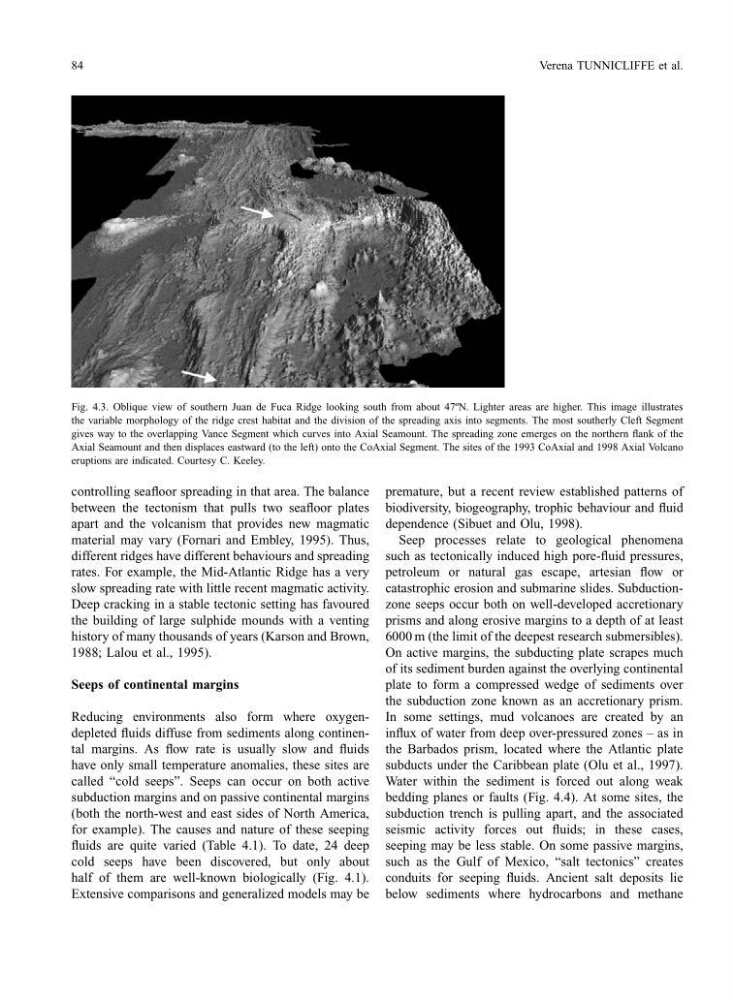
Fig. 4.3. Oblique view of southern Juan de Fuca Ridge looking south from about 47ºN. Lighter areas are higher. This image illustrates
the variable morphology of the ridge crest habitat and the division of the spreading axis into segments. The most southerly Cleft Segment
gives way to the overlapping Vance Segment which curves into Axial Seamount. The spreading zone emerges on the northern flank of the
Axial Seamount and then displaces eastward (to the left) onto the CoAxial Segment. The sites of the 1993 CoAxial and 1998 Axial Volcano
eruptions are indicated. Courtesy C. Keeley.
controlling seafloor spreading in that area. The balance
between the tectonism that pulls two seafloor plates
apart and the volcanism that provides new magmatic
material may vary (Fornari and Embley, 1995). Thus,
different ridges have different behaviours and spreading
rates. For example, the Mid-Atlantic Ridge has a very
slow spreading rate with little recent magmatic activity.
Deep cracking in a stable tectonic setting has favoured
the building of large sulphide mounds with a venting
history of many thousands of years (Karson and Brown,
1988; Lalou et al., 1995).
Seeps of continental margins
Reducing environments also form where oxygendepleted fluids diffuse from sediments along continental margins. As flow rate is usually slow and fluids
have only small temperature anomalies, these sites are
called “cold seeps”. Seeps can occur on both active
subduction margins and on passive continental margins
(both the north-west and east sides of North America,
for example). The causes and nature of these seeping
fluids are quite varied (Table 4.1). To date, 24 deep
cold seeps have been discovered, but only about
half of them are well-known biologically (Fig. 4.1).
Extensive comparisons and generalized models may be
premature, but a recent review established patterns of
biodiversity, biogeography, trophic behaviour and fluid
dependence (Sibuet and Olu, 1998).
Seep processes relate to geological phenomena
such as tectonically induced high pore-fluid pressures,
petroleum or natural gas escape, artesian flow or
catastrophic erosion and submarine slides. Subductionzone seeps occur both on well-developed accretionary
prisms and along erosive margins to a depth of at least
6000 m (the limit of the deepest research submersibles).
On active margins, the subducting plate scrapes much
of its sediment burden against the overlying continental
plate to form a compressed wedge of sediments over
the subduction zone known as an accretionary prism.
In some settings, mud volcanoes are created by an
influx of water from deep over-pressured zones – as in
the Barbados prism, located where the Atlantic plate
subducts under the Caribbean plate (Olu et al., 1997).
Water within the sediment is forced out along weak
bedding planes or faults (Fig. 4.4). At some sites, the
subduction trench is pulling apart, and the associated
seismic activity forces out fluids; in these cases,
seeping may be less stable. On some passive margins,
such as the Gulf of Mexico, “salt tectonics” creates
conduits for seeping fluids. Ancient salt deposits lie
below sediments where hydrocarbons and methane
Verena TUNNICLIFFE et al.
Fig. 4.3. Oblique view of southern Juan de Fuca Ridge looking south from about 47ºN. Lighter areas are higher. This image illustrates
the variable morphology of the ridge crest habitat and the division of the spreading axis into segments. The most southerly Cleft Segment
gives way to the overlapping Vance Segment which curves into Axial Seamount. The spreading zone emerges on the northern flank of the
Axial Seamount and then displaces eastward (to the left) onto the CoAxial Segment. The sites of the 1993 CoAxial and 1998 Axial Volcano
eruptions are indicated. Courtesy C. Keeley.
controlling seafloor spreading in that area. The balance
between the tectonism that pulls two seafloor plates
apart and the volcanism that provides new magmatic
material may vary (Fornari and Embley, 1995). Thus,
different ridges have different behaviours and spreading
rates. For example, the Mid-Atlantic Ridge has a very
slow spreading rate with little recent magmatic activity.
Deep cracking in a stable tectonic setting has favoured
the building of large sulphide mounds with a venting
history of many thousands of years (Karson and Brown,
1988; Lalou et al., 1995).
Seeps of continental margins
Reducing environments also form where oxygendepleted fluids diffuse from sediments along continental margins. As flow rate is usually slow and fluids
have only small temperature anomalies, these sites are
called “cold seeps”. Seeps can occur on both active
subduction margins and on passive continental margins
(both the north-west and east sides of North America,
for example). The causes and nature of these seeping
fluids are quite varied (Table 4.1). To date, 24 deep
cold seeps have been discovered, but only about
half of them are well-known biologically (Fig. 4.1).
Extensive comparisons and generalized models may be
premature, but a recent review established patterns of
biodiversity, biogeography, trophic behaviour and fluid
dependence (Sibuet and Olu, 1998).
Seep processes relate to geological phenomena
such as tectonically induced high pore-fluid pressures,
petroleum or natural gas escape, artesian flow or
catastrophic erosion and submarine slides. Subductionzone seeps occur both on well-developed accretionary
prisms and along erosive margins to a depth of at least
6000 m (the limit of the deepest research submersibles).
On active margins, the subducting plate scrapes much
of its sediment burden against the overlying continental
plate to form a compressed wedge of sediments over
the subduction zone known as an accretionary prism.
In some settings, mud volcanoes are created by an
influx of water from deep over-pressured zones – as in
the Barbados prism, located where the Atlantic plate
subducts under the Caribbean plate (Olu et al., 1997).
Water within the sediment is forced out along weak
bedding planes or faults (Fig. 4.4). At some sites, the
subduction trench is pulling apart, and the associated
seismic activity forces out fluids; in these cases,
seeping may be less stable. On some passive margins,
such as the Gulf of Mexico, “salt tectonics” creates
conduits for seeping fluids. Ancient salt deposits lie
below sediments where hydrocarbons and methane