

74
Martin V. ANGEL
a rapid escape capability. Hence the high energetic
costs of having and maintaining heavy muscles and
their associated skeletal support no longer have to be
met. Thus many of the elaborately developed sensory
systems supported by large brains and a well developed
central nervous system, typical of many species in
the upper mesopelagic and epipelagic zones, become
a liability rather than an asset (Marshall, 1971). As
a result many bathypelagic species are physiologically
more akin to jellyfish than they are to their evolutionary
closest relatives (Childress and Thuesen, 1992). In
the many bathypelagic fishes that have larval stages
that live and feed near the surface, as the maturing
larvae migrate down into deep water many of their
sensory systems such as eyes regress. There are also
reductions in those parts of the central nervous system
which become redundant as the sensory systems they
previously supported become non-functional. Visual
receptors are often replaced by elaborations of the
lateral-line mechano-receptors and olfactory organs.
Thus, physiological demands on animals living deeper
within the water column are reduced as a result of this
relaxation of predation and competitive pressures, and
this enables the organisms to cope with the smaller and
possibly less predictable food supply.
Physiological adaptations
Oxygen consumption rates can be used as an indicator
of general activity levels. The rates of consumption of
oxygen by pelagic animals decrease rapidly over the
first kilometre of the water column (Childress, 1975;
Torres et al., 1979; Cowles et al., 1991; Thuesen and
Childress, 1993a,b). Initially it was assumed that this
decline was a result of the lower temperatures in deep
water and changes in chemical composition. However,
careful observational and experimental studies have
shown that these factors play a relatively small role in
the decline in metabolic rates (Childress and Thuesen,
1992). For example, in the Southern Ocean both pelagic
crustaceans (Ikeda, 1988) and midwater fishes (Torres
and Somero, 1988) show bathymetric declines in their
metabolic rates, although there is little difference in
temperatures between the near surface and the deep
waters.
Two hypotheses have been advanced to explain why
the basal metabolic rates of decapods and fish decline
with depth. The first is that the diminishing availability
of food favours the selection of lower metabolic rates
and so increases the efficiency with which the available
energy is utilized. The second is that, as the ambient
light levels decline, so the range over which organisms
can be detected visually increases. The resulting
reduction in the intensity of visual predator–prey
interactions with depth reduces the selection pressure
for strong swimming capabilities to avoid predators.
If the first hypothesis is valid, then species inhabiting
the low-productivity oligotrophic waters off Hawaii,
where food availability is very low, would be expected
to have lower metabolic rates than similar species
inhabiting the highly productive, food-rich waters of
the California Current. However, Cowles et al. (1991)
found that oxygen consumption rates are comparable
in the two contrasting regions. An important test of
the second hypothesis has been the examination of the
metabolic rates of species that do not orientate visually
such as chaetognaths and medusae. According to the
first hypothesis these taxa should show similar declines
in metabolic activity with depth as occur in decapods
and fish. The second hypothesis implies that their
metabolic rates will be independent of their bathymetric
distribution. Thuesen and Childress (1993a) found that
there are considerable variations in the metabolic rates
of different chaetognath species, but these variations
have proved to be independent of the depths at which
they occur and only partially related to body size, thus
vindicating the second hypothesis.
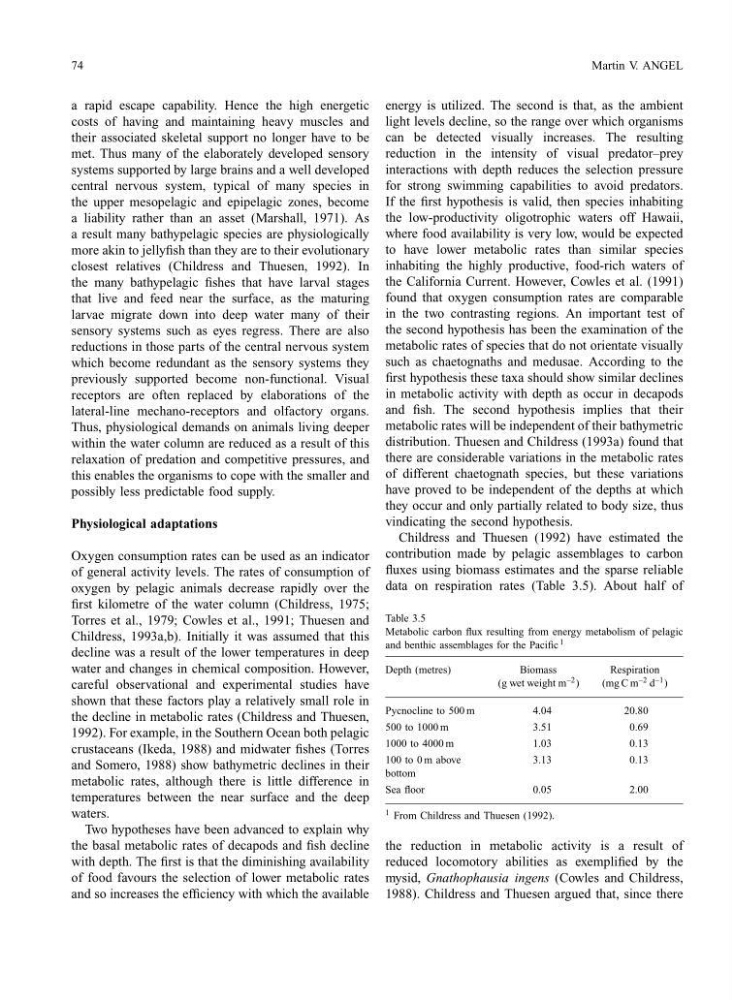
Childress and Thuesen (1992) have estimated the
contribution made by pelagic assemblages to carbon
fluxes using biomass estimates and the sparse reliable
data on respiration rates (Table 3.5). About half of
Table 3.5
Metabolic carbon flux resulting from energy metabolism of pelagic
and benthic assemblages for the Pacific 1
Depth (metres)
Biomass
(g wet weight m −2 )
Respiration
(mg C m −2 d −1 )
Pycnocline to 500 m
4.04
20.80
500 to 1000 m
3.51
0.69
1000 to 4000 m
1.03
0.13
100 to 0 m above
bottom
3.13
0.13
Sea floor
0.05
2.00
1 From Childress and Thuesen (1992).
the reduction in metabolic activity is a result of
reduced locomotory abilities as exemplified by the
mysid, Gnathophausia ingens (Cowles and Childress,
1988). Childress and Thuesen argued that, since there
Martin V. ANGEL
a rapid escape capability. Hence the high energetic
costs of having and maintaining heavy muscles and
their associated skeletal support no longer have to be
met. Thus many of the elaborately developed sensory
systems supported by large brains and a well developed
central nervous system, typical of many species in
the upper mesopelagic and epipelagic zones, become
a liability rather than an asset (Marshall, 1971). As
a result many bathypelagic species are physiologically
more akin to jellyfish than they are to their evolutionary
closest relatives (Childress and Thuesen, 1992). In
the many bathypelagic fishes that have larval stages
that live and feed near the surface, as the maturing
larvae migrate down into deep water many of their
sensory systems such as eyes regress. There are also
reductions in those parts of the central nervous system
which become redundant as the sensory systems they
previously supported become non-functional. Visual
receptors are often replaced by elaborations of the
lateral-line mechano-receptors and olfactory organs.
Thus, physiological demands on animals living deeper
within the water column are reduced as a result of this
relaxation of predation and competitive pressures, and
this enables the organisms to cope with the smaller and
possibly less predictable food supply.
Physiological adaptations
Oxygen consumption rates can be used as an indicator
of general activity levels. The rates of consumption of
oxygen by pelagic animals decrease rapidly over the
first kilometre of the water column (Childress, 1975;
Torres et al., 1979; Cowles et al., 1991; Thuesen and
Childress, 1993a,b). Initially it was assumed that this
decline was a result of the lower temperatures in deep
water and changes in chemical composition. However,
careful observational and experimental studies have
shown that these factors play a relatively small role in
the decline in metabolic rates (Childress and Thuesen,
1992). For example, in the Southern Ocean both pelagic
crustaceans (Ikeda, 1988) and midwater fishes (Torres
and Somero, 1988) show bathymetric declines in their
metabolic rates, although there is little difference in
temperatures between the near surface and the deep
waters.
Two hypotheses have been advanced to explain why
the basal metabolic rates of decapods and fish decline
with depth. The first is that the diminishing availability
of food favours the selection of lower metabolic rates
and so increases the efficiency with which the available
energy is utilized. The second is that, as the ambient
light levels decline, so the range over which organisms
can be detected visually increases. The resulting
reduction in the intensity of visual predator–prey
interactions with depth reduces the selection pressure
for strong swimming capabilities to avoid predators.
If the first hypothesis is valid, then species inhabiting
the low-productivity oligotrophic waters off Hawaii,
where food availability is very low, would be expected
to have lower metabolic rates than similar species
inhabiting the highly productive, food-rich waters of
the California Current. However, Cowles et al. (1991)
found that oxygen consumption rates are comparable
in the two contrasting regions. An important test of
the second hypothesis has been the examination of the
metabolic rates of species that do not orientate visually
such as chaetognaths and medusae. According to the
first hypothesis these taxa should show similar declines
in metabolic activity with depth as occur in decapods
and fish. The second hypothesis implies that their
metabolic rates will be independent of their bathymetric
distribution. Thuesen and Childress (1993a) found that
there are considerable variations in the metabolic rates
of different chaetognath species, but these variations
have proved to be independent of the depths at which
they occur and only partially related to body size, thus
vindicating the second hypothesis.
Childress and Thuesen (1992) have estimated the
contribution made by pelagic assemblages to carbon
fluxes using biomass estimates and the sparse reliable
data on respiration rates (Table 3.5). About half of
Table 3.5
Metabolic carbon flux resulting from energy metabolism of pelagic
and benthic assemblages for the Pacific 1
Depth (metres)
Biomass
(g wet weight m −2 )
Respiration
(mg C m −2 d −1 )
Pycnocline to 500 m
4.04
20.80
500 to 1000 m
3.51
0.69
1000 to 4000 m
1.03
0.13
100 to 0 m above
bottom
3.13
0.13
Sea floor
0.05
2.00
1 From Childress and Thuesen (1992).
the reduction in metabolic activity is a result of
reduced locomotory abilities as exemplified by the
mysid, Gnathophausia ingens (Cowles and Childress,
1988). Childress and Thuesen argued that, since there