

THE PELAGIC ENVIRONMENT OF THE OPEN OCEAN
73
Shelf
Shelf
Shelf Shelf
w
A
S
S
E
1 2 3
4
5
6
Ad
E
1 2 3
4
5
6
Ad
S
W
S
A
AASW
CDW
B
AASW
CDW
B
400
200
200
400
Alacia hettacra
Alacia belgica
Depth m
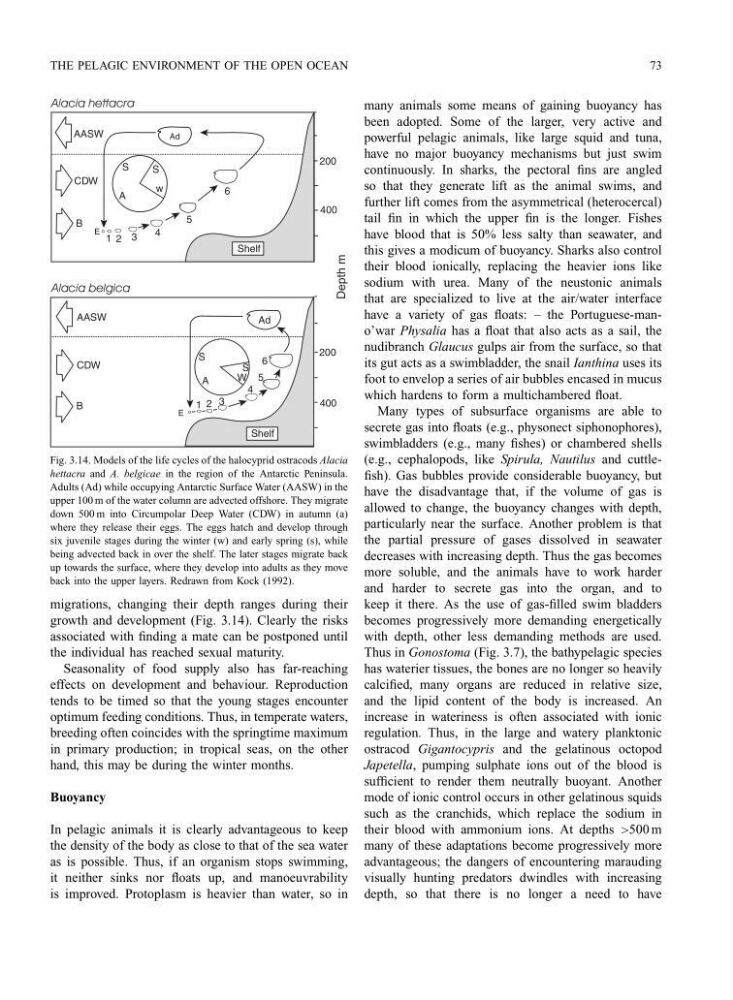
Fig. 3.14. Models of the life cycles of the halocyprid ostracods Alacia
hettacra and A. belgicae in the region of the Antarctic Peninsula.
Adults (Ad) while occupying Antarctic Surface Water (AASW) in the
upper 100 m of the water column are advected offshore. They migrate
down 500 m into Circumpolar Deep Water (CDW) in autumn (a)
where they release their eggs. The eggs hatch and develop through
six juvenile stages during the winter (w) and early spring (s), while
being advected back in over the shelf. The later stages migrate back
up towards the surface, where they develop into adults as they move
back into the upper layers. Redrawn from Kock (1992).
migrations, changing their depth ranges during their
growth and development (Fig. 3.14). Clearly the risks
associated with finding a mate can be postponed until
the individual has reached sexual maturity.
Seasonality of food supply also has far-reaching
effects on development and behaviour. Reproduction
tends to be timed so that the young stages encounter
optimum feeding conditions. Thus, in temperate waters,
breeding often coincides with the springtime maximum
in primary production; in tropical seas, on the other
hand, this may be during the winter months.
Buoyancy
In pelagic animals it is clearly advantageous to keep
the density of the body as close to that of the sea water
as is possible. Thus, if an organism stops swimming,
it neither sinks nor floats up, and manoeuvrability
is improved. Protoplasm is heavier than water, so in
many animals some means of gaining buoyancy has
been adopted. Some of the larger, very active and
powerful pelagic animals, like large squid and tuna,
have no major buoyancy mechanisms but just swim
continuously. In sharks, the pectoral fins are angled
so that they generate lift as the animal swims, and
further lift comes from the asymmetrical (heterocercal)
tail fin in which the upper fin is the longer. Fishes
have blood that is 50% less salty than seawater, and
this gives a modicum of buoyancy. Sharks also control
their blood ionically, replacing the heavier ions like
sodium with urea. Many of the neustonic animals
that are specialized to live at the air/water interface
have a variety of gas floats: – the Portuguese-mano’war Physalia has a float that also acts as a sail, the
nudibranch Glaucus gulps air from the surface, so that
its gut acts as a swimbladder, the snail Ianthina uses its
foot to envelop a series of air bubbles encased in mucus
which hardens to form a multichambered float.
Many types of subsurface organisms are able to
secrete gas into floats (e.g., physonect siphonophores),
swimbladders (e.g., many fishes) or chambered shells
(e.g., cephalopods, like Spirula, Nautilus and cuttlefish). Gas bubbles provide considerable buoyancy, but
have the disadvantage that, if the volume of gas is
allowed to change, the buoyancy changes with depth,
particularly near the surface. Another problem is that
the partial pressure of gases dissolved in seawater
decreases with increasing depth. Thus the gas becomes
more soluble, and the animals have to work harder
and harder to secrete gas into the organ, and to
keep it there. As the use of gas-filled swim bladders
becomes progressively more demanding energetically
with depth, other less demanding methods are used.
Thus in Gonostoma (Fig. 3.7), the bathypelagic species
has waterier tissues, the bones are no longer so heavily
calcified, many organs are reduced in relative size,
and the lipid content of the body is increased. An
increase in wateriness is often associated with ionic
regulation. Thus, in the large and watery planktonic
ostracod Gigantocypris and the gelatinous octopod
Japetella, pumping sulphate ions out of the blood is
sufficient to render them neutrally buoyant. Another
mode of ionic control occurs in other gelatinous squids
such as the cranchids, which replace the sodium in
their blood with ammonium ions. At depths >500 m
many of these adaptations become progressively more
advantageous; the dangers of encountering marauding
visually hunting predators dwindles with increasing
depth, so that there is no longer a need to have
73
Shelf
Shelf
Shelf Shelf
w
A
S
S
E
1 2 3
4
5
6
Ad
E
1 2 3
4
5
6
Ad
S
W
S
A
AASW
CDW
B
AASW
CDW
B
400
200
200
400
Alacia hettacra
Alacia belgica
Depth m
Fig. 3.14. Models of the life cycles of the halocyprid ostracods Alacia
hettacra and A. belgicae in the region of the Antarctic Peninsula.
Adults (Ad) while occupying Antarctic Surface Water (AASW) in the
upper 100 m of the water column are advected offshore. They migrate
down 500 m into Circumpolar Deep Water (CDW) in autumn (a)
where they release their eggs. The eggs hatch and develop through
six juvenile stages during the winter (w) and early spring (s), while
being advected back in over the shelf. The later stages migrate back
up towards the surface, where they develop into adults as they move
back into the upper layers. Redrawn from Kock (1992).
migrations, changing their depth ranges during their
growth and development (Fig. 3.14). Clearly the risks
associated with finding a mate can be postponed until
the individual has reached sexual maturity.
Seasonality of food supply also has far-reaching
effects on development and behaviour. Reproduction
tends to be timed so that the young stages encounter
optimum feeding conditions. Thus, in temperate waters,
breeding often coincides with the springtime maximum
in primary production; in tropical seas, on the other
hand, this may be during the winter months.
Buoyancy
In pelagic animals it is clearly advantageous to keep
the density of the body as close to that of the sea water
as is possible. Thus, if an organism stops swimming,
it neither sinks nor floats up, and manoeuvrability
is improved. Protoplasm is heavier than water, so in
many animals some means of gaining buoyancy has
been adopted. Some of the larger, very active and
powerful pelagic animals, like large squid and tuna,
have no major buoyancy mechanisms but just swim
continuously. In sharks, the pectoral fins are angled
so that they generate lift as the animal swims, and
further lift comes from the asymmetrical (heterocercal)
tail fin in which the upper fin is the longer. Fishes
have blood that is 50% less salty than seawater, and
this gives a modicum of buoyancy. Sharks also control
their blood ionically, replacing the heavier ions like
sodium with urea. Many of the neustonic animals
that are specialized to live at the air/water interface
have a variety of gas floats: – the Portuguese-mano’war Physalia has a float that also acts as a sail, the
nudibranch Glaucus gulps air from the surface, so that
its gut acts as a swimbladder, the snail Ianthina uses its
foot to envelop a series of air bubbles encased in mucus
which hardens to form a multichambered float.
Many types of subsurface organisms are able to
secrete gas into floats (e.g., physonect siphonophores),
swimbladders (e.g., many fishes) or chambered shells
(e.g., cephalopods, like Spirula, Nautilus and cuttlefish). Gas bubbles provide considerable buoyancy, but
have the disadvantage that, if the volume of gas is
allowed to change, the buoyancy changes with depth,
particularly near the surface. Another problem is that
the partial pressure of gases dissolved in seawater
decreases with increasing depth. Thus the gas becomes
more soluble, and the animals have to work harder
and harder to secrete gas into the organ, and to
keep it there. As the use of gas-filled swim bladders
becomes progressively more demanding energetically
with depth, other less demanding methods are used.
Thus in Gonostoma (Fig. 3.7), the bathypelagic species
has waterier tissues, the bones are no longer so heavily
calcified, many organs are reduced in relative size,
and the lipid content of the body is increased. An
increase in wateriness is often associated with ionic
regulation. Thus, in the large and watery planktonic
ostracod Gigantocypris and the gelatinous octopod
Japetella, pumping sulphate ions out of the blood is
sufficient to render them neutrally buoyant. Another
mode of ionic control occurs in other gelatinous squids
such as the cranchids, which replace the sodium in
their blood with ammonium ions. At depths >500 m
many of these adaptations become progressively more
advantageous; the dangers of encountering marauding
visually hunting predators dwindles with increasing
depth, so that there is no longer a need to have