

64
Martin V. ANGEL
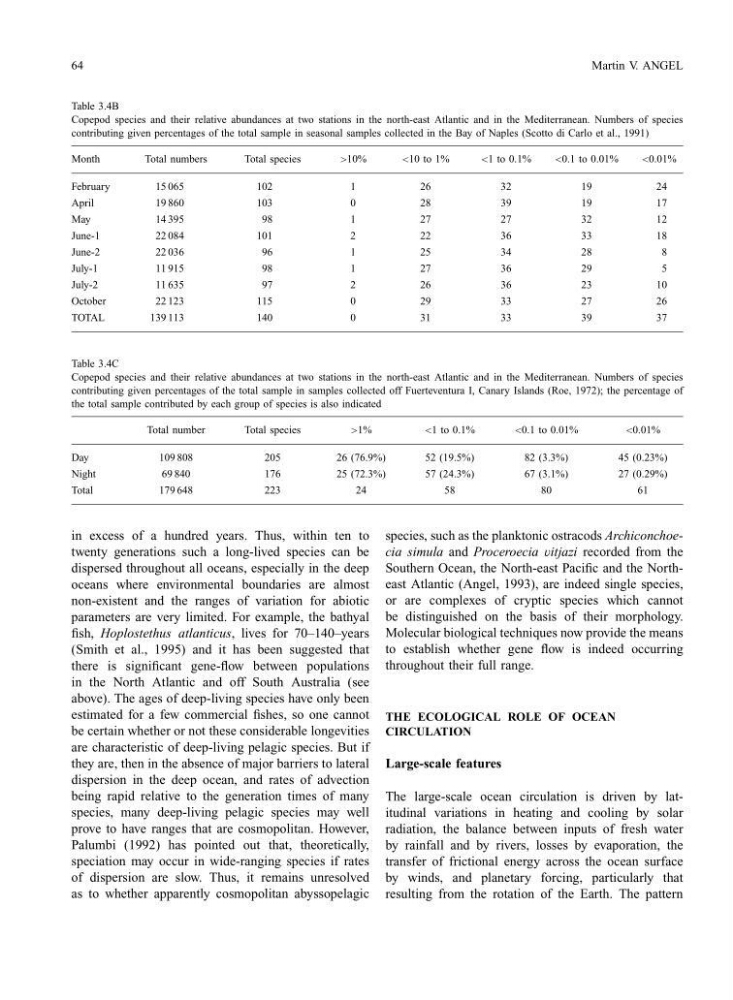
Table 3.4B
Copepod species and their relative abundances at two stations in the north-east Atlantic and in the Mediterranean. Numbers of species
contributing given percentages of the total sample in seasonal samples collected in the Bay of Naples (Scotto di Carlo et al., 1991)
Month
Total numbers
Total species
>10%
<10 to 1%
<1 to 0.1%
<0.1 to 0.01%
<0.01%
February
15 065
102
1
26
32
19
24
April
19 860
103
0
28
39
19
17
May
14 395
98
1
27
27
32
12
June-1
22 084
101
2
22
36
33
18
June-2
22 036
96
1
25
34
28
8
July-1
11 915
98
1
27
36
29
5
July-2
11 635
97
2
26
36
23
10
October
22 123
115
0
29
33
27
26
TOTAL
139 113
140
0
31
33
39
37
Table 3.4C
Copepod species and their relative abundances at two stations in the north-east Atlantic and in the Mediterranean. Numbers of species
contributing given percentages of the total sample in samples collected off Fuerteventura I, Canary Islands (Roe, 1972); the percentage of
the total sample contributed by each group of species is also indicated
Total number
Total species
>1%
<1 to 0.1%
<0.1 to 0.01%
<0.01%
Day
109 808
205
26 (76.9%)
52 (19.5%)
82 (3.3%)
45 (0.23%)
Night
69 840
176
25 (72.3%)
57 (24.3%)
67 (3.1%)
27 (0.29%)
Total
179 648
223
24
58
80
61
in excess of a hundred years. Thus, within ten to
twenty generations such a long-lived species can be
dispersed throughout all oceans, especially in the deep
oceans where environmental boundaries are almost
non-existent and the ranges of variation for abiotic
parameters are very limited. For example, the bathyal
fish, Hoplostethus atlanticus, lives for 70–140–years
(Smith et al., 1995) and it has been suggested that
there is significant gene-flow between populations
in the North Atlantic and off South Australia (see
above). The ages of deep-living species have only been
estimated for a few commercial fishes, so one cannot
be certain whether or not these considerable longevities
are characteristic of deep-living pelagic species. But if
they are, then in the absence of major barriers to lateral
dispersion in the deep ocean, and rates of advection
being rapid relative to the generation times of many
species, many deep-living pelagic species may well
prove to have ranges that are cosmopolitan. However,
Palumbi (1992) has pointed out that, theoretically,
speciation may occur in wide-ranging species if rates
of dispersion are slow. Thus, it remains unresolved
as to whether apparently cosmopolitan abyssopelagic
species, such as the planktonic ostracods Archiconchoecia simula and Proceroecia vitjazi recorded from the
Southern Ocean, the North-east Pacific and the Northeast Atlantic (Angel, 1993), are indeed single species,
or are complexes of cryptic species which cannot
be distinguished on the basis of their morphology.
Molecular biological techniques now provide the means
to establish whether gene flow is indeed occurring
throughout their full range.
THE ECOLOGICAL ROLE OF OCEAN
CIRCULATION
Large-scale features
The large-scale ocean circulation is driven by latitudinal variations in heating and cooling by solar
radiation, the balance between inputs of fresh water
by rainfall and by rivers, losses by evaporation, the
transfer of frictional energy across the ocean surface
by winds, and planetary forcing, particularly that
resulting from the rotation of the Earth. The pattern
Martin V. ANGEL
Table 3.4B
Copepod species and their relative abundances at two stations in the north-east Atlantic and in the Mediterranean. Numbers of species
contributing given percentages of the total sample in seasonal samples collected in the Bay of Naples (Scotto di Carlo et al., 1991)
Month
Total numbers
Total species
>10%
<10 to 1%
<1 to 0.1%
<0.1 to 0.01%
<0.01%
February
15 065
102
1
26
32
19
24
April
19 860
103
0
28
39
19
17
May
14 395
98
1
27
27
32
12
June-1
22 084
101
2
22
36
33
18
June-2
22 036
96
1
25
34
28
8
July-1
11 915
98
1
27
36
29
5
July-2
11 635
97
2
26
36
23
10
October
22 123
115
0
29
33
27
26
TOTAL
139 113
140
0
31
33
39
37
Table 3.4C
Copepod species and their relative abundances at two stations in the north-east Atlantic and in the Mediterranean. Numbers of species
contributing given percentages of the total sample in samples collected off Fuerteventura I, Canary Islands (Roe, 1972); the percentage of
the total sample contributed by each group of species is also indicated
Total number
Total species
>1%
<1 to 0.1%
<0.1 to 0.01%
<0.01%
Day
109 808
205
26 (76.9%)
52 (19.5%)
82 (3.3%)
45 (0.23%)
Night
69 840
176
25 (72.3%)
57 (24.3%)
67 (3.1%)
27 (0.29%)
Total
179 648
223
24
58
80
61
in excess of a hundred years. Thus, within ten to
twenty generations such a long-lived species can be
dispersed throughout all oceans, especially in the deep
oceans where environmental boundaries are almost
non-existent and the ranges of variation for abiotic
parameters are very limited. For example, the bathyal
fish, Hoplostethus atlanticus, lives for 70–140–years
(Smith et al., 1995) and it has been suggested that
there is significant gene-flow between populations
in the North Atlantic and off South Australia (see
above). The ages of deep-living species have only been
estimated for a few commercial fishes, so one cannot
be certain whether or not these considerable longevities
are characteristic of deep-living pelagic species. But if
they are, then in the absence of major barriers to lateral
dispersion in the deep ocean, and rates of advection
being rapid relative to the generation times of many
species, many deep-living pelagic species may well
prove to have ranges that are cosmopolitan. However,
Palumbi (1992) has pointed out that, theoretically,
speciation may occur in wide-ranging species if rates
of dispersion are slow. Thus, it remains unresolved
as to whether apparently cosmopolitan abyssopelagic
species, such as the planktonic ostracods Archiconchoecia simula and Proceroecia vitjazi recorded from the
Southern Ocean, the North-east Pacific and the Northeast Atlantic (Angel, 1993), are indeed single species,
or are complexes of cryptic species which cannot
be distinguished on the basis of their morphology.
Molecular biological techniques now provide the means
to establish whether gene flow is indeed occurring
throughout their full range.
THE ECOLOGICAL ROLE OF OCEAN
CIRCULATION
Large-scale features
The large-scale ocean circulation is driven by latitudinal variations in heating and cooling by solar
radiation, the balance between inputs of fresh water
by rainfall and by rivers, losses by evaporation, the
transfer of frictional energy across the ocean surface
by winds, and planetary forcing, particularly that
resulting from the rotation of the Earth. The pattern