

ANTHROPOGENIC IMPACTS ON THE DEEP SEA
447
Table 13.2
Characteristics of polymetallic nodules and crusts
Characteristic
Term
Polymetallic, ferromanganese
or manganese nodules
Polymetallic, ferromanganese,
manganese or cobalt-rich crusts
Form
Spheroidal, ellipsoidal, discoidal or asymmetrical;
diameter up to 25 cm
Crusts up to 15 cm thick (rarely 20−40 cm)
Surface
Smooth or granular, botryoidal
Smooth to rough, knobbed, botryoidal
Growth rate
Few millimetres per million years, max. 18 mm
Few millimetres per million years
Accretion process
Hydrogenetic (in water), diagenetic (in sediment)
Hydrogenetic
Distribution
All oceans
All oceans
Habitat
(a) Sediment of abyssal plains and hills;
(b) top and flanks of sea-mounts
Rock outcrops on slopes, and tops of seamounts
Depths (m), predominantly
(a) 4000–6000
(b) 1000–4000
Few hundred to 2000 m
Deposit
Two-dimensional, single units in sediment surface
Two-dimensional, continuous crust
Coverage
Up to 90% of sediment surface
100%
Abundance
Up to 60 kg m −2
Minimum mining
5000 metric tonnes per day
Same?
Valuable metals
Co, Cu, Mn, Ni
Co, Cu, Ni, Mn, Zn
Minor components
Ag, Au, Mb, Pt, Ti, Zn
Mo, Pt, V
Mining intensity
1 km 2 per day, 300 km 2 per year
Less?
South African continental shelf in 1874 (Murray and
Renard, 1891). Polymetallic sulphides were discovered
later; metalliferous muds were collected from the
Atlantis II Deep in the central Red Sea during the
International Indian Ocean Expedition (1959–1965)
(Swallow and Crease, 1965; Miller et al., 1966; Degens
and Ross, 1969; Schoell and Hartmann, 1978). In
conjunction with the discoveries of seafloor spreading,
consolidated massive sulphide deposits were found
near the centres of crust genesis and hydrothermal
vents (Francheteau et al., 1979; Hekinian et al., 1980;
MacDonald et al., 1980; Spiess et al., 1980; Edmond,
1984; Lonsdale, 1984).
Some of these ores were already known on land,
and mined to some extent. In 1861 G¨ umbel had
collected manganese nodules in the Alps (Jenkyns,
1977); massive sulphides are well-known and mined
from Cyprus (Scott, 1983; Oudin and Constantinou,
1984), in Canada (Malahoff, 1982), Oman and Japan
(Ballard, 1984) and in Russia (Kusnetzov et al., 1993).
Their marine origin was suggested by the presence of
fossil vent animals, but a true understanding developed
only after the discovery of active hydrothermal vents in
the deep sea (Kusnetzov and Maslennikov, 2000).
Although five different ore types have been described
from the deep sea, they have much in common and, in
respect of aspects of mining, potential environmental
impact, environmental risk assessment, and the need for
precautionary research will be dealt with together.
Polymetallic nodules and crusts
These ores are so similar in their material accretion
and their metal components that they can be considered
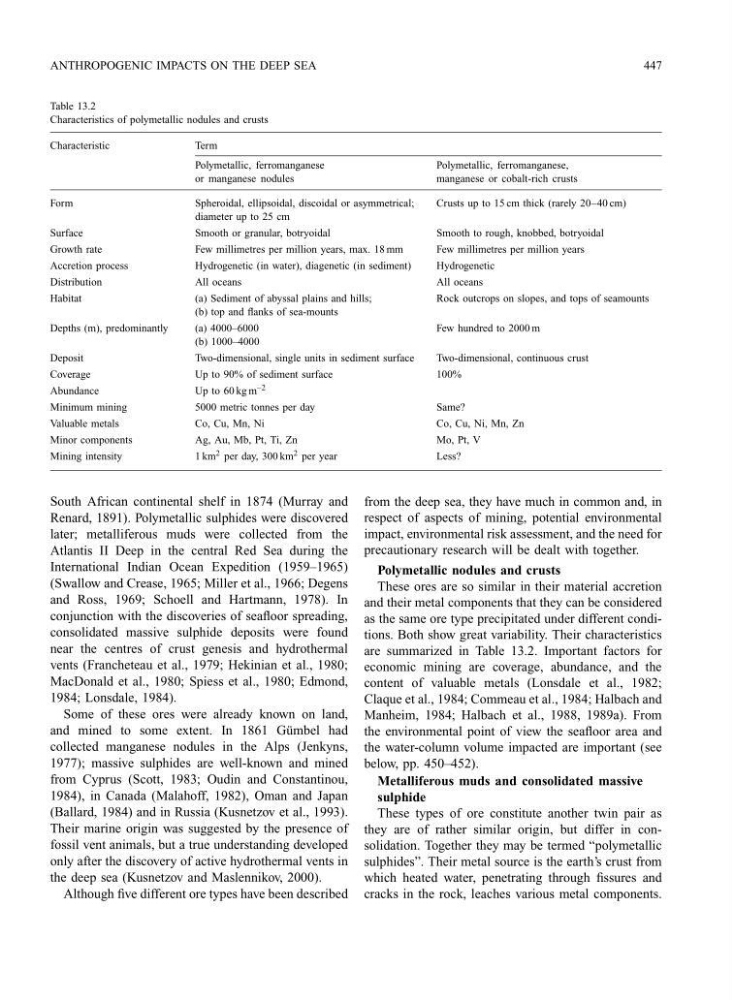
as the same ore type precipitated under different conditions. Both show great variability. Their characteristics
are summarized in Table 13.2. Important factors for
economic mining are coverage, abundance, and the
content of valuable metals (Lonsdale et al., 1982;
Claque et al., 1984; Commeau et al., 1984; Halbach and
Manheim, 1984; Halbach et al., 1988, 1989a). From
the environmental point of view the seafloor area and
the water-column volume impacted are important (see
below, pp. 450–452).
Metalliferous muds and consolidated massive
sulphide
These types of ore constitute another twin pair as
they are of rather similar origin, but differ in consolidation. Together they may be termed “polymetallic
sulphides”. Their metal source is the earth’s crust from
which heated water, penetrating through fissures and
cracks in the rock, leaches various metal components.
447
Table 13.2
Characteristics of polymetallic nodules and crusts
Characteristic
Term
Polymetallic, ferromanganese
or manganese nodules
Polymetallic, ferromanganese,
manganese or cobalt-rich crusts
Form
Spheroidal, ellipsoidal, discoidal or asymmetrical;
diameter up to 25 cm
Crusts up to 15 cm thick (rarely 20−40 cm)
Surface
Smooth or granular, botryoidal
Smooth to rough, knobbed, botryoidal
Growth rate
Few millimetres per million years, max. 18 mm
Few millimetres per million years
Accretion process
Hydrogenetic (in water), diagenetic (in sediment)
Hydrogenetic
Distribution
All oceans
All oceans
Habitat
(a) Sediment of abyssal plains and hills;
(b) top and flanks of sea-mounts
Rock outcrops on slopes, and tops of seamounts
Depths (m), predominantly
(a) 4000–6000
(b) 1000–4000
Few hundred to 2000 m
Deposit
Two-dimensional, single units in sediment surface
Two-dimensional, continuous crust
Coverage
Up to 90% of sediment surface
100%
Abundance
Up to 60 kg m −2
Minimum mining
5000 metric tonnes per day
Same?
Valuable metals
Co, Cu, Mn, Ni
Co, Cu, Ni, Mn, Zn
Minor components
Ag, Au, Mb, Pt, Ti, Zn
Mo, Pt, V
Mining intensity
1 km 2 per day, 300 km 2 per year
Less?
South African continental shelf in 1874 (Murray and
Renard, 1891). Polymetallic sulphides were discovered
later; metalliferous muds were collected from the
Atlantis II Deep in the central Red Sea during the
International Indian Ocean Expedition (1959–1965)
(Swallow and Crease, 1965; Miller et al., 1966; Degens
and Ross, 1969; Schoell and Hartmann, 1978). In
conjunction with the discoveries of seafloor spreading,
consolidated massive sulphide deposits were found
near the centres of crust genesis and hydrothermal
vents (Francheteau et al., 1979; Hekinian et al., 1980;
MacDonald et al., 1980; Spiess et al., 1980; Edmond,
1984; Lonsdale, 1984).
Some of these ores were already known on land,
and mined to some extent. In 1861 G¨ umbel had
collected manganese nodules in the Alps (Jenkyns,
1977); massive sulphides are well-known and mined
from Cyprus (Scott, 1983; Oudin and Constantinou,
1984), in Canada (Malahoff, 1982), Oman and Japan
(Ballard, 1984) and in Russia (Kusnetzov et al., 1993).
Their marine origin was suggested by the presence of
fossil vent animals, but a true understanding developed
only after the discovery of active hydrothermal vents in
the deep sea (Kusnetzov and Maslennikov, 2000).
Although five different ore types have been described
from the deep sea, they have much in common and, in
respect of aspects of mining, potential environmental
impact, environmental risk assessment, and the need for
precautionary research will be dealt with together.
Polymetallic nodules and crusts
These ores are so similar in their material accretion
and their metal components that they can be considered
as the same ore type precipitated under different conditions. Both show great variability. Their characteristics
are summarized in Table 13.2. Important factors for
economic mining are coverage, abundance, and the
content of valuable metals (Lonsdale et al., 1982;
Claque et al., 1984; Commeau et al., 1984; Halbach and
Manheim, 1984; Halbach et al., 1988, 1989a). From
the environmental point of view the seafloor area and
the water-column volume impacted are important (see
below, pp. 450–452).
Metalliferous muds and consolidated massive
sulphide
These types of ore constitute another twin pair as
they are of rather similar origin, but differ in consolidation. Together they may be termed “polymetallic
sulphides”. Their metal source is the earth’s crust from
which heated water, penetrating through fissures and
cracks in the rock, leaches various metal components.