

446
Hjalmar THIEL
may be difficult to extrapolate the results to natural
systems, and large-scale experiments therefore seem
to be unavoidable (Drange et al., 2002). These could
be executed in well-defined more or less landlocked
deep basins, such as a fjord, or in open ocean waters.
A confined-basin experiment would allow the study of
the reactions of the organisms and the system, and
their restoration after natural flushing from the ocean.
It would also help in the design of an open-ocean
experiment, unless it demonstrates that the disposal of
carbon dioxide into the ocean is unacceptable.
A few in situ experiments have been conducted
recently, employing submersibles and remotely operated vehicles (Brewer et al., 1999; Tamburri et al.,
2000). Unexpectedly, it was observed that animals on
the seafloor may not necessarily avoid low pH and
high concentrations of carbon dioxide, but actively
move upstream, particularly when the current carries
the odour of potential food (e.g., bait). Further tests are
essential to understand the impact of carbon dioxide on
life in the ocean.
Laying of submarine cables
Submarine communication cables have criss-crossed
the oceans for almost 150 years, and their laying on or
in the deep seafloor impacts the sediment surface, and
life there. The cable may come to rest on hard bottom,
may sink into soft ooze, or may be ploughed into deeper
sediment layers. The local impact remains limited, and
even the ploughing effects of sediment turnover and
blanketing affects a path no more than a few metres
wide. Animals from the neighbouring vast stretches of
the abyssal plains and hills colonize the disturbed tracks
relatively quickly, and sedentary species may settle on
the cable mantle, using it as hard substrate (see p. 453).
In fact, one of the early observations and proof for the
existence of life in the deep sea was based on deepwater corals collected from a cable retrieved in 1860
from a depth below 2000 m in the Mediterranean Sea
between Sicily and Africa (e.g., Menzies et al., 1973).
EXPLOITATION OF RESOURCES
The deep sea harbours living and non-living resources.
The technology for their exploitation either is already
available or is being developed. The use of living
resources began some 20 years ago, but recent economic developments suggest that non-living resources
could not be mined profitably for at least another
20 years. Oceanographers have assumed the obligations
of environmental impact assessment for these existing
and potential activities, and they need to channel their
concerns into the industrial, administrative and political
discussions.
Seafloor mineral resources and mining
In February 1873 the British HMS Challenger dredged
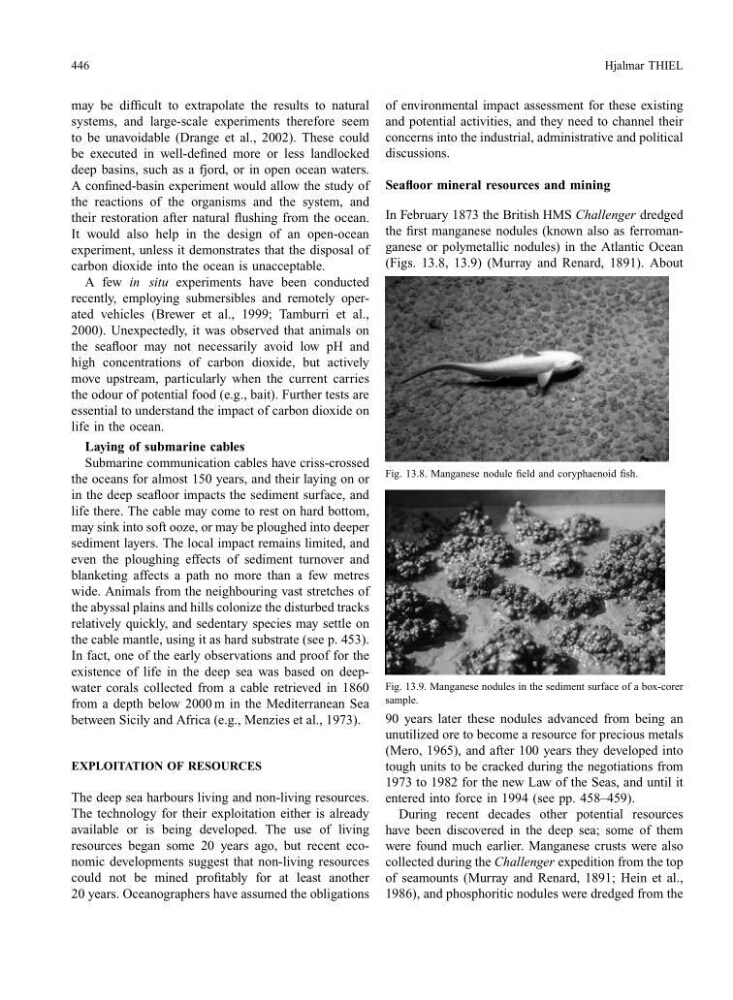
the first manganese nodules (known also as ferromanganese or polymetallic nodules) in the Atlantic Ocean
(Figs. 13.8, 13.9) (Murray and Renard, 1891). About
Fig. 13.8. Manganese nodule field and coryphaenoid fish.
Fig. 13.9. Manganese nodules in the sediment surface of a box-corer
sample.
90 years later these nodules advanced from being an
unutilized ore to become a resource for precious metals
(Mero, 1965), and after 100 years they developed into
tough units to be cracked during the negotiations from
1973 to 1982 for the new Law of the Seas, and until it
entered into force in 1994 (see pp. 458–459).
During recent decades other potential resources
have been discovered in the deep sea; some of them
were found much earlier. Manganese crusts were also
collected during the Challenger expedition from the top
of seamounts (Murray and Renard, 1891; Hein et al.,
1986), and phosphoritic nodules were dredged from the
Hjalmar THIEL
may be difficult to extrapolate the results to natural
systems, and large-scale experiments therefore seem
to be unavoidable (Drange et al., 2002). These could
be executed in well-defined more or less landlocked
deep basins, such as a fjord, or in open ocean waters.
A confined-basin experiment would allow the study of
the reactions of the organisms and the system, and
their restoration after natural flushing from the ocean.
It would also help in the design of an open-ocean
experiment, unless it demonstrates that the disposal of
carbon dioxide into the ocean is unacceptable.
A few in situ experiments have been conducted
recently, employing submersibles and remotely operated vehicles (Brewer et al., 1999; Tamburri et al.,
2000). Unexpectedly, it was observed that animals on
the seafloor may not necessarily avoid low pH and
high concentrations of carbon dioxide, but actively
move upstream, particularly when the current carries
the odour of potential food (e.g., bait). Further tests are
essential to understand the impact of carbon dioxide on
life in the ocean.
Laying of submarine cables
Submarine communication cables have criss-crossed
the oceans for almost 150 years, and their laying on or
in the deep seafloor impacts the sediment surface, and
life there. The cable may come to rest on hard bottom,
may sink into soft ooze, or may be ploughed into deeper
sediment layers. The local impact remains limited, and
even the ploughing effects of sediment turnover and
blanketing affects a path no more than a few metres
wide. Animals from the neighbouring vast stretches of
the abyssal plains and hills colonize the disturbed tracks
relatively quickly, and sedentary species may settle on
the cable mantle, using it as hard substrate (see p. 453).
In fact, one of the early observations and proof for the
existence of life in the deep sea was based on deepwater corals collected from a cable retrieved in 1860
from a depth below 2000 m in the Mediterranean Sea
between Sicily and Africa (e.g., Menzies et al., 1973).
EXPLOITATION OF RESOURCES
The deep sea harbours living and non-living resources.
The technology for their exploitation either is already
available or is being developed. The use of living
resources began some 20 years ago, but recent economic developments suggest that non-living resources
could not be mined profitably for at least another
20 years. Oceanographers have assumed the obligations
of environmental impact assessment for these existing
and potential activities, and they need to channel their
concerns into the industrial, administrative and political
discussions.
Seafloor mineral resources and mining
In February 1873 the British HMS Challenger dredged
the first manganese nodules (known also as ferromanganese or polymetallic nodules) in the Atlantic Ocean
(Figs. 13.8, 13.9) (Murray and Renard, 1891). About
Fig. 13.8. Manganese nodule field and coryphaenoid fish.
Fig. 13.9. Manganese nodules in the sediment surface of a box-corer
sample.
90 years later these nodules advanced from being an
unutilized ore to become a resource for precious metals
(Mero, 1965), and after 100 years they developed into
tough units to be cracked during the negotiations from
1973 to 1982 for the new Law of the Seas, and until it
entered into force in 1994 (see pp. 458–459).
During recent decades other potential resources
have been discovered in the deep sea; some of them
were found much earlier. Manganese crusts were also
collected during the Challenger expedition from the top
of seamounts (Murray and Renard, 1891; Hein et al.,
1986), and phosphoritic nodules were dredged from the