

436
Hjalmar THIEL
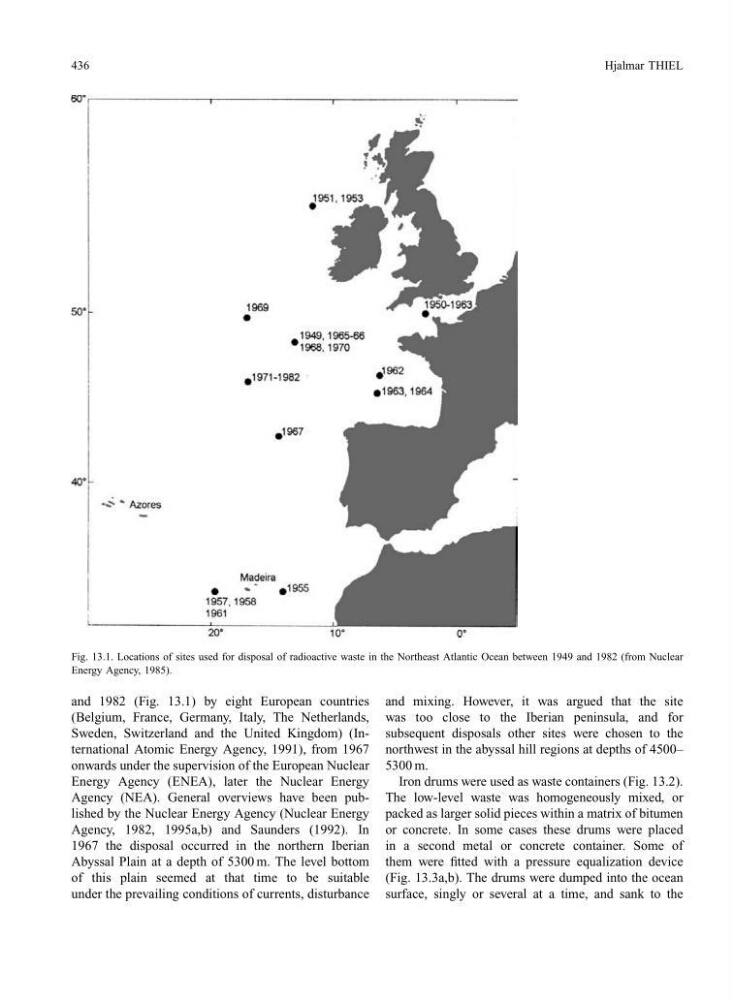
Fig. 13.1. Locations of sites used for disposal of radioactive waste in the Northeast Atlantic Ocean between 1949 and 1982 (from Nuclear
Energy Agency, 1985).
and 1982 (Fig. 13.1) by eight European countries
(Belgium, France, Germany, Italy, The Netherlands,
Sweden, Switzerland and the United Kingdom) (International Atomic Energy Agency, 1991), from 1967
onwards under the supervision of the European Nuclear
Energy Agency (ENEA), later the Nuclear Energy
Agency (NEA). General overviews have been published by the Nuclear Energy Agency (Nuclear Energy
Agency, 1982, 1995a,b) and Saunders (1992). In
1967 the disposal occurred in the northern Iberian
Abyssal Plain at a depth of 5300 m. The level bottom
of this plain seemed at that time to be suitable
under the prevailing conditions of currents, disturbance
and mixing. However, it was argued that the site
was too close to the Iberian peninsula, and for
subsequent disposals other sites were chosen to the
northwest in the abyssal hill regions at depths of 4500–
5300 m.
Iron drums were used as waste containers (Fig. 13.2).
The low-level waste was homogeneously mixed, or
packed as larger solid pieces within a matrix of bitumen
or concrete. In some cases these drums were placed
in a second metal or concrete container. Some of
them were fitted with a pressure equalization device
(Fig. 13.3a,b). The drums were dumped into the ocean
surface, singly or several at a time, and sank to the
Hjalmar THIEL
Fig. 13.1. Locations of sites used for disposal of radioactive waste in the Northeast Atlantic Ocean between 1949 and 1982 (from Nuclear
Energy Agency, 1985).
and 1982 (Fig. 13.1) by eight European countries
(Belgium, France, Germany, Italy, The Netherlands,
Sweden, Switzerland and the United Kingdom) (International Atomic Energy Agency, 1991), from 1967
onwards under the supervision of the European Nuclear
Energy Agency (ENEA), later the Nuclear Energy
Agency (NEA). General overviews have been published by the Nuclear Energy Agency (Nuclear Energy
Agency, 1982, 1995a,b) and Saunders (1992). In
1967 the disposal occurred in the northern Iberian
Abyssal Plain at a depth of 5300 m. The level bottom
of this plain seemed at that time to be suitable
under the prevailing conditions of currents, disturbance
and mixing. However, it was argued that the site
was too close to the Iberian peninsula, and for
subsequent disposals other sites were chosen to the
northwest in the abyssal hill regions at depths of 4500–
5300 m.
Iron drums were used as waste containers (Fig. 13.2).
The low-level waste was homogeneously mixed, or
packed as larger solid pieces within a matrix of bitumen
or concrete. In some cases these drums were placed
in a second metal or concrete container. Some of
them were fitted with a pressure equalization device
(Fig. 13.3a,b). The drums were dumped into the ocean
surface, singly or several at a time, and sank to the