

FOOD INPUTS, UTILIZATION, CARBON FLOW AND ENERGETICS
345
but work has also shown that microbial biomass
does not itself constitute the major food source for
detritivores (e.g., Kemp, 1987; Plante et al., 1990;
Plante and Mayer, 1994). Mayer et al. (1997) have
shown that similarities in the enzymatic profile between
deposit- and suspension-feeding polychaetes are much
greater than between deposit-feeding polychaetes and
holothurians. This suggests that the biochemical nature
of the food digested is different between these two
important deposit-feeding taxonomic classes, even if
they are considered functionally similar. Evidence from
sediment distribution, enzyme and bacterial profiles
along the digestive tracts of Oneirophanta mutabilis,
Pseudostichopus sp. and Psychropotes longicauda in
the abyssal Northeast Atlantic indicate gut tissue, rather
than bacteria, as the main source of enzymes, while
between-species differences in some glycosidases, such
as chitobiase, suggest dietary differences (Roberts
et al., 2001). These authors indicate that differences
in bacterial activity observed along the guts probably
reflect changes in the microbial environment which
may favour different microbial communities. These
differences at least offer the potential for microbial
breakdown of a broader range of substrates than would
otherwise be possible by the animal itself.
Particle selection
In highly specialized deposit-feeding organisms,
such as bivalves, a high rate of processing may be
achieved by means of prior sorting and rejection
of unsuitable particles as pseudofaeces. Deep-sea
protobranch bivalves have been described as possessing
specialized structures performing this function (Allen,
1978). In the deep sea, as in shallow-water cohesive
sediments, deposit feeders concentrate on the most
nutritious, surface-most layer of the sediment where
micro-organisms and the most recently deposited
detritus is concentrated. Even the largest depositfeeding organisms skim off only the very surface film
of sediment. The feeding structure morphology, in
situ observations, and analyses of stomach contents
(e.g., Sibuet et al., 1984; Billett et al., 1988) support
this for a range of large motile epifaunal organisms.
Self and Jumars (1988) show surface deposit feeders
employing radically differing food-gathering mechanisms have converged towards selection for particles
of low specific gravity. These mechanisms include the
‘vacuum cleaner’ lifestyle of elasipod holothurians, the
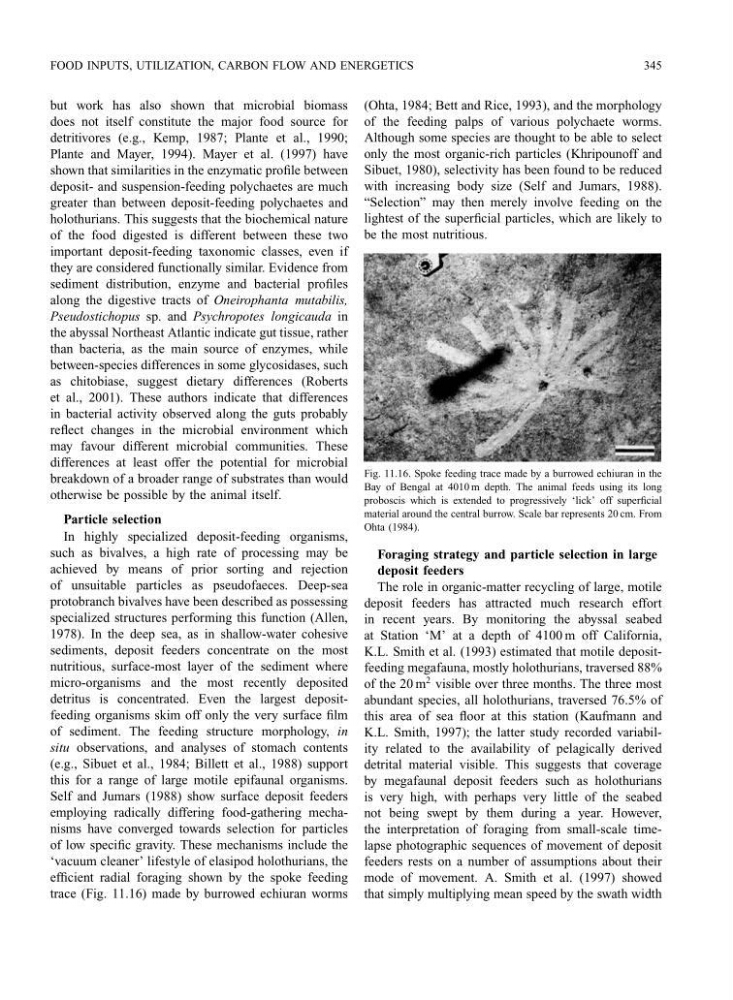
efficient radial foraging shown by the spoke feeding
trace (Fig. 11.16) made by burrowed echiuran worms
(Ohta, 1984; Bett and Rice, 1993), and the morphology
of the feeding palps of various polychaete worms.
Although some species are thought to be able to select
only the most organic-rich particles (Khripounoff and
Sibuet, 1980), selectivity has been found to be reduced
with increasing body size (Self and Jumars, 1988).
“Selection” may then merely involve feeding on the
lightest of the superficial particles, which are likely to
be the most nutritious.
Fig. 11.16. Spoke feeding trace made by a burrowed echiuran in the
Bay of Bengal at 4010 m depth. The animal feeds using its long
proboscis which is extended to progressively ‘lick’ off superficial
material around the central burrow. Scale bar represents 20 cm. From
Ohta (1984).
Foraging strategy and particle selection in large
deposit feeders
The role in organic-matter recycling of large, motile
deposit feeders has attracted much research effort
in recent years. By monitoring the abyssal seabed
at Station ‘M’ at a depth of 4100 m off California,
K.L. Smith et al. (1993) estimated that motile depositfeeding megafauna, mostly holothurians, traversed 88%
of the 20 m
2 visible over three months. The three most
abundant species, all holothurians, traversed 76.5% of
this area of sea floor at this station (Kaufmann and
K.L. Smith, 1997); the latter study recorded variability related to the availability of pelagically derived
detrital material visible. This suggests that coverage
by megafaunal deposit feeders such as holothurians
is very high, with perhaps very little of the seabed
not being swept by them during a year. However,
the interpretation of foraging from small-scale timelapse photographic sequences of movement of deposit
feeders rests on a number of assumptions about their
mode of movement. A. Smith et al. (1997) showed
that simply multiplying mean speed by the swath width
345
but work has also shown that microbial biomass
does not itself constitute the major food source for
detritivores (e.g., Kemp, 1987; Plante et al., 1990;
Plante and Mayer, 1994). Mayer et al. (1997) have
shown that similarities in the enzymatic profile between
deposit- and suspension-feeding polychaetes are much
greater than between deposit-feeding polychaetes and
holothurians. This suggests that the biochemical nature
of the food digested is different between these two
important deposit-feeding taxonomic classes, even if
they are considered functionally similar. Evidence from
sediment distribution, enzyme and bacterial profiles
along the digestive tracts of Oneirophanta mutabilis,
Pseudostichopus sp. and Psychropotes longicauda in
the abyssal Northeast Atlantic indicate gut tissue, rather
than bacteria, as the main source of enzymes, while
between-species differences in some glycosidases, such
as chitobiase, suggest dietary differences (Roberts
et al., 2001). These authors indicate that differences
in bacterial activity observed along the guts probably
reflect changes in the microbial environment which
may favour different microbial communities. These
differences at least offer the potential for microbial
breakdown of a broader range of substrates than would
otherwise be possible by the animal itself.
Particle selection
In highly specialized deposit-feeding organisms,
such as bivalves, a high rate of processing may be
achieved by means of prior sorting and rejection
of unsuitable particles as pseudofaeces. Deep-sea
protobranch bivalves have been described as possessing
specialized structures performing this function (Allen,
1978). In the deep sea, as in shallow-water cohesive
sediments, deposit feeders concentrate on the most
nutritious, surface-most layer of the sediment where
micro-organisms and the most recently deposited
detritus is concentrated. Even the largest depositfeeding organisms skim off only the very surface film
of sediment. The feeding structure morphology, in
situ observations, and analyses of stomach contents
(e.g., Sibuet et al., 1984; Billett et al., 1988) support
this for a range of large motile epifaunal organisms.
Self and Jumars (1988) show surface deposit feeders
employing radically differing food-gathering mechanisms have converged towards selection for particles
of low specific gravity. These mechanisms include the
‘vacuum cleaner’ lifestyle of elasipod holothurians, the
efficient radial foraging shown by the spoke feeding
trace (Fig. 11.16) made by burrowed echiuran worms
(Ohta, 1984; Bett and Rice, 1993), and the morphology
of the feeding palps of various polychaete worms.
Although some species are thought to be able to select
only the most organic-rich particles (Khripounoff and
Sibuet, 1980), selectivity has been found to be reduced
with increasing body size (Self and Jumars, 1988).
“Selection” may then merely involve feeding on the
lightest of the superficial particles, which are likely to
be the most nutritious.
Fig. 11.16. Spoke feeding trace made by a burrowed echiuran in the
Bay of Bengal at 4010 m depth. The animal feeds using its long
proboscis which is extended to progressively ‘lick’ off superficial
material around the central burrow. Scale bar represents 20 cm. From
Ohta (1984).
Foraging strategy and particle selection in large
deposit feeders
The role in organic-matter recycling of large, motile
deposit feeders has attracted much research effort
in recent years. By monitoring the abyssal seabed
at Station ‘M’ at a depth of 4100 m off California,
K.L. Smith et al. (1993) estimated that motile depositfeeding megafauna, mostly holothurians, traversed 88%
of the 20 m
2 visible over three months. The three most
abundant species, all holothurians, traversed 76.5% of
this area of sea floor at this station (Kaufmann and
K.L. Smith, 1997); the latter study recorded variability related to the availability of pelagically derived
detrital material visible. This suggests that coverage
by megafaunal deposit feeders such as holothurians
is very high, with perhaps very little of the seabed
not being swept by them during a year. However,
the interpretation of foraging from small-scale timelapse photographic sequences of movement of deposit
feeders rests on a number of assumptions about their
mode of movement. A. Smith et al. (1997) showed
that simply multiplying mean speed by the swath width