

FOOD INPUTS, UTILIZATION, CARBON FLOW AND ENERGETICS
343
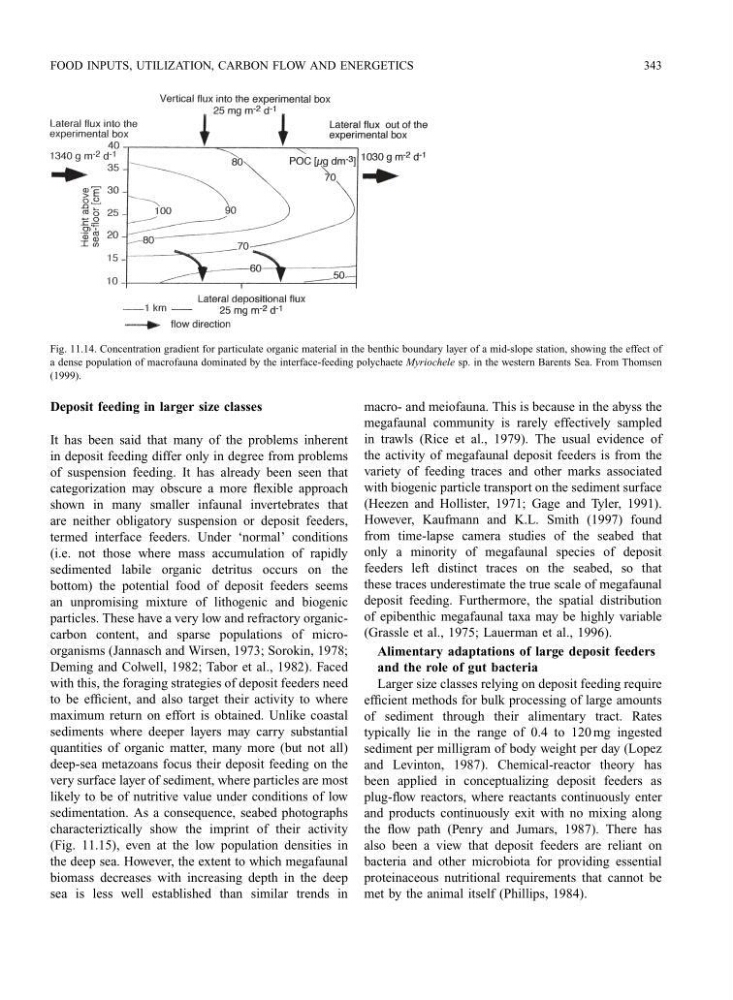
Fig. 11.14. Concentration gradient for particulate organic material in the benthic boundary layer of a mid-slope station, showing the effect of
a dense population of macrofauna dominated by the interface-feeding polychaete Myriochele sp. in the western Barents Sea. From Thomsen
(1999).
Deposit feeding in larger size classes
It has been said that many of the problems inherent
in deposit feeding differ only in degree from problems
of suspension feeding. It has already been seen that
categorization may obscure a more flexible approach
shown in many smaller infaunal invertebrates that
are neither obligatory suspension or deposit feeders,
termed interface feeders. Under ‘normal’ conditions
(i.e. not those where mass accumulation of rapidly
sedimented labile organic detritus occurs on the
bottom) the potential food of deposit feeders seems
an unpromising mixture of lithogenic and biogenic
particles. These have a very low and refractory organiccarbon content, and sparse populations of microorganisms (Jannasch and Wirsen, 1973; Sorokin, 1978;
Deming and Colwell, 1982; Tabor et al., 1982). Faced
with this, the foraging strategies of deposit feeders need
to be efficient, and also target their activity to where
maximum return on effort is obtained. Unlike coastal
sediments where deeper layers may carry substantial
quantities of organic matter, many more (but not all)
deep-sea metazoans focus their deposit feeding on the
very surface layer of sediment, where particles are most
likely to be of nutritive value under conditions of low
sedimentation. As a consequence, seabed photographs
characteriztically show the imprint of their activity
(Fig. 11.15), even at the low population densities in
the deep sea. However, the extent to which megafaunal
biomass decreases with increasing depth in the deep
sea is less well established than similar trends in
macro- and meiofauna. This is because in the abyss the
megafaunal community is rarely effectively sampled
in trawls (Rice et al., 1979). The usual evidence of
the activity of megafaunal deposit feeders is from the
variety of feeding traces and other marks associated
with biogenic particle transport on the sediment surface
(Heezen and Hollister, 1971; Gage and Tyler, 1991).
However, Kaufmann and K.L. Smith (1997) found
from time-lapse camera studies of the seabed that
only a minority of megafaunal species of deposit
feeders left distinct traces on the seabed, so that
these traces underestimate the true scale of megafaunal
deposit feeding. Furthermore, the spatial distribution
of epibenthic megafaunal taxa may be highly variable
(Grassle et al., 1975; Lauerman et al., 1996).
Alimentary adaptations of large deposit feeders
and the role of gut bacteria
Larger size classes relying on deposit feeding require
efficient methods for bulk processing of large amounts
of sediment through their alimentary tract. Rates
typically lie in the range of 0.4 to 120 mg ingested
sediment per milligram of body weight per day (Lopez
and Levinton, 1987). Chemical-reactor theory has
been applied in conceptualizing deposit feeders as
plug-flow reactors, where reactants continuously enter
and products continuously exit with no mixing along
the flow path (Penry and Jumars, 1987). There has
also been a view that deposit feeders are reliant on
bacteria and other microbiota for providing essential
proteinaceous nutritional requirements that cannot be
met by the animal itself (Phillips, 1984).
343
Fig. 11.14. Concentration gradient for particulate organic material in the benthic boundary layer of a mid-slope station, showing the effect of
a dense population of macrofauna dominated by the interface-feeding polychaete Myriochele sp. in the western Barents Sea. From Thomsen
(1999).
Deposit feeding in larger size classes
It has been said that many of the problems inherent
in deposit feeding differ only in degree from problems
of suspension feeding. It has already been seen that
categorization may obscure a more flexible approach
shown in many smaller infaunal invertebrates that
are neither obligatory suspension or deposit feeders,
termed interface feeders. Under ‘normal’ conditions
(i.e. not those where mass accumulation of rapidly
sedimented labile organic detritus occurs on the
bottom) the potential food of deposit feeders seems
an unpromising mixture of lithogenic and biogenic
particles. These have a very low and refractory organiccarbon content, and sparse populations of microorganisms (Jannasch and Wirsen, 1973; Sorokin, 1978;
Deming and Colwell, 1982; Tabor et al., 1982). Faced
with this, the foraging strategies of deposit feeders need
to be efficient, and also target their activity to where
maximum return on effort is obtained. Unlike coastal
sediments where deeper layers may carry substantial
quantities of organic matter, many more (but not all)
deep-sea metazoans focus their deposit feeding on the
very surface layer of sediment, where particles are most
likely to be of nutritive value under conditions of low
sedimentation. As a consequence, seabed photographs
characteriztically show the imprint of their activity
(Fig. 11.15), even at the low population densities in
the deep sea. However, the extent to which megafaunal
biomass decreases with increasing depth in the deep
sea is less well established than similar trends in
macro- and meiofauna. This is because in the abyss the
megafaunal community is rarely effectively sampled
in trawls (Rice et al., 1979). The usual evidence of
the activity of megafaunal deposit feeders is from the
variety of feeding traces and other marks associated
with biogenic particle transport on the sediment surface
(Heezen and Hollister, 1971; Gage and Tyler, 1991).
However, Kaufmann and K.L. Smith (1997) found
from time-lapse camera studies of the seabed that
only a minority of megafaunal species of deposit
feeders left distinct traces on the seabed, so that
these traces underestimate the true scale of megafaunal
deposit feeding. Furthermore, the spatial distribution
of epibenthic megafaunal taxa may be highly variable
(Grassle et al., 1975; Lauerman et al., 1996).
Alimentary adaptations of large deposit feeders
and the role of gut bacteria
Larger size classes relying on deposit feeding require
efficient methods for bulk processing of large amounts
of sediment through their alimentary tract. Rates
typically lie in the range of 0.4 to 120 mg ingested
sediment per milligram of body weight per day (Lopez
and Levinton, 1987). Chemical-reactor theory has
been applied in conceptualizing deposit feeders as
plug-flow reactors, where reactants continuously enter
and products continuously exit with no mixing along
the flow path (Penry and Jumars, 1987). There has
also been a view that deposit feeders are reliant on
bacteria and other microbiota for providing essential
proteinaceous nutritional requirements that cannot be
met by the animal itself (Phillips, 1984).