

FOOD INPUTS, UTILIZATION, CARBON FLOW AND ENERGETICS
341
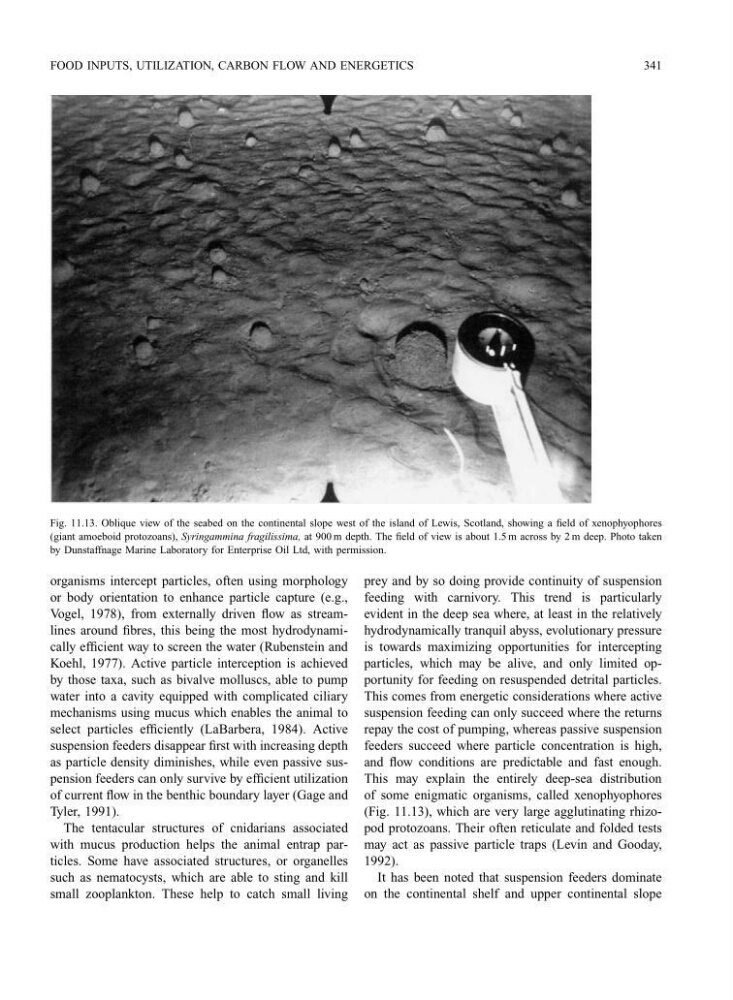
Fig. 11.13. Oblique view of the seabed on the continental slope west of the island of Lewis, Scotland, showing a field of xenophyophores
(giant amoeboid protozoans), Syringammina fragilissima, at 900 m depth. The field of view is about 1.5 m across by 2 m deep. Photo taken
by Dunstaffnage Marine Laboratory for Enterprise Oil Ltd, with permission.
organisms intercept particles, often using morphology
or body orientation to enhance particle capture (e.g.,
Vogel, 1978), from externally driven flow as streamlines around fibres, this being the most hydrodynamically efficient way to screen the water (Rubenstein and
Koehl, 1977). Active particle interception is achieved
by those taxa, such as bivalve molluscs, able to pump
water into a cavity equipped with complicated ciliary
mechanisms using mucus which enables the animal to
select particles efficiently (LaBarbera, 1984). Active
suspension feeders disappear first with increasing depth
as particle density diminishes, while even passive suspension feeders can only survive by efficient utilization
of current flow in the benthic boundary layer (Gage and
Tyler, 1991).
The tentacular structures of cnidarians associated
with mucus production helps the animal entrap particles. Some have associated structures, or organelles
such as nematocysts, which are able to sting and kill
small zooplankton. These help to catch small living
prey and by so doing provide continuity of suspension
feeding with carnivory. This trend is particularly
evident in the deep sea where, at least in the relatively
hydrodynamically tranquil abyss, evolutionary pressure
is towards maximizing opportunities for intercepting
particles, which may be alive, and only limited opportunity for feeding on resuspended detrital particles.
This comes from energetic considerations where active
suspension feeding can only succeed where the returns
repay the cost of pumping, whereas passive suspension
feeders succeed where particle concentration is high,
and flow conditions are predictable and fast enough.
This may explain the entirely deep-sea distribution
of some enigmatic organisms, called xenophyophores
(Fig. 11.13), which are very large agglutinating rhizopod protozoans. Their often reticulate and folded tests
may act as passive particle traps (Levin and Gooday,
1992).
It has been noted that suspension feeders dominate
on the continental shelf and upper continental slope
341
Fig. 11.13. Oblique view of the seabed on the continental slope west of the island of Lewis, Scotland, showing a field of xenophyophores
(giant amoeboid protozoans), Syringammina fragilissima, at 900 m depth. The field of view is about 1.5 m across by 2 m deep. Photo taken
by Dunstaffnage Marine Laboratory for Enterprise Oil Ltd, with permission.
organisms intercept particles, often using morphology
or body orientation to enhance particle capture (e.g.,
Vogel, 1978), from externally driven flow as streamlines around fibres, this being the most hydrodynamically efficient way to screen the water (Rubenstein and
Koehl, 1977). Active particle interception is achieved
by those taxa, such as bivalve molluscs, able to pump
water into a cavity equipped with complicated ciliary
mechanisms using mucus which enables the animal to
select particles efficiently (LaBarbera, 1984). Active
suspension feeders disappear first with increasing depth
as particle density diminishes, while even passive suspension feeders can only survive by efficient utilization
of current flow in the benthic boundary layer (Gage and
Tyler, 1991).
The tentacular structures of cnidarians associated
with mucus production helps the animal entrap particles. Some have associated structures, or organelles
such as nematocysts, which are able to sting and kill
small zooplankton. These help to catch small living
prey and by so doing provide continuity of suspension
feeding with carnivory. This trend is particularly
evident in the deep sea where, at least in the relatively
hydrodynamically tranquil abyss, evolutionary pressure
is towards maximizing opportunities for intercepting
particles, which may be alive, and only limited opportunity for feeding on resuspended detrital particles.
This comes from energetic considerations where active
suspension feeding can only succeed where the returns
repay the cost of pumping, whereas passive suspension
feeders succeed where particle concentration is high,
and flow conditions are predictable and fast enough.
This may explain the entirely deep-sea distribution
of some enigmatic organisms, called xenophyophores
(Fig. 11.13), which are very large agglutinating rhizopod protozoans. Their often reticulate and folded tests
may act as passive particle traps (Levin and Gooday,
1992).
It has been noted that suspension feeders dominate
on the continental shelf and upper continental slope