

340
John D. GAGE
the hexactinellid sponge Pheronema carpenteri (Rice
et al., 1990; Barthel et al., 1996). The demosponges,
including large species of Geodia, Isops phlegraei,
and Stryphnus ponderosus, have long been known
by fishermen as “ostur” (meaning “cheese bottom”)
occurring along the shelf break around the Færøerne
(Northeast Atlantic), where sponges may constitute
more than 90% of benthic biomass, excluding fish.
Other suspension feeders, such as the cold-water
coral Lophelia pertusa, large octocorals (Alcyonaria),
stylasterids (large Hydrozoa) and some brachiopods
seem to occur in the same areas.
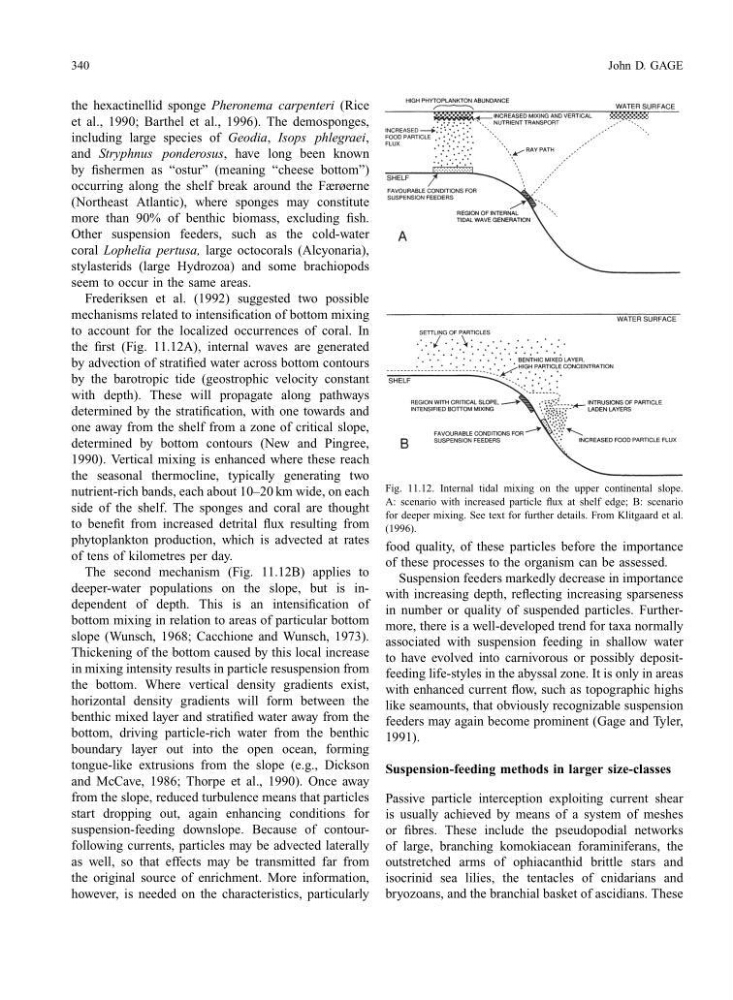
Frederiksen et al. (1992) suggested two possible
mechanisms related to intensification of bottom mixing
to account for the localized occurrences of coral. In
the first (Fig. 11.12A), internal waves are generated
by advection of stratified water across bottom contours
by the barotropic tide (geostrophic velocity constant
with depth). These will propagate along pathways
determined by the stratification, with one towards and
one away from the shelf from a zone of critical slope,
determined by bottom contours (New and Pingree,
1990). Vertical mixing is enhanced where these reach
the seasonal thermocline, typically generating two
nutrient-rich bands, each about 10–20 km wide, on each
side of the shelf. The sponges and coral are thought
to benefit from increased detrital flux resulting from
phytoplankton production, which is advected at rates
of tens of kilometres per day.
The second mechanism (Fig. 11.12B) applies to
deeper-water populations on the slope, but is independent of depth. This is an intensification of
bottom mixing in relation to areas of particular bottom
slope (Wunsch, 1968; Cacchione and Wunsch, 1973).
Thickening of the bottom caused by this local increase
in mixing intensity results in particle resuspension from
the bottom. Where vertical density gradients exist,
horizontal density gradients will form between the
benthic mixed layer and stratified water away from the
bottom, driving particle-rich water from the benthic
boundary layer out into the open ocean, forming
tongue-like extrusions from the slope (e.g., Dickson
and McCave, 1986; Thorpe et al., 1990). Once away
from the slope, reduced turbulence means that particles
start dropping out, again enhancing conditions for
suspension-feeding downslope. Because of contourfollowing currents, particles may be advected laterally
as well, so that effects may be transmitted far from
the original source of enrichment. More information,
however, is needed on the characteristics, particularly
Fig. 11.12. Internal tidal mixing on the upper continental slope.
A: scenario with increased particle flux at shelf edge; B: scenario
for deeper mixing. See text for further details. From Klitgaard et al.
(1996).
food quality, of these particles before the importance
of these processes to the organism can be assessed.
Suspension feeders markedly decrease in importance
with increasing depth, reflecting increasing sparseness
in number or quality of suspended particles. Furthermore, there is a well-developed trend for taxa normally
associated with suspension feeding in shallow water
to have evolved into carnivorous or possibly depositfeeding life-styles in the abyssal zone. It is only in areas
with enhanced current flow, such as topographic highs
like seamounts, that obviously recognizable suspension
feeders may again become prominent (Gage and Tyler,
1991).
Suspension-feeding methods in larger size-classes
Passive particle interception exploiting current shear
is usually achieved by means of a system of meshes
or fibres. These include the pseudopodial networks
of large, branching komokiacean foraminiferans, the
outstretched arms of ophiacanthid brittle stars and
isocrinid sea lilies, the tentacles of cnidarians and
bryozoans, and the branchial basket of ascidians. These
John D. GAGE
the hexactinellid sponge Pheronema carpenteri (Rice
et al., 1990; Barthel et al., 1996). The demosponges,
including large species of Geodia, Isops phlegraei,
and Stryphnus ponderosus, have long been known
by fishermen as “ostur” (meaning “cheese bottom”)
occurring along the shelf break around the Færøerne
(Northeast Atlantic), where sponges may constitute
more than 90% of benthic biomass, excluding fish.
Other suspension feeders, such as the cold-water
coral Lophelia pertusa, large octocorals (Alcyonaria),
stylasterids (large Hydrozoa) and some brachiopods
seem to occur in the same areas.
Frederiksen et al. (1992) suggested two possible
mechanisms related to intensification of bottom mixing
to account for the localized occurrences of coral. In
the first (Fig. 11.12A), internal waves are generated
by advection of stratified water across bottom contours
by the barotropic tide (geostrophic velocity constant
with depth). These will propagate along pathways
determined by the stratification, with one towards and
one away from the shelf from a zone of critical slope,
determined by bottom contours (New and Pingree,
1990). Vertical mixing is enhanced where these reach
the seasonal thermocline, typically generating two
nutrient-rich bands, each about 10–20 km wide, on each
side of the shelf. The sponges and coral are thought
to benefit from increased detrital flux resulting from
phytoplankton production, which is advected at rates
of tens of kilometres per day.
The second mechanism (Fig. 11.12B) applies to
deeper-water populations on the slope, but is independent of depth. This is an intensification of
bottom mixing in relation to areas of particular bottom
slope (Wunsch, 1968; Cacchione and Wunsch, 1973).
Thickening of the bottom caused by this local increase
in mixing intensity results in particle resuspension from
the bottom. Where vertical density gradients exist,
horizontal density gradients will form between the
benthic mixed layer and stratified water away from the
bottom, driving particle-rich water from the benthic
boundary layer out into the open ocean, forming
tongue-like extrusions from the slope (e.g., Dickson
and McCave, 1986; Thorpe et al., 1990). Once away
from the slope, reduced turbulence means that particles
start dropping out, again enhancing conditions for
suspension-feeding downslope. Because of contourfollowing currents, particles may be advected laterally
as well, so that effects may be transmitted far from
the original source of enrichment. More information,
however, is needed on the characteristics, particularly
Fig. 11.12. Internal tidal mixing on the upper continental slope.
A: scenario with increased particle flux at shelf edge; B: scenario
for deeper mixing. See text for further details. From Klitgaard et al.
(1996).
food quality, of these particles before the importance
of these processes to the organism can be assessed.
Suspension feeders markedly decrease in importance
with increasing depth, reflecting increasing sparseness
in number or quality of suspended particles. Furthermore, there is a well-developed trend for taxa normally
associated with suspension feeding in shallow water
to have evolved into carnivorous or possibly depositfeeding life-styles in the abyssal zone. It is only in areas
with enhanced current flow, such as topographic highs
like seamounts, that obviously recognizable suspension
feeders may again become prominent (Gage and Tyler,
1991).
Suspension-feeding methods in larger size-classes
Passive particle interception exploiting current shear
is usually achieved by means of a system of meshes
or fibres. These include the pseudopodial networks
of large, branching komokiacean foraminiferans, the
outstretched arms of ophiacanthid brittle stars and
isocrinid sea lilies, the tentacles of cnidarians and
bryozoans, and the branchial basket of ascidians. These