

FOOD INPUTS, UTILIZATION, CARBON FLOW AND ENERGETICS
331
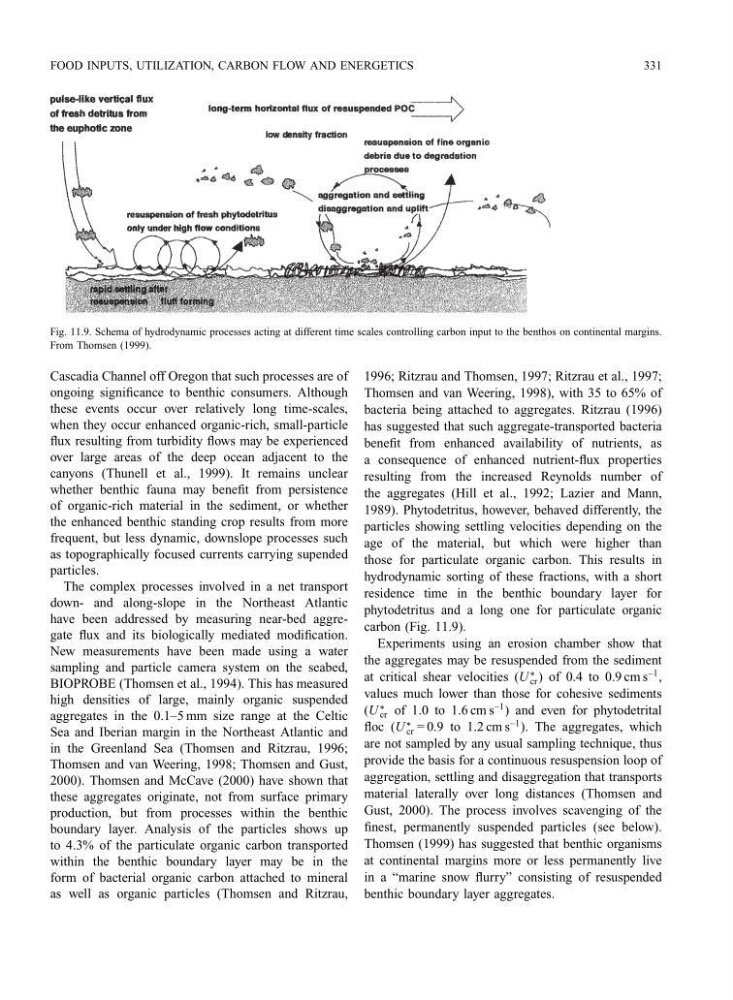
Fig. 11.9. Schema of hydrodynamic processes acting at different time scales controlling carbon input to the benthos on continental margins.
From Thomsen (1999).
Cascadia Channel off Oregon that such processes are of
ongoing significance to benthic consumers. Although
these events occur over relatively long time-scales,
when they occur enhanced organic-rich, small-particle
flux resulting from turbidity flows may be experienced
over large areas of the deep ocean adjacent to the
canyons (Thunell et al., 1999). It remains unclear
whether benthic fauna may benefit from persistence
of organic-rich material in the sediment, or whether
the enhanced benthic standing crop results from more
frequent, but less dynamic, downslope processes such
as topographically focused currents carrying supended
particles.
The complex processes involved in a net transport
down- and along-slope in the Northeast Atlantic
have been addressed by measuring near-bed aggregate flux and its biologically mediated modification.
New measurements have been made using a water
sampling and particle camera system on the seabed,
BIOPROBE (Thomsen et al., 1994). This has measured
high densities of large, mainly organic suspended
aggregates in the 0.1–5 mm size range at the Celtic
Sea and Iberian margin in the Northeast Atlantic and
in the Greenland Sea (Thomsen and Ritzrau, 1996;
Thomsen and van Weering, 1998; Thomsen and Gust,
2000). Thomsen and McCave (2000) have shown that
these aggregates originate, not from surface primary
production, but from processes within the benthic
boundary layer. Analysis of the particles shows up
to 4.3% of the particulate organic carbon transported
within the benthic boundary layer may be in the
form of bacterial organic carbon attached to mineral
as well as organic particles (Thomsen and Ritzrau,
1996; Ritzrau and Thomsen, 1997; Ritzrau et al., 1997;
Thomsen and van Weering, 1998), with 35 to 65% of
bacteria being attached to aggregates. Ritzrau (1996)
has suggested that such aggregate-transported bacteria
benefit from enhanced availability of nutrients, as
a consequence of enhanced nutrient-flux properties
resulting from the increased Reynolds number of
the aggregates (Hill et al., 1992; Lazier and Mann,
1989). Phytodetritus, however, behaved differently, the
particles showing settling velocities depending on the
age of the material, but which were higher than
those for particulate organic carbon. This results in
hydrodynamic sorting of these fractions, with a short
residence time in the benthic boundary layer for
phytodetritus and a long one for particulate organic
carbon (Fig. 11.9).
Experiments using an erosion chamber show that
the aggregates may be resuspended from the sediment
at critical shear velocities (U
°
cr ) of 0.4 to 0.9 cm s
−1 ,
values much lower than those for cohesive sediments
(U
°
cr of 1.0 to 1.6 cm s
−1 ) and even for phytodetrital
floc (U
°
cr = 0.9 to 1.2 cm s
−1 ). The aggregates, which
are not sampled by any usual sampling technique, thus
provide the basis for a continuous resuspension loop of
aggregation, settling and disaggregation that transports
material laterally over long distances (Thomsen and
Gust, 2000). The process involves scavenging of the
finest, permanently suspended particles (see below).
Thomsen (1999) has suggested that benthic organisms
at continental margins more or less permanently live
in a “marine snow flurry” consisting of resuspended
benthic boundary layer aggregates.
331
Fig. 11.9. Schema of hydrodynamic processes acting at different time scales controlling carbon input to the benthos on continental margins.
From Thomsen (1999).
Cascadia Channel off Oregon that such processes are of
ongoing significance to benthic consumers. Although
these events occur over relatively long time-scales,
when they occur enhanced organic-rich, small-particle
flux resulting from turbidity flows may be experienced
over large areas of the deep ocean adjacent to the
canyons (Thunell et al., 1999). It remains unclear
whether benthic fauna may benefit from persistence
of organic-rich material in the sediment, or whether
the enhanced benthic standing crop results from more
frequent, but less dynamic, downslope processes such
as topographically focused currents carrying supended
particles.
The complex processes involved in a net transport
down- and along-slope in the Northeast Atlantic
have been addressed by measuring near-bed aggregate flux and its biologically mediated modification.
New measurements have been made using a water
sampling and particle camera system on the seabed,
BIOPROBE (Thomsen et al., 1994). This has measured
high densities of large, mainly organic suspended
aggregates in the 0.1–5 mm size range at the Celtic
Sea and Iberian margin in the Northeast Atlantic and
in the Greenland Sea (Thomsen and Ritzrau, 1996;
Thomsen and van Weering, 1998; Thomsen and Gust,
2000). Thomsen and McCave (2000) have shown that
these aggregates originate, not from surface primary
production, but from processes within the benthic
boundary layer. Analysis of the particles shows up
to 4.3% of the particulate organic carbon transported
within the benthic boundary layer may be in the
form of bacterial organic carbon attached to mineral
as well as organic particles (Thomsen and Ritzrau,
1996; Ritzrau and Thomsen, 1997; Ritzrau et al., 1997;
Thomsen and van Weering, 1998), with 35 to 65% of
bacteria being attached to aggregates. Ritzrau (1996)
has suggested that such aggregate-transported bacteria
benefit from enhanced availability of nutrients, as
a consequence of enhanced nutrient-flux properties
resulting from the increased Reynolds number of
the aggregates (Hill et al., 1992; Lazier and Mann,
1989). Phytodetritus, however, behaved differently, the
particles showing settling velocities depending on the
age of the material, but which were higher than
those for particulate organic carbon. This results in
hydrodynamic sorting of these fractions, with a short
residence time in the benthic boundary layer for
phytodetritus and a long one for particulate organic
carbon (Fig. 11.9).
Experiments using an erosion chamber show that
the aggregates may be resuspended from the sediment
at critical shear velocities (U
°
cr ) of 0.4 to 0.9 cm s
−1 ,
values much lower than those for cohesive sediments
(U
°
cr of 1.0 to 1.6 cm s
−1 ) and even for phytodetrital
floc (U
°
cr = 0.9 to 1.2 cm s
−1 ). The aggregates, which
are not sampled by any usual sampling technique, thus
provide the basis for a continuous resuspension loop of
aggregation, settling and disaggregation that transports
material laterally over long distances (Thomsen and
Gust, 2000). The process involves scavenging of the
finest, permanently suspended particles (see below).
Thomsen (1999) has suggested that benthic organisms
at continental margins more or less permanently live
in a “marine snow flurry” consisting of resuspended
benthic boundary layer aggregates.