

THE PERIPHERAL DEEP SEAS
267
Temperature
Salinity
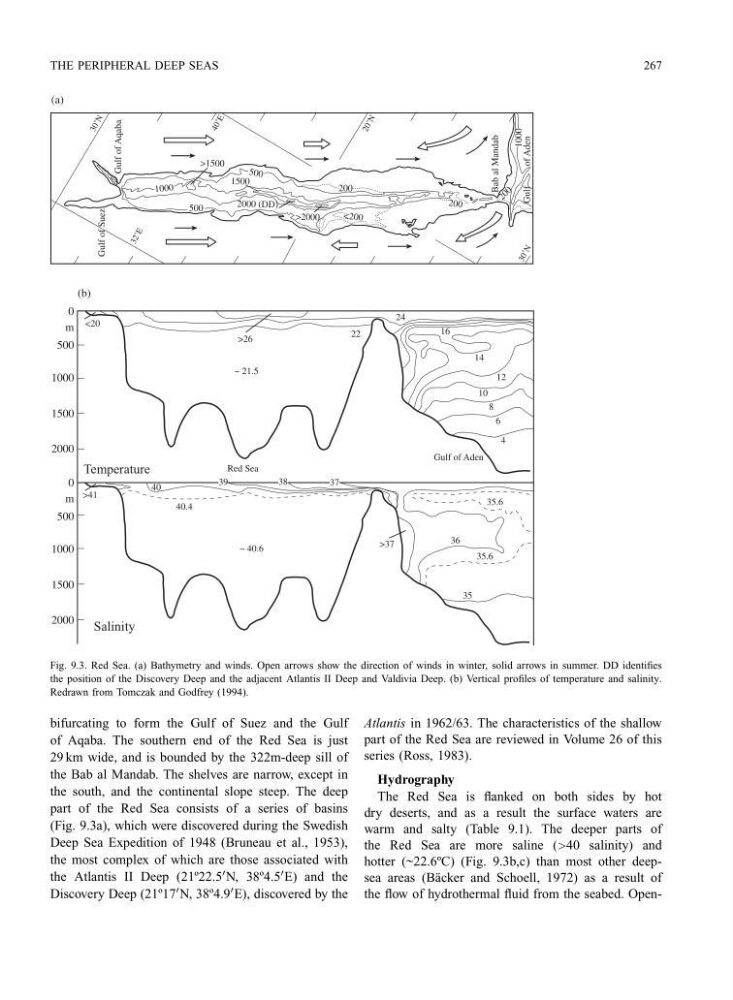
Fig. 9.3. Red Sea. (a) Bathymetry and winds. Open arrows show the direction of winds in winter, solid arrows in summer. DD identifies
the position of the Discovery Deep and the adjacent Atlantis II Deep and Valdivia Deep. (b) Vertical profiles of temperature and salinity.
Redrawn from Tomczak and Godfrey (1994).
bifurcating to form the Gulf of Suez and the Gulf
of Aqaba. The southern end of the Red Sea is just
29 km wide, and is bounded by the 322m-deep sill of
the Bab al Mandab. The shelves are narrow, except in
the south, and the continental slope steep. The deep
part of the Red Sea consists of a series of basins
(Fig. 9.3a), which were discovered during the Swedish
Deep Sea Expedition of 1948 (Bruneau et al., 1953),
the most complex of which are those associated with
the Atlantis II Deep (21º22.5
N, 38º4.5
E) and the
Discovery Deep (21º17
N, 38º4.9
E), discovered by the
Atlantis in 1962/63. The characteristics of the shallow
part of the Red Sea are reviewed in Volume 26 of this
series (Ross, 1983).
Hydrography
The Red Sea is flanked on both sides by hot
dry deserts, and as a result the surface waters are
warm and salty (Table 9.1). The deeper parts of
the Red Sea are more saline (>40 salinity) and
hotter (~22.6ºC) (Fig. 9.3b,c) than most other deepsea areas (B¨ acker and Schoell, 1972) as a result of
the flow of hydrothermal fluid from the seabed. Open-
267
Temperature
Salinity
Fig. 9.3. Red Sea. (a) Bathymetry and winds. Open arrows show the direction of winds in winter, solid arrows in summer. DD identifies
the position of the Discovery Deep and the adjacent Atlantis II Deep and Valdivia Deep. (b) Vertical profiles of temperature and salinity.
Redrawn from Tomczak and Godfrey (1994).
bifurcating to form the Gulf of Suez and the Gulf
of Aqaba. The southern end of the Red Sea is just
29 km wide, and is bounded by the 322m-deep sill of
the Bab al Mandab. The shelves are narrow, except in
the south, and the continental slope steep. The deep
part of the Red Sea consists of a series of basins
(Fig. 9.3a), which were discovered during the Swedish
Deep Sea Expedition of 1948 (Bruneau et al., 1953),
the most complex of which are those associated with
the Atlantis II Deep (21º22.5
N, 38º4.5
E) and the
Discovery Deep (21º17
N, 38º4.9
E), discovered by the
Atlantis in 1962/63. The characteristics of the shallow
part of the Red Sea are reviewed in Volume 26 of this
series (Ross, 1983).
Hydrography
The Red Sea is flanked on both sides by hot
dry deserts, and as a result the surface waters are
warm and salty (Table 9.1). The deeper parts of
the Red Sea are more saline (>40 salinity) and
hotter (~22.6ºC) (Fig. 9.3b,c) than most other deepsea areas (B¨ acker and Schoell, 1972) as a result of
the flow of hydrothermal fluid from the seabed. Open-