

THE POLAR DEEP SEAS
255
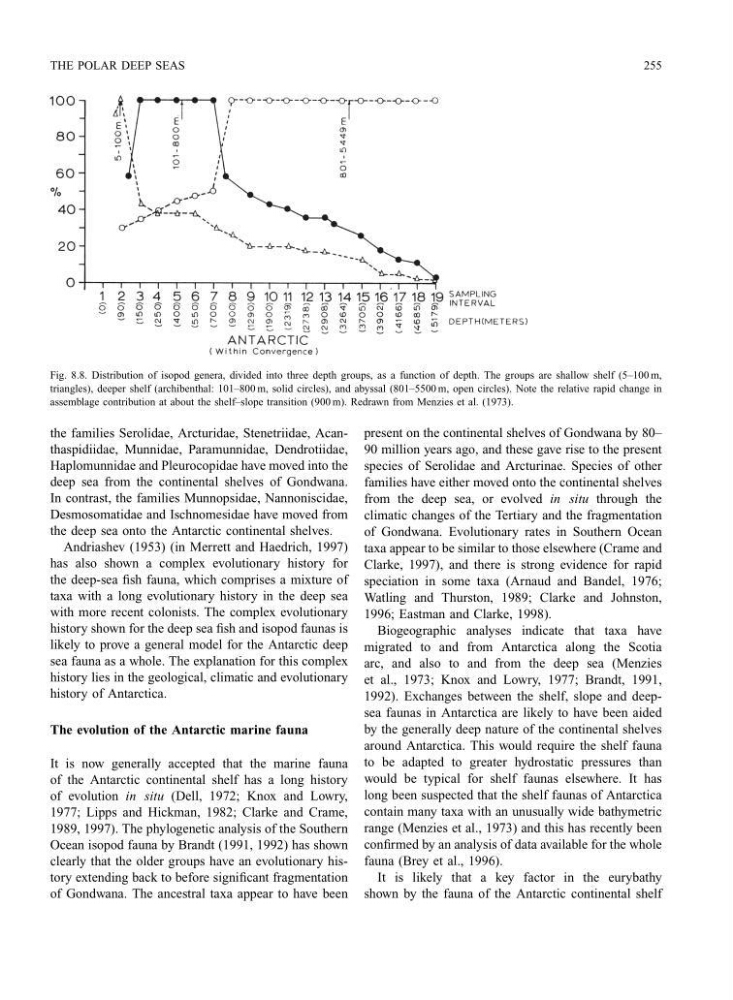
Fig. 8.8. Distribution of isopod genera, divided into three depth groups, as a function of depth. The groups are shallow shelf (5–100 m,
triangles), deeper shelf (archibenthal: 101–800 m, solid circles), and abyssal (801–5500 m, open circles). Note the relative rapid change in
assemblage contribution at about the shelf–slope transition (900 m). Redrawn from Menzies et al. (1973).
the families Serolidae, Arcturidae, Stenetriidae, Acanthaspidiidae, Munnidae, Paramunnidae, Dendrotiidae,
Haplomunnidae and Pleurocopidae have moved into the
deep sea from the continental shelves of Gondwana.
In contrast, the families Munnopsidae, Nannoniscidae,
Desmosomatidae and Ischnomesidae have moved from
the deep sea onto the Antarctic continental shelves.
Andriashev (1953) (in Merrett and Haedrich, 1997)
has also shown a complex evolutionary history for
the deep-sea fish fauna, which comprises a mixture of
taxa with a long evolutionary history in the deep sea
with more recent colonists. The complex evolutionary
history shown for the deep sea fish and isopod faunas is
likely to prove a general model for the Antarctic deep
sea fauna as a whole. The explanation for this complex
history lies in the geological, climatic and evolutionary
history of Antarctica.
The evolution of the Antarctic marine fauna
It is now generally accepted that the marine fauna
of the Antarctic continental shelf has a long history
of evolution in situ (Dell, 1972; Knox and Lowry,
1977; Lipps and Hickman, 1982; Clarke and Crame,
1989, 1997). The phylogenetic analysis of the Southern
Ocean isopod fauna by Brandt (1991, 1992) has shown
clearly that the older groups have an evolutionary history extending back to before significant fragmentation
of Gondwana. The ancestral taxa appear to have been
present on the continental shelves of Gondwana by 80–
90 million years ago, and these gave rise to the present
species of Serolidae and Arcturinae. Species of other
families have either moved onto the continental shelves
from the deep sea, or evolved in situ through the
climatic changes of the Tertiary and the fragmentation
of Gondwana. Evolutionary rates in Southern Ocean
taxa appear to be similar to those elsewhere (Crame and
Clarke, 1997), and there is strong evidence for rapid
speciation in some taxa (Arnaud and Bandel, 1976;
Watling and Thurston, 1989; Clarke and Johnston,
1996; Eastman and Clarke, 1998).
Biogeographic analyses indicate that taxa have
migrated to and from Antarctica along the Scotia
arc, and also to and from the deep sea (Menzies
et al., 1973; Knox and Lowry, 1977; Brandt, 1991,
1992). Exchanges between the shelf, slope and deepsea faunas in Antarctica are likely to have been aided
by the generally deep nature of the continental shelves
around Antarctica. This would require the shelf fauna
to be adapted to greater hydrostatic pressures than
would be typical for shelf faunas elsewhere. It has
long been suspected that the shelf faunas of Antarctica
contain many taxa with an unusually wide bathymetric
range (Menzies et al., 1973) and this has recently been
confirmed by an analysis of data available for the whole
fauna (Brey et al., 1996).
It is likely that a key factor in the eurybathy
shown by the fauna of the Antarctic continental shelf
255
Fig. 8.8. Distribution of isopod genera, divided into three depth groups, as a function of depth. The groups are shallow shelf (5–100 m,
triangles), deeper shelf (archibenthal: 101–800 m, solid circles), and abyssal (801–5500 m, open circles). Note the relative rapid change in
assemblage contribution at about the shelf–slope transition (900 m). Redrawn from Menzies et al. (1973).
the families Serolidae, Arcturidae, Stenetriidae, Acanthaspidiidae, Munnidae, Paramunnidae, Dendrotiidae,
Haplomunnidae and Pleurocopidae have moved into the
deep sea from the continental shelves of Gondwana.
In contrast, the families Munnopsidae, Nannoniscidae,
Desmosomatidae and Ischnomesidae have moved from
the deep sea onto the Antarctic continental shelves.
Andriashev (1953) (in Merrett and Haedrich, 1997)
has also shown a complex evolutionary history for
the deep-sea fish fauna, which comprises a mixture of
taxa with a long evolutionary history in the deep sea
with more recent colonists. The complex evolutionary
history shown for the deep sea fish and isopod faunas is
likely to prove a general model for the Antarctic deep
sea fauna as a whole. The explanation for this complex
history lies in the geological, climatic and evolutionary
history of Antarctica.
The evolution of the Antarctic marine fauna
It is now generally accepted that the marine fauna
of the Antarctic continental shelf has a long history
of evolution in situ (Dell, 1972; Knox and Lowry,
1977; Lipps and Hickman, 1982; Clarke and Crame,
1989, 1997). The phylogenetic analysis of the Southern
Ocean isopod fauna by Brandt (1991, 1992) has shown
clearly that the older groups have an evolutionary history extending back to before significant fragmentation
of Gondwana. The ancestral taxa appear to have been
present on the continental shelves of Gondwana by 80–
90 million years ago, and these gave rise to the present
species of Serolidae and Arcturinae. Species of other
families have either moved onto the continental shelves
from the deep sea, or evolved in situ through the
climatic changes of the Tertiary and the fragmentation
of Gondwana. Evolutionary rates in Southern Ocean
taxa appear to be similar to those elsewhere (Crame and
Clarke, 1997), and there is strong evidence for rapid
speciation in some taxa (Arnaud and Bandel, 1976;
Watling and Thurston, 1989; Clarke and Johnston,
1996; Eastman and Clarke, 1998).
Biogeographic analyses indicate that taxa have
migrated to and from Antarctica along the Scotia
arc, and also to and from the deep sea (Menzies
et al., 1973; Knox and Lowry, 1977; Brandt, 1991,
1992). Exchanges between the shelf, slope and deepsea faunas in Antarctica are likely to have been aided
by the generally deep nature of the continental shelves
around Antarctica. This would require the shelf fauna
to be adapted to greater hydrostatic pressures than
would be typical for shelf faunas elsewhere. It has
long been suspected that the shelf faunas of Antarctica
contain many taxa with an unusually wide bathymetric
range (Menzies et al., 1973) and this has recently been
confirmed by an analysis of data available for the whole
fauna (Brey et al., 1996).
It is likely that a key factor in the eurybathy
shown by the fauna of the Antarctic continental shelf