

THE POLAR DEEP SEAS
251
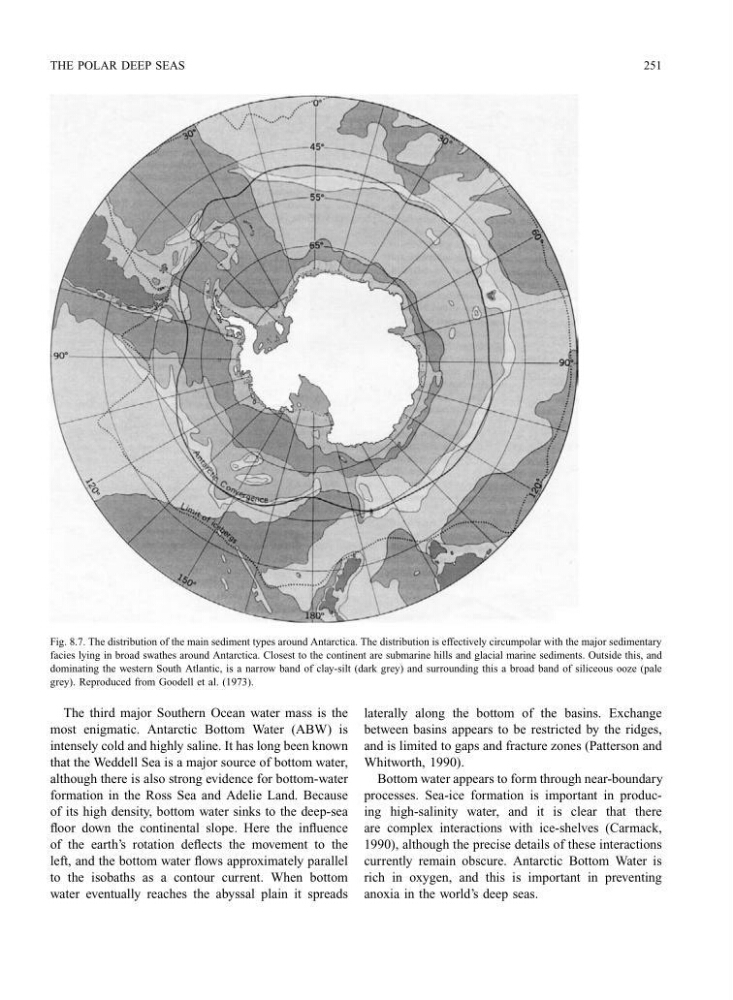
Fig. 8.7. The distribution of the main sediment types around Antarctica. The distribution is effectively circumpolar with the major sedimentary
facies lying in broad swathes around Antarctica. Closest to the continent are submarine hills and glacial marine sediments. Outside this, and
dominating the western South Atlantic, is a narrow band of clay-silt (dark grey) and surrounding this a broad band of siliceous ooze (pale
grey). Reproduced from Goodell et al. (1973).
The third major Southern Ocean water mass is the
most enigmatic. Antarctic Bottom Water (ABW) is
intensely cold and highly saline. It has long been known
that the Weddell Sea is a major source of bottom water,
although there is also strong evidence for bottom-water
formation in the Ross Sea and Adelie Land. Because
of its high density, bottom water sinks to the deep-sea
floor down the continental slope. Here the influence
of the earth’s rotation deflects the movement to the
left, and the bottom water flows approximately parallel
to the isobaths as a contour current. When bottom
water eventually reaches the abyssal plain it spreads
laterally along the bottom of the basins. Exchange
between basins appears to be restricted by the ridges,
and is limited to gaps and fracture zones (Patterson and
Whitworth, 1990).
Bottom water appears to form through near-boundary
processes. Sea-ice formation is important in producing high-salinity water, and it is clear that there
are complex interactions with ice-shelves (Carmack,
1990), although the precise details of these interactions
currently remain obscure. Antarctic Bottom Water is
rich in oxygen, and this is important in preventing
anoxia in the world’s deep seas.
251
Fig. 8.7. The distribution of the main sediment types around Antarctica. The distribution is effectively circumpolar with the major sedimentary
facies lying in broad swathes around Antarctica. Closest to the continent are submarine hills and glacial marine sediments. Outside this, and
dominating the western South Atlantic, is a narrow band of clay-silt (dark grey) and surrounding this a broad band of siliceous ooze (pale
grey). Reproduced from Goodell et al. (1973).
The third major Southern Ocean water mass is the
most enigmatic. Antarctic Bottom Water (ABW) is
intensely cold and highly saline. It has long been known
that the Weddell Sea is a major source of bottom water,
although there is also strong evidence for bottom-water
formation in the Ross Sea and Adelie Land. Because
of its high density, bottom water sinks to the deep-sea
floor down the continental slope. Here the influence
of the earth’s rotation deflects the movement to the
left, and the bottom water flows approximately parallel
to the isobaths as a contour current. When bottom
water eventually reaches the abyssal plain it spreads
laterally along the bottom of the basins. Exchange
between basins appears to be restricted by the ridges,
and is limited to gaps and fracture zones (Patterson and
Whitworth, 1990).
Bottom water appears to form through near-boundary
processes. Sea-ice formation is important in producing high-salinity water, and it is clear that there
are complex interactions with ice-shelves (Carmack,
1990), although the precise details of these interactions
currently remain obscure. Antarctic Bottom Water is
rich in oxygen, and this is important in preventing
anoxia in the world’s deep seas.