

250
Andrew CLARKE
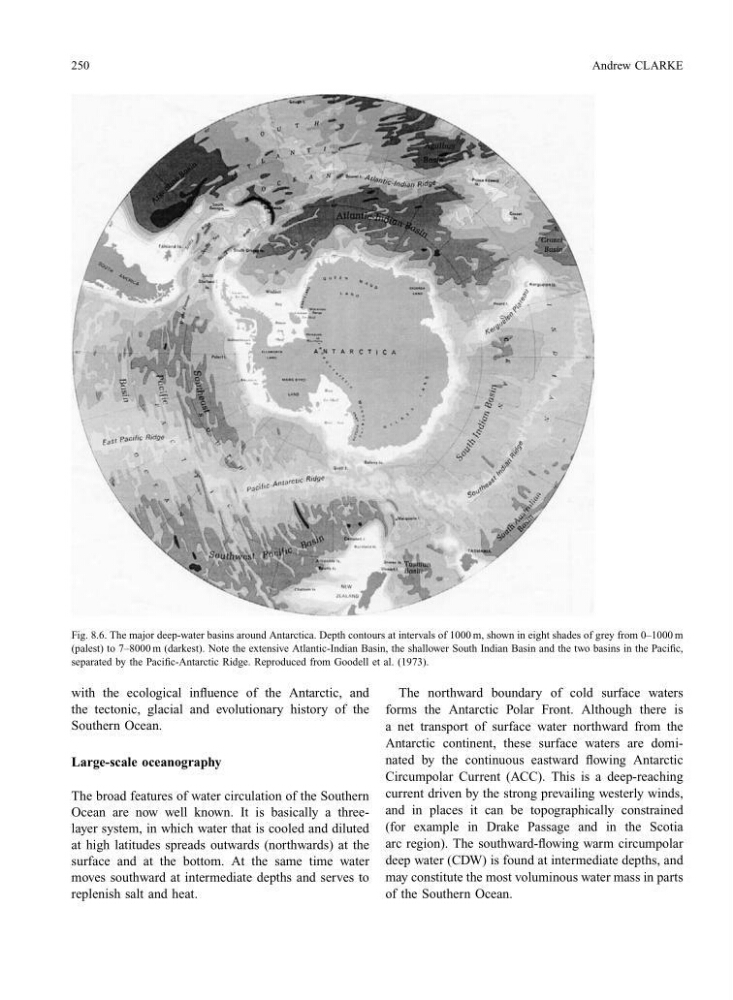
Fig. 8.6. The major deep-water basins around Antarctica. Depth contours at intervals of 1000 m, shown in eight shades of grey from 0–1000 m
(palest) to 7–8000 m (darkest). Note the extensive Atlantic-Indian Basin, the shallower South Indian Basin and the two basins in the Pacific,
separated by the Pacific-Antarctic Ridge. Reproduced from Goodell et al. (1973).
with the ecological influence of the Antarctic, and
the tectonic, glacial and evolutionary history of the
Southern Ocean.
Large-scale oceanography
The broad features of water circulation of the Southern
Ocean are now well known. It is basically a threelayer system, in which water that is cooled and diluted
at high latitudes spreads outwards (northwards) at the
surface and at the bottom. At the same time water
moves southward at intermediate depths and serves to
replenish salt and heat.
The northward boundary of cold surface waters
forms the Antarctic Polar Front. Although there is
a net transport of surface water northward from the
Antarctic continent, these surface waters are dominated by the continuous eastward flowing Antarctic
Circumpolar Current (ACC). This is a deep-reaching
current driven by the strong prevailing westerly winds,
and in places it can be topographically constrained
(for example in Drake Passage and in the Scotia
arc region). The southward-flowing warm circumpolar
deep water (CDW) is found at intermediate depths, and
may constitute the most voluminous water mass in parts
of the Southern Ocean.
Andrew CLARKE
Fig. 8.6. The major deep-water basins around Antarctica. Depth contours at intervals of 1000 m, shown in eight shades of grey from 0–1000 m
(palest) to 7–8000 m (darkest). Note the extensive Atlantic-Indian Basin, the shallower South Indian Basin and the two basins in the Pacific,
separated by the Pacific-Antarctic Ridge. Reproduced from Goodell et al. (1973).
with the ecological influence of the Antarctic, and
the tectonic, glacial and evolutionary history of the
Southern Ocean.
Large-scale oceanography
The broad features of water circulation of the Southern
Ocean are now well known. It is basically a threelayer system, in which water that is cooled and diluted
at high latitudes spreads outwards (northwards) at the
surface and at the bottom. At the same time water
moves southward at intermediate depths and serves to
replenish salt and heat.
The northward boundary of cold surface waters
forms the Antarctic Polar Front. Although there is
a net transport of surface water northward from the
Antarctic continent, these surface waters are dominated by the continuous eastward flowing Antarctic
Circumpolar Current (ACC). This is a deep-reaching
current driven by the strong prevailing westerly winds,
and in places it can be topographically constrained
(for example in Drake Passage and in the Scotia
arc region). The southward-flowing warm circumpolar
deep water (CDW) is found at intermediate depths, and
may constitute the most voluminous water mass in parts
of the Southern Ocean.