

234
Amanda W.J. DEMOPOULOS et al.
and Moore, 1971; Ohta, 1984). During present sealevel conditions, a majority of sediments from large
rivers (the Ganges and Brahmaputra) are reported to be
trapped in the subsiding deltas and on the inner shelf,
and thus little sediment and nutrients are transported by
the turbidity channels (Curray and Moore, 1971). The
Bay of Bengal experiences wind-generated upwelling
along the coast, promoting primary productivity. Average primary productivity in the Bay is 109.5 g C m
−2 y
−1
(Pant, 1992). The carbonate compensation depth in
these waters is ~4500 m; at shallower depths, the
calcium-carbonate sediments are covered with thin
greenish brown flocculent material.
Limited data from this region come from sediments collected by grab samples; the total benthic
biomass (meiofauna and macrofauna) in the Bay of
Bengal ranges from 0.11 to 0.38 g m
−2 (Sokolova and
Pasternak, 1962, 1964; Neyman et al., 1973). These
abundances appear to be low compared to the rest of
the Indian Ocean. Despite the relatively low biomass
of deep-sea benthic organisms in the Bay of Bengal,
distinct biogenic features can be observed on the
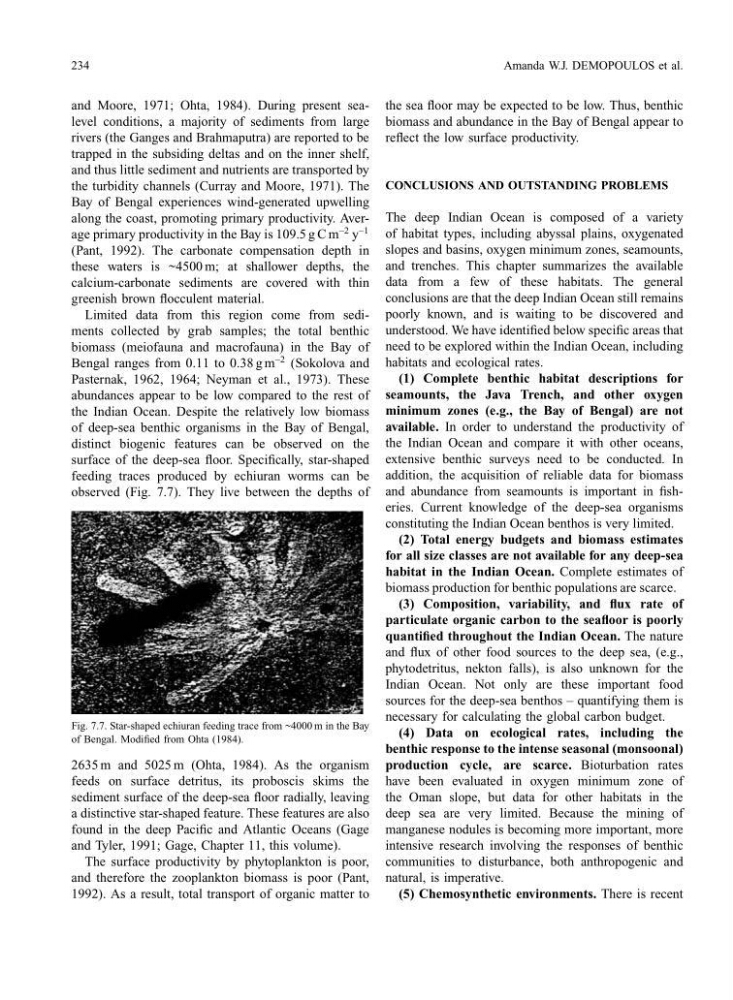
surface of the deep-sea floor. Specifically, star-shaped
feeding traces produced by echiuran worms can be
observed (Fig. 7.7). They live between the depths of
Fig. 7.7. Star-shaped echiuran feeding trace from ~4000 m in the Bay
of Bengal. Modified from Ohta (1984).
2635 m and 5025 m (Ohta, 1984). As the organism
feeds on surface detritus, its proboscis skims the
sediment surface of the deep-sea floor radially, leaving
a distinctive star-shaped feature. These features are also
found in the deep Pacific and Atlantic Oceans (Gage
and Tyler, 1991; Gage, Chapter 11, this volume).
The surface productivity by phytoplankton is poor,
and therefore the zooplankton biomass is poor (Pant,
1992). As a result, total transport of organic matter to
the sea floor may be expected to be low. Thus, benthic
biomass and abundance in the Bay of Bengal appear to
reflect the low surface productivity.
CONCLUSIONS AND OUTSTANDING PROBLEMS
The deep Indian Ocean is composed of a variety
of habitat types, including abyssal plains, oxygenated
slopes and basins, oxygen minimum zones, seamounts,
and trenches. This chapter summarizes the available
data from a few of these habitats. The general
conclusions are that the deep Indian Ocean still remains
poorly known, and is waiting to be discovered and
understood. We have identified below specific areas that
need to be explored within the Indian Ocean, including
habitats and ecological rates.
(1) Complete benthic habitat descriptions for
seamounts, the Java Trench, and other oxygen
minimum zones (e.g., the Bay of Bengal) are not
available. In order to understand the productivity of
the Indian Ocean and compare it with other oceans,
extensive benthic surveys need to be conducted. In
addition, the acquisition of reliable data for biomass
and abundance from seamounts is important in fisheries. Current knowledge of the deep-sea organisms
constituting the Indian Ocean benthos is very limited.
(2) Total energy budgets and biomass estimates
for all size classes are not available for any deep-sea
habitat in the Indian Ocean. Complete estimates of
biomass production for benthic populations are scarce.
(3) Composition, variability, and flux rate of
particulate organic carbon to the seafloor is poorly
quantified throughout the Indian Ocean. The nature
and flux of other food sources to the deep sea, (e.g.,
phytodetritus, nekton falls), is also unknown for the
Indian Ocean. Not only are these important food
sources for the deep-sea benthos – quantifying them is
necessary for calculating the global carbon budget.
(4) Data on ecological rates, including the
benthic response to the intense seasonal (monsoonal)
production cycle, are scarce. Bioturbation rates
have been evaluated in oxygen minimum zone of
the Oman slope, but data for other habitats in the
deep sea are very limited. Because the mining of
manganese nodules is becoming more important, more
intensive research involving the responses of benthic
communities to disturbance, both anthropogenic and
natural, is imperative.
(5) Chemosynthetic environments. There is recent
Amanda W.J. DEMOPOULOS et al.
and Moore, 1971; Ohta, 1984). During present sealevel conditions, a majority of sediments from large
rivers (the Ganges and Brahmaputra) are reported to be
trapped in the subsiding deltas and on the inner shelf,
and thus little sediment and nutrients are transported by
the turbidity channels (Curray and Moore, 1971). The
Bay of Bengal experiences wind-generated upwelling
along the coast, promoting primary productivity. Average primary productivity in the Bay is 109.5 g C m
−2 y
−1
(Pant, 1992). The carbonate compensation depth in
these waters is ~4500 m; at shallower depths, the
calcium-carbonate sediments are covered with thin
greenish brown flocculent material.
Limited data from this region come from sediments collected by grab samples; the total benthic
biomass (meiofauna and macrofauna) in the Bay of
Bengal ranges from 0.11 to 0.38 g m
−2 (Sokolova and
Pasternak, 1962, 1964; Neyman et al., 1973). These
abundances appear to be low compared to the rest of
the Indian Ocean. Despite the relatively low biomass
of deep-sea benthic organisms in the Bay of Bengal,
distinct biogenic features can be observed on the
surface of the deep-sea floor. Specifically, star-shaped
feeding traces produced by echiuran worms can be
observed (Fig. 7.7). They live between the depths of
Fig. 7.7. Star-shaped echiuran feeding trace from ~4000 m in the Bay
of Bengal. Modified from Ohta (1984).
2635 m and 5025 m (Ohta, 1984). As the organism
feeds on surface detritus, its proboscis skims the
sediment surface of the deep-sea floor radially, leaving
a distinctive star-shaped feature. These features are also
found in the deep Pacific and Atlantic Oceans (Gage
and Tyler, 1991; Gage, Chapter 11, this volume).
The surface productivity by phytoplankton is poor,
and therefore the zooplankton biomass is poor (Pant,
1992). As a result, total transport of organic matter to
the sea floor may be expected to be low. Thus, benthic
biomass and abundance in the Bay of Bengal appear to
reflect the low surface productivity.
CONCLUSIONS AND OUTSTANDING PROBLEMS
The deep Indian Ocean is composed of a variety
of habitat types, including abyssal plains, oxygenated
slopes and basins, oxygen minimum zones, seamounts,
and trenches. This chapter summarizes the available
data from a few of these habitats. The general
conclusions are that the deep Indian Ocean still remains
poorly known, and is waiting to be discovered and
understood. We have identified below specific areas that
need to be explored within the Indian Ocean, including
habitats and ecological rates.
(1) Complete benthic habitat descriptions for
seamounts, the Java Trench, and other oxygen
minimum zones (e.g., the Bay of Bengal) are not
available. In order to understand the productivity of
the Indian Ocean and compare it with other oceans,
extensive benthic surveys need to be conducted. In
addition, the acquisition of reliable data for biomass
and abundance from seamounts is important in fisheries. Current knowledge of the deep-sea organisms
constituting the Indian Ocean benthos is very limited.
(2) Total energy budgets and biomass estimates
for all size classes are not available for any deep-sea
habitat in the Indian Ocean. Complete estimates of
biomass production for benthic populations are scarce.
(3) Composition, variability, and flux rate of
particulate organic carbon to the seafloor is poorly
quantified throughout the Indian Ocean. The nature
and flux of other food sources to the deep sea, (e.g.,
phytodetritus, nekton falls), is also unknown for the
Indian Ocean. Not only are these important food
sources for the deep-sea benthos – quantifying them is
necessary for calculating the global carbon budget.
(4) Data on ecological rates, including the
benthic response to the intense seasonal (monsoonal)
production cycle, are scarce. Bioturbation rates
have been evaluated in oxygen minimum zone of
the Oman slope, but data for other habitats in the
deep sea are very limited. Because the mining of
manganese nodules is becoming more important, more
intensive research involving the responses of benthic
communities to disturbance, both anthropogenic and
natural, is imperative.
(5) Chemosynthetic environments. There is recent