

222
Amanda W.J. DEMOPOULOS et al.
E
30°
60°
90°
120° E
90°
60°
30°
S
0°
30°
30°
N
S
0°
N
E
30°
60°
90°
120° E
North Equatorial Current
Equatorial Counter Current
South Equatorial Current
Subtropical Gyre
South Indian Ocean Current
A g u lh a s C .
M o z a m b iq u e C u r r e n t
SC
ZC
SJC
WGB
Circumpolar
Current
STF
SAF
PF
L e e u w in C .
E a s t I n d i a n
C
.
EMC
E A C
S o m a l i C .
M o z a m b iq u e C .
ZC
Southwest Monsoon
Current
South Equatorial Current
S J C
A.
B.
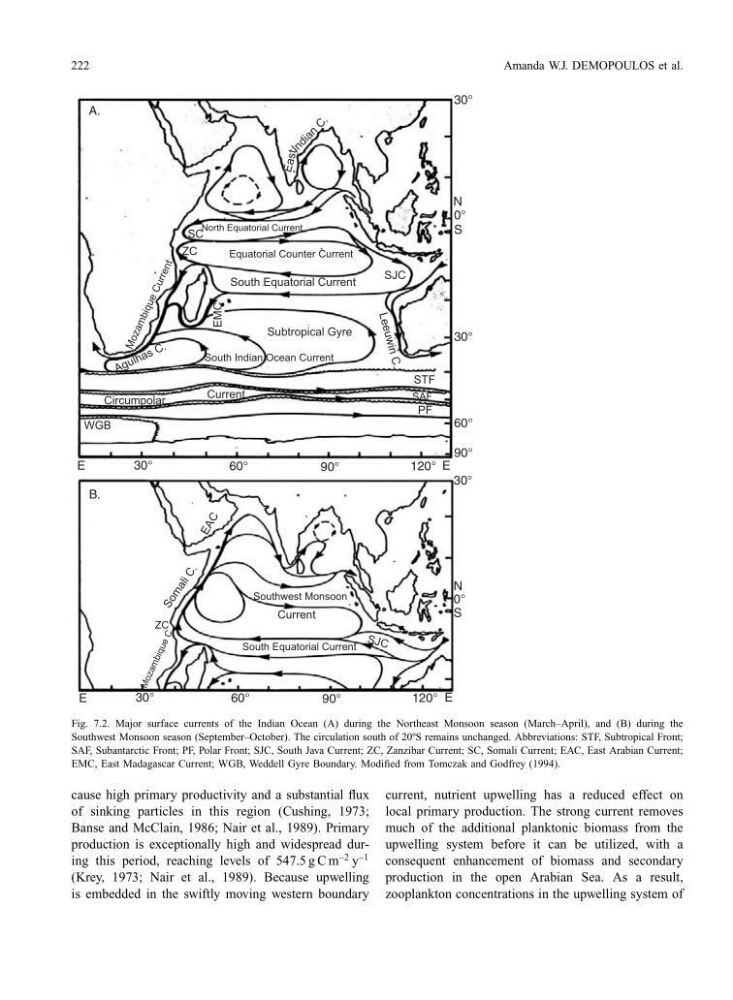
Fig. 7.2. Major surface currents of the Indian Ocean (A) during the Northeast Monsoon season (March–April), and (B) during the
Southwest Monsoon season (September–October). The circulation south of 20ºS remains unchanged. Abbreviations: STF, Subtropical Front;
SAF, Subantarctic Front; PF, Polar Front; SJC, South Java Current; ZC, Zanzibar Current; SC, Somali Current; EAC, East Arabian Current;
EMC, East Madagascar Current; WGB, Weddell Gyre Boundary. Modified from Tomczak and Godfrey (1994).
cause high primary productivity and a substantial flux
of sinking particles in this region (Cushing, 1973;
Banse and McClain, 1986; Nair et al., 1989). Primary
production is exceptionally high and widespread during this period, reaching levels of 547.5 g C m
−2 y
−1
(Krey, 1973; Nair et al., 1989). Because upwelling
is embedded in the swiftly moving western boundary
current, nutrient upwelling has a reduced effect on
local primary production. The strong current removes
much of the additional planktonic biomass from the
upwelling system before it can be utilized, with a
consequent enhancement of biomass and secondary
production in the open Arabian Sea. As a result,
zooplankton concentrations in the upwelling system of
Amanda W.J. DEMOPOULOS et al.
E
30°
60°
90°
120° E
90°
60°
30°
S
0°
30°
30°
N
S
0°
N
E
30°
60°
90°
120° E
North Equatorial Current
Equatorial Counter Current
South Equatorial Current
Subtropical Gyre
South Indian Ocean Current
A g u lh a s C .
M o z a m b iq u e C u r r e n t
SC
ZC
SJC
WGB
Circumpolar
Current
STF
SAF
PF
L e e u w in C .
E a s t I n d i a n
C
.
EMC
E A C
S o m a l i C .
M o z a m b iq u e C .
ZC
Southwest Monsoon
Current
South Equatorial Current
S J C
A.
B.
Fig. 7.2. Major surface currents of the Indian Ocean (A) during the Northeast Monsoon season (March–April), and (B) during the
Southwest Monsoon season (September–October). The circulation south of 20ºS remains unchanged. Abbreviations: STF, Subtropical Front;
SAF, Subantarctic Front; PF, Polar Front; SJC, South Java Current; ZC, Zanzibar Current; SC, Somali Current; EAC, East Arabian Current;
EMC, East Madagascar Current; WGB, Weddell Gyre Boundary. Modified from Tomczak and Godfrey (1994).
cause high primary productivity and a substantial flux
of sinking particles in this region (Cushing, 1973;
Banse and McClain, 1986; Nair et al., 1989). Primary
production is exceptionally high and widespread during this period, reaching levels of 547.5 g C m
−2 y
−1
(Krey, 1973; Nair et al., 1989). Because upwelling
is embedded in the swiftly moving western boundary
current, nutrient upwelling has a reduced effect on
local primary production. The strong current removes
much of the additional planktonic biomass from the
upwelling system before it can be utilized, with a
consequent enhancement of biomass and secondary
production in the open Arabian Sea. As a result,
zooplankton concentrations in the upwelling system of