

12
David THISTLE
see Koslow et al., 1995), they have been crucial in estimating the abundance and biomass of such organisms
and in discerning their distribution patterns (Hecker,
1994). For surveys, vertically oriented cameras have
been suspended above the seabed from a ship’s trawl
wire to photograph the seabed as the ship moves (Rowe
and Menzies, 1969; Huggett, 1987). Cameras have
also been mounted obliquely on towed sleds (Thiel,
1970; Rice et al., 1982; Hecker, 1990) and on research
submarines (Grassle et al., 1975).
Cameras have also been important in documenting
the behavior of deep-sea megafauna, and in the discovery of rates of some deep-sea processes. For these
purposes, cameras are mounted in frames (vertically
or obliquely) and left for times ranging from hours to
months, taking photographs at preset intervals (Paul
et al., 1978). At the appropriate time, ballast weights
are released, and the buoyant instrument package
rises to the surface for recovery. This “free-vehicle”
approach (Rowe and Sibuet, 1983) has been used,
for example, to document the date of appearance of
phytodetritus on the seafloor (Lampitt, 1985), the rates
of mound-building by an echiurid (Smith et al., 1986),
and megafaunal activity rates (Smith et al., 1993).
Stationary cameras with bait placed in the field of view
have been crucial to the discovery and study of foodparcel-attending species in the deep sea (Hessler et al.,
1972).
Cameras cannot provide information about smaller
epibenthic organisms or organisms of any size that
are inconspicuous or evasive or that live below the
sediment-water interface and make no conspicuous
indications of their presence on the sediment surface.
Further, cameras return no specimens, so they are not
useful for work that requires biological material such as
physiological or taxonomic studies (but see Lauerman
et al., 1996).
Trawls, sledges, and sleds
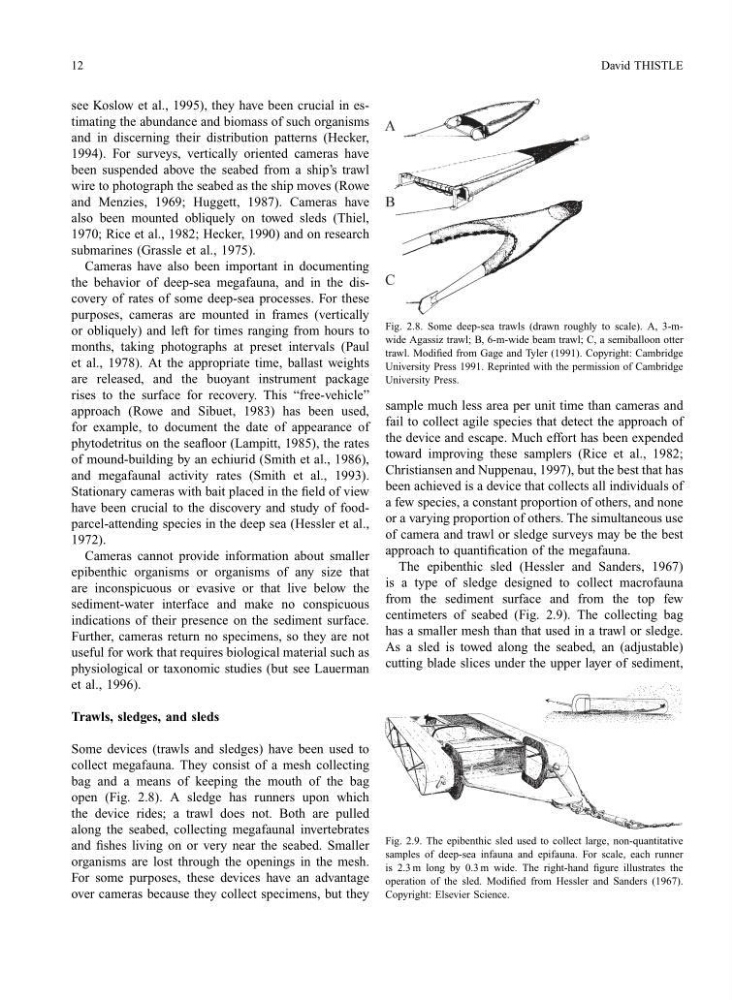
Some devices (trawls and sledges) have been used to
collect megafauna. They consist of a mesh collecting
bag and a means of keeping the mouth of the bag
open (Fig. 2.8). A sledge has runners upon which
the device rides; a trawl does not. Both are pulled
along the seabed, collecting megafaunal invertebrates
and fishes living on or very near the seabed. Smaller
organisms are lost through the openings in the mesh.
For some purposes, these devices have an advantage
over cameras because they collect specimens, but they
Fig. 2.8. Some deep-sea trawls (drawn roughly to scale). A, 3-mwide Agassiz trawl; B, 6-m-wide beam trawl; C, a semiballoon otter
trawl. Modified from Gage and Tyler (1991). Copyright: Cambridge
University Press 1991. Reprinted with the permission of Cambridge
University Press.
sample much less area per unit time than cameras and
fail to collect agile species that detect the approach of
the device and escape. Much effort has been expended
toward improving these samplers (Rice et al., 1982;
Christiansen and Nuppenau, 1997), but the best that has
been achieved is a device that collects all individuals of
a few species, a constant proportion of others, and none
or a varying proportion of others. The simultaneous use
of camera and trawl or sledge surveys may be the best
approach to quantification of the megafauna.
The epibenthic sled (Hessler and Sanders, 1967)
is a type of sledge designed to collect macrofauna
from the sediment surface and from the top few
centimeters of seabed (Fig. 2.9). The collecting bag
has a smaller mesh than that used in a trawl or sledge.
As a sled is towed along the seabed, an (adjustable)
cutting blade slices under the upper layer of sediment,
Fig. 2.9. The epibenthic sled used to collect large, non-quantitative
samples of deep-sea infauna and epifauna. For scale, each runner
is 2.3 m long by 0.3 m wide. The right-hand figure illustrates the
operation of the sled. Modified from Hessler and Sanders (1967).
Copyright: Elsevier Science.
David THISTLE
see Koslow et al., 1995), they have been crucial in estimating the abundance and biomass of such organisms
and in discerning their distribution patterns (Hecker,
1994). For surveys, vertically oriented cameras have
been suspended above the seabed from a ship’s trawl
wire to photograph the seabed as the ship moves (Rowe
and Menzies, 1969; Huggett, 1987). Cameras have
also been mounted obliquely on towed sleds (Thiel,
1970; Rice et al., 1982; Hecker, 1990) and on research
submarines (Grassle et al., 1975).
Cameras have also been important in documenting
the behavior of deep-sea megafauna, and in the discovery of rates of some deep-sea processes. For these
purposes, cameras are mounted in frames (vertically
or obliquely) and left for times ranging from hours to
months, taking photographs at preset intervals (Paul
et al., 1978). At the appropriate time, ballast weights
are released, and the buoyant instrument package
rises to the surface for recovery. This “free-vehicle”
approach (Rowe and Sibuet, 1983) has been used,
for example, to document the date of appearance of
phytodetritus on the seafloor (Lampitt, 1985), the rates
of mound-building by an echiurid (Smith et al., 1986),
and megafaunal activity rates (Smith et al., 1993).
Stationary cameras with bait placed in the field of view
have been crucial to the discovery and study of foodparcel-attending species in the deep sea (Hessler et al.,
1972).
Cameras cannot provide information about smaller
epibenthic organisms or organisms of any size that
are inconspicuous or evasive or that live below the
sediment-water interface and make no conspicuous
indications of their presence on the sediment surface.
Further, cameras return no specimens, so they are not
useful for work that requires biological material such as
physiological or taxonomic studies (but see Lauerman
et al., 1996).
Trawls, sledges, and sleds
Some devices (trawls and sledges) have been used to
collect megafauna. They consist of a mesh collecting
bag and a means of keeping the mouth of the bag
open (Fig. 2.8). A sledge has runners upon which
the device rides; a trawl does not. Both are pulled
along the seabed, collecting megafaunal invertebrates
and fishes living on or very near the seabed. Smaller
organisms are lost through the openings in the mesh.
For some purposes, these devices have an advantage
over cameras because they collect specimens, but they
Fig. 2.8. Some deep-sea trawls (drawn roughly to scale). A, 3-mwide Agassiz trawl; B, 6-m-wide beam trawl; C, a semiballoon otter
trawl. Modified from Gage and Tyler (1991). Copyright: Cambridge
University Press 1991. Reprinted with the permission of Cambridge
University Press.
sample much less area per unit time than cameras and
fail to collect agile species that detect the approach of
the device and escape. Much effort has been expended
toward improving these samplers (Rice et al., 1982;
Christiansen and Nuppenau, 1997), but the best that has
been achieved is a device that collects all individuals of
a few species, a constant proportion of others, and none
or a varying proportion of others. The simultaneous use
of camera and trawl or sledge surveys may be the best
approach to quantification of the megafauna.
The epibenthic sled (Hessler and Sanders, 1967)
is a type of sledge designed to collect macrofauna
from the sediment surface and from the top few
centimeters of seabed (Fig. 2.9). The collecting bag
has a smaller mesh than that used in a trawl or sledge.
As a sled is towed along the seabed, an (adjustable)
cutting blade slices under the upper layer of sediment,
Fig. 2.9. The epibenthic sled used to collect large, non-quantitative
samples of deep-sea infauna and epifauna. For scale, each runner
is 2.3 m long by 0.3 m wide. The right-hand figure illustrates the
operation of the sled. Modified from Hessler and Sanders (1967).
Copyright: Elsevier Science.