

THE DEEP-SEA FLOOR: AN OVERVIEW
11
retreated because of variation in the Earth’s axis of
rotation. These temperature changes are correlated with
changes in ostracod diversity (Cronin and Raymo,
1997). In the last 60 000 years, global warming
and cooling cycles on a 1000-yr time scale are
correlated with changes in foraminifer assemblages
in the deep sea off California (Behl and Kennett,
1996).
Summarizing, in much of the deep sea the variability
in temperature, salinity, and oxygen over ecological
time at a location is not important, and current
velocities are nonerosive. In this sense, the deep-seafloor environment is physically stable (Sanders, 1968).
Even in regions with these physical characteristics,
the sediment is heterogeneous at the millimeter-tometer scale because of the modifications made by the
organisms, small-scale disturbances, and manganese
nodules. In contrast to these physically quiescent
areas, some deep-sea locations experience erosive
currents (Hollister and Nowell, 1991; Levin et al.,
1994).
OBTAINING INFORMATION ABOUT THE
DEEP-SEA-FLOOR ECOSYSTEM
By definition, 200 m or more of seawater separates
deep-sea ecologists from the environment that they
study. They, therefore, depend totally on technology
to obtain information. Any shortcomings of their
sampling devices must be understood, because defects
can distort perceptions of the deep-sea-floor ecosystem.
For example, the deep-sea floor was thought to be a
species-poor environment until Hessler and Sanders
(1967) showed that this erroneous view resulted from
the inadequacies of older samplers.
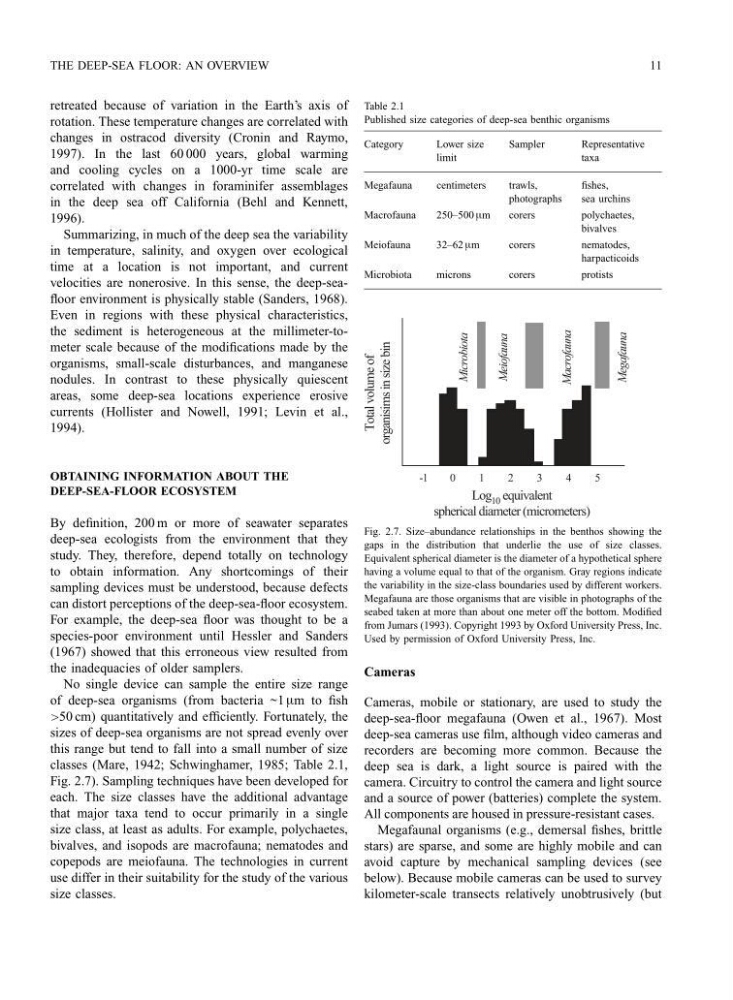
No single device can sample the entire size range
of deep-sea organisms (from bacteria ~1 mm to fish
>50 cm) quantitatively and efficiently. Fortunately, the
sizes of deep-sea organisms are not spread evenly over
this range but tend to fall into a small number of size
classes (Mare, 1942; Schwinghamer, 1985; Table 2.1,
Fig. 2.7). Sampling techniques have been developed for
each. The size classes have the additional advantage
that major taxa tend to occur primarily in a single
size class, at least as adults. For example, polychaetes,
bivalves, and isopods are macrofauna; nematodes and
copepods are meiofauna. The technologies in current
use differ in their suitability for the study of the various
size classes.
Table 2.1
Published size categories of deep-sea benthic organisms
Category
Lower size
limit
Sampler
Representative
taxa
Megafauna
centimeters
trawls,
photographs
fishes,
sea urchins
Macrofauna
250–500 mm
corers
polychaetes,
bivalves
Meiofauna
32–62 mm
corers
nematodes,
harpacticoids
Microbiota
microns
corers
protists
Fig. 2.7. Size–abundance relationships in the benthos showing the
gaps in the distribution that underlie the use of size classes.
Equivalent spherical diameter is the diameter of a hypothetical sphere
having a volume equal to that of the organism. Gray regions indicate
the variability in the size-class boundaries used by different workers.
Megafauna are those organisms that are visible in photographs of the
seabed taken at more than about one meter off the bottom. Modified
from Jumars (1993). Copyright 1993 by Oxford University Press, Inc.
Used by permission of Oxford University Press, Inc.
Cameras
Cameras, mobile or stationary, are used to study the
deep-sea-floor megafauna (Owen et al., 1967). Most
deep-sea cameras use film, although video cameras and
recorders are becoming more common. Because the
deep sea is dark, a light source is paired with the
camera. Circuitry to control the camera and light source
and a source of power (batteries) complete the system.
All components are housed in pressure-resistant cases.
Megafaunal organisms (e.g., demersal fishes, brittle
stars) are sparse, and some are highly mobile and can
avoid capture by mechanical sampling devices (see
below). Because mobile cameras can be used to survey
kilometer-scale transects relatively unobtrusively (but
11
retreated because of variation in the Earth’s axis of
rotation. These temperature changes are correlated with
changes in ostracod diversity (Cronin and Raymo,
1997). In the last 60 000 years, global warming
and cooling cycles on a 1000-yr time scale are
correlated with changes in foraminifer assemblages
in the deep sea off California (Behl and Kennett,
1996).
Summarizing, in much of the deep sea the variability
in temperature, salinity, and oxygen over ecological
time at a location is not important, and current
velocities are nonerosive. In this sense, the deep-seafloor environment is physically stable (Sanders, 1968).
Even in regions with these physical characteristics,
the sediment is heterogeneous at the millimeter-tometer scale because of the modifications made by the
organisms, small-scale disturbances, and manganese
nodules. In contrast to these physically quiescent
areas, some deep-sea locations experience erosive
currents (Hollister and Nowell, 1991; Levin et al.,
1994).
OBTAINING INFORMATION ABOUT THE
DEEP-SEA-FLOOR ECOSYSTEM
By definition, 200 m or more of seawater separates
deep-sea ecologists from the environment that they
study. They, therefore, depend totally on technology
to obtain information. Any shortcomings of their
sampling devices must be understood, because defects
can distort perceptions of the deep-sea-floor ecosystem.
For example, the deep-sea floor was thought to be a
species-poor environment until Hessler and Sanders
(1967) showed that this erroneous view resulted from
the inadequacies of older samplers.
No single device can sample the entire size range
of deep-sea organisms (from bacteria ~1 mm to fish
>50 cm) quantitatively and efficiently. Fortunately, the
sizes of deep-sea organisms are not spread evenly over
this range but tend to fall into a small number of size
classes (Mare, 1942; Schwinghamer, 1985; Table 2.1,
Fig. 2.7). Sampling techniques have been developed for
each. The size classes have the additional advantage
that major taxa tend to occur primarily in a single
size class, at least as adults. For example, polychaetes,
bivalves, and isopods are macrofauna; nematodes and
copepods are meiofauna. The technologies in current
use differ in their suitability for the study of the various
size classes.
Table 2.1
Published size categories of deep-sea benthic organisms
Category
Lower size
limit
Sampler
Representative
taxa
Megafauna
centimeters
trawls,
photographs
fishes,
sea urchins
Macrofauna
250–500 mm
corers
polychaetes,
bivalves
Meiofauna
32–62 mm
corers
nematodes,
harpacticoids
Microbiota
microns
corers
protists
Fig. 2.7. Size–abundance relationships in the benthos showing the
gaps in the distribution that underlie the use of size classes.
Equivalent spherical diameter is the diameter of a hypothetical sphere
having a volume equal to that of the organism. Gray regions indicate
the variability in the size-class boundaries used by different workers.
Megafauna are those organisms that are visible in photographs of the
seabed taken at more than about one meter off the bottom. Modified
from Jumars (1993). Copyright 1993 by Oxford University Press, Inc.
Used by permission of Oxford University Press, Inc.
Cameras
Cameras, mobile or stationary, are used to study the
deep-sea-floor megafauna (Owen et al., 1967). Most
deep-sea cameras use film, although video cameras and
recorders are becoming more common. Because the
deep sea is dark, a light source is paired with the
camera. Circuitry to control the camera and light source
and a source of power (batteries) complete the system.
All components are housed in pressure-resistant cases.
Megafaunal organisms (e.g., demersal fishes, brittle
stars) are sparse, and some are highly mobile and can
avoid capture by mechanical sampling devices (see
below). Because mobile cameras can be used to survey
kilometer-scale transects relatively unobtrusively (but