

200
Craig R. SMITH and Amanda W.J. DEMOPOULOS
production is enhanced to 15º north and south of the
equator between 90 and 100ºW longitude. Further westward along the equator, nutrient upwelling gradually
tapers off, yielding a narrowing tongue of productivity
roughly centered on the equator. At 140ºW longitude,
the equatorial “tongue” is less than 20º degrees wide
and, by 160ºE longitude, the productivity tongue has
disappeared (e.g., Berger, 1989).
High productivity near the equator yields an enhanced flux of particulate organic carbon to the ocean’s
interior (Honjo et al., 1995). Most of the equatorial
zone varies little in water depth (i.e., from 4000 to
5000 m) and is far removed from lateral inputs from
the ocean’s margin (Fig. 6.1); thus, spatial variations
in flux of particulate organic carbon to the seafloor are
primarily controlled by patterns of overlying productivity. Within the equatorial zone, flux of particulate
organic carbon declines gradually from east to west
along any line of latitude (roughly halving from 120ºW
to 180ºW; Jahnke, 1996) and steeply with distance
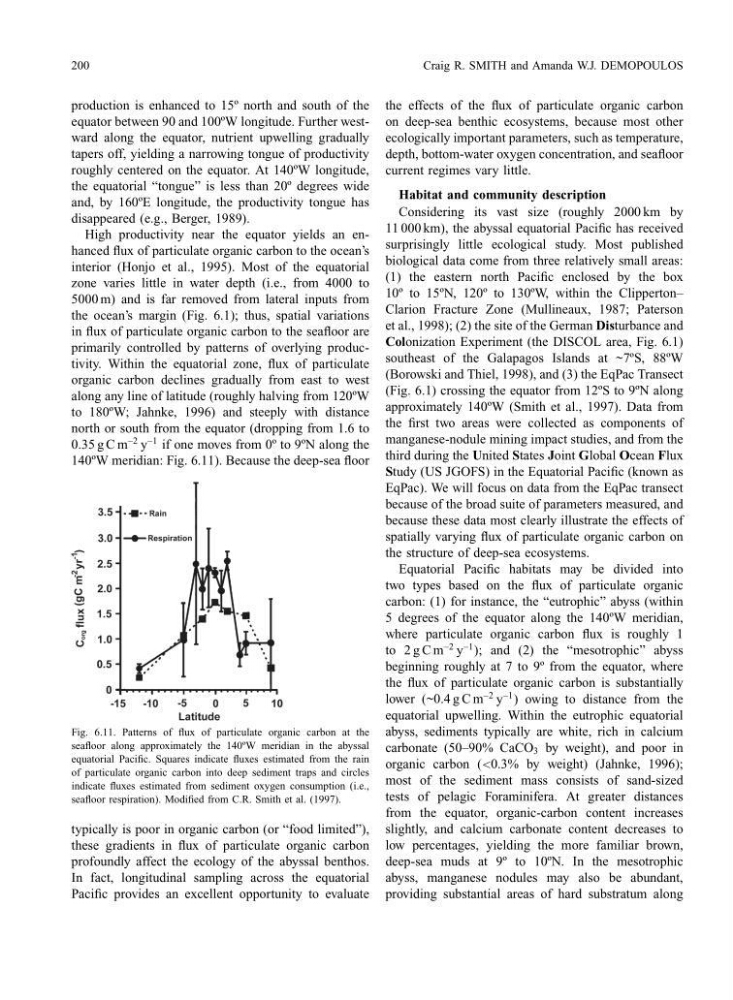
north or south from the equator (dropping from 1.6 to
0.35 g C m
−2 y
−1 if one moves from 0º to 9ºN along the
140ºW meridian: Fig. 6.11). Because the deep-sea floor
Fig. 6.11. Patterns of flux of particulate organic carbon at the
seafloor along approximately the 140ºW meridian in the abyssal
equatorial Pacific. Squares indicate fluxes estimated from the rain
of particulate organic carbon into deep sediment traps and circles
indicate fluxes estimated from sediment oxygen consumption (i.e.,
seafloor respiration). Modified from C.R. Smith et al. (1997).
typically is poor in organic carbon (or “food limited”),
these gradients in flux of particulate organic carbon
profoundly affect the ecology of the abyssal benthos.
In fact, longitudinal sampling across the equatorial
Pacific provides an excellent opportunity to evaluate
the effects of the flux of particulate organic carbon
on deep-sea benthic ecosystems, because most other
ecologically important parameters, such as temperature,
depth, bottom-water oxygen concentration, and seafloor
current regimes vary little.
Habitat and community description
Considering its vast size (roughly 2000 km by
11 000 km), the abyssal equatorial Pacific has received
surprisingly little ecological study. Most published
biological data come from three relatively small areas:
(1) the eastern north Pacific enclosed by the box
10º to 15ºN, 120º to 130ºW, within the Clipperton–
Clarion Fracture Zone (Mullineaux, 1987; Paterson
et al., 1998); (2) the site of the German Disturbance and
Colonization Experiment (the DISCOL area, Fig. 6.1)
southeast of the Galapagos Islands at ~7ºS, 88ºW
(Borowski and Thiel, 1998), and (3) the EqPac Transect
(Fig. 6.1) crossing the equator from 12ºS to 9ºN along
approximately 140ºW (Smith et al., 1997). Data from
the first two areas were collected as components of
manganese-nodule mining impact studies, and from the
third during the United States Joint Global Ocean Flux
Study (US JGOFS) in the Equatorial Pacific (known as
EqPac). We will focus on data from the EqPac transect
because of the broad suite of parameters measured, and
because these data most clearly illustrate the effects of
spatially varying flux of particulate organic carbon on
the structure of deep-sea ecosystems.
Equatorial Pacific habitats may be divided into
two types based on the flux of particulate organic
carbon: (1) for instance, the “eutrophic” abyss (within
5 degrees of the equator along the 140ºW meridian,
where particulate organic carbon flux is roughly 1
to 2 g C m
−2 y
−1 ); and (2) the “mesotrophic” abyss
beginning roughly at 7 to 9º from the equator, where
the flux of particulate organic carbon is substantially
lower (~0.4 g C m
−2 y
−1 ) owing to distance from the
equatorial upwelling. Within the eutrophic equatorial
abyss, sediments typically are white, rich in calcium
carbonate (50–90% CaCO 3 by weight), and poor in
organic carbon (<0.3% by weight) (Jahnke, 1996);
most of the sediment mass consists of sand-sized
tests of pelagic Foraminifera. At greater distances
from the equator, organic-carbon content increases
slightly, and calcium carbonate content decreases to
low percentages, yielding the more familiar brown,
deep-sea muds at 9º to 10ºN. In the mesotrophic
abyss, manganese nodules may also be abundant,
providing substantial areas of hard substratum along
Craig R. SMITH and Amanda W.J. DEMOPOULOS
production is enhanced to 15º north and south of the
equator between 90 and 100ºW longitude. Further westward along the equator, nutrient upwelling gradually
tapers off, yielding a narrowing tongue of productivity
roughly centered on the equator. At 140ºW longitude,
the equatorial “tongue” is less than 20º degrees wide
and, by 160ºE longitude, the productivity tongue has
disappeared (e.g., Berger, 1989).
High productivity near the equator yields an enhanced flux of particulate organic carbon to the ocean’s
interior (Honjo et al., 1995). Most of the equatorial
zone varies little in water depth (i.e., from 4000 to
5000 m) and is far removed from lateral inputs from
the ocean’s margin (Fig. 6.1); thus, spatial variations
in flux of particulate organic carbon to the seafloor are
primarily controlled by patterns of overlying productivity. Within the equatorial zone, flux of particulate
organic carbon declines gradually from east to west
along any line of latitude (roughly halving from 120ºW
to 180ºW; Jahnke, 1996) and steeply with distance
north or south from the equator (dropping from 1.6 to
0.35 g C m
−2 y
−1 if one moves from 0º to 9ºN along the
140ºW meridian: Fig. 6.11). Because the deep-sea floor
Fig. 6.11. Patterns of flux of particulate organic carbon at the
seafloor along approximately the 140ºW meridian in the abyssal
equatorial Pacific. Squares indicate fluxes estimated from the rain
of particulate organic carbon into deep sediment traps and circles
indicate fluxes estimated from sediment oxygen consumption (i.e.,
seafloor respiration). Modified from C.R. Smith et al. (1997).
typically is poor in organic carbon (or “food limited”),
these gradients in flux of particulate organic carbon
profoundly affect the ecology of the abyssal benthos.
In fact, longitudinal sampling across the equatorial
Pacific provides an excellent opportunity to evaluate
the effects of the flux of particulate organic carbon
on deep-sea benthic ecosystems, because most other
ecologically important parameters, such as temperature,
depth, bottom-water oxygen concentration, and seafloor
current regimes vary little.
Habitat and community description
Considering its vast size (roughly 2000 km by
11 000 km), the abyssal equatorial Pacific has received
surprisingly little ecological study. Most published
biological data come from three relatively small areas:
(1) the eastern north Pacific enclosed by the box
10º to 15ºN, 120º to 130ºW, within the Clipperton–
Clarion Fracture Zone (Mullineaux, 1987; Paterson
et al., 1998); (2) the site of the German Disturbance and
Colonization Experiment (the DISCOL area, Fig. 6.1)
southeast of the Galapagos Islands at ~7ºS, 88ºW
(Borowski and Thiel, 1998), and (3) the EqPac Transect
(Fig. 6.1) crossing the equator from 12ºS to 9ºN along
approximately 140ºW (Smith et al., 1997). Data from
the first two areas were collected as components of
manganese-nodule mining impact studies, and from the
third during the United States Joint Global Ocean Flux
Study (US JGOFS) in the Equatorial Pacific (known as
EqPac). We will focus on data from the EqPac transect
because of the broad suite of parameters measured, and
because these data most clearly illustrate the effects of
spatially varying flux of particulate organic carbon on
the structure of deep-sea ecosystems.
Equatorial Pacific habitats may be divided into
two types based on the flux of particulate organic
carbon: (1) for instance, the “eutrophic” abyss (within
5 degrees of the equator along the 140ºW meridian,
where particulate organic carbon flux is roughly 1
to 2 g C m
−2 y
−1 ); and (2) the “mesotrophic” abyss
beginning roughly at 7 to 9º from the equator, where
the flux of particulate organic carbon is substantially
lower (~0.4 g C m
−2 y
−1 ) owing to distance from the
equatorial upwelling. Within the eutrophic equatorial
abyss, sediments typically are white, rich in calcium
carbonate (50–90% CaCO 3 by weight), and poor in
organic carbon (<0.3% by weight) (Jahnke, 1996);
most of the sediment mass consists of sand-sized
tests of pelagic Foraminifera. At greater distances
from the equator, organic-carbon content increases
slightly, and calcium carbonate content decreases to
low percentages, yielding the more familiar brown,
deep-sea muds at 9º to 10ºN. In the mesotrophic
abyss, manganese nodules may also be abundant,
providing substantial areas of hard substratum along