

192
Craig R. SMITH and Amanda W.J. DEMOPOULOS
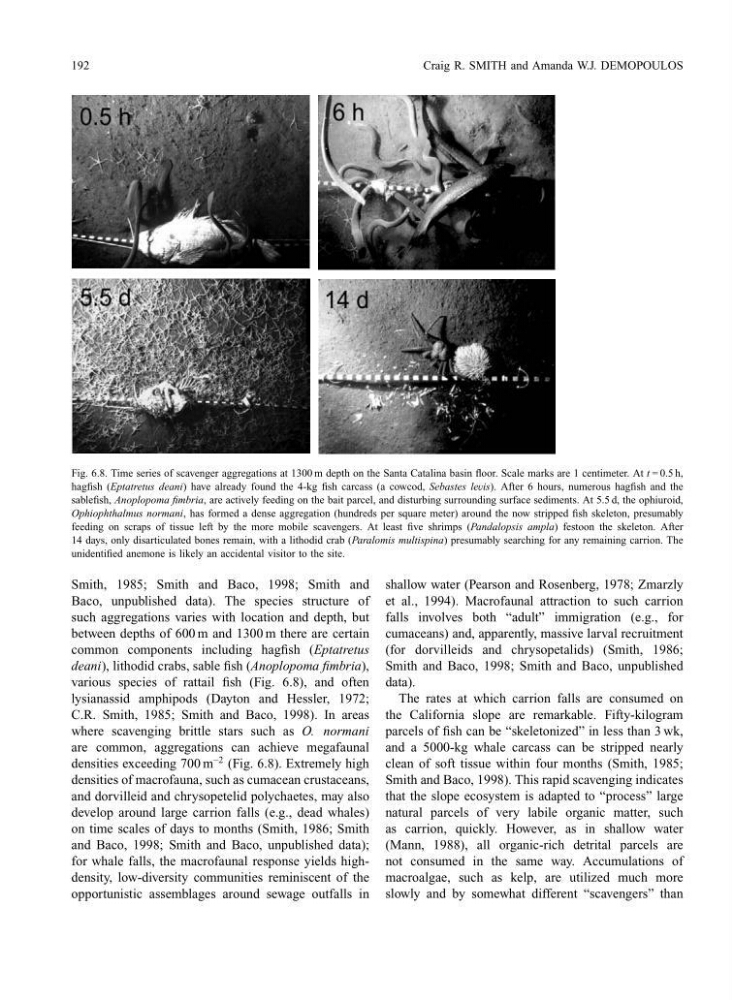
Fig. 6.8. Time series of scavenger aggregations at 1300 m depth on the Santa Catalina basin floor. Scale marks are 1 centimeter. At t = 0.5 h,
hagfish (Eptatretus deani) have already found the 4-kg fish carcass (a cowcod, Sebastes levis). After 6 hours, numerous hagfish and the
sablefish, Anoplopoma fimbria, are actively feeding on the bait parcel, and disturbing surrounding surface sediments. At 5.5 d, the ophiuroid,
Ophiophthalmus normani, has formed a dense aggregation (hundreds per square meter) around the now stripped fish skeleton, presumably
feeding on scraps of tissue left by the more mobile scavengers. At least five shrimps (Pandalopsis ampla) festoon the skeleton. After
14 days, only disarticulated bones remain, with a lithodid crab (Paralomis multispina) presumably searching for any remaining carrion. The
unidentified anemone is likely an accidental visitor to the site.
Smith, 1985; Smith and Baco, 1998; Smith and
Baco, unpublished data). The species structure of
such aggregations varies with location and depth, but
between depths of 600 m and 1300 m there are certain
common components including hagfish (Eptatretus
deani), lithodid crabs, sable fish (Anoplopoma fimbria),
various species of rattail fish (Fig. 6.8), and often
lysianassid amphipods (Dayton and Hessler, 1972;
C.R. Smith, 1985; Smith and Baco, 1998). In areas
where scavenging brittle stars such as O. normani
are common, aggregations can achieve megafaunal
densities exceeding 700 m
−2 (Fig. 6.8). Extremely high
densities of macrofauna, such as cumacean crustaceans,
and dorvilleid and chrysopetelid polychaetes, may also
develop around large carrion falls (e.g., dead whales)
on time scales of days to months (Smith, 1986; Smith
and Baco, 1998; Smith and Baco, unpublished data);
for whale falls, the macrofaunal response yields highdensity, low-diversity communities reminiscent of the
opportunistic assemblages around sewage outfalls in
shallow water (Pearson and Rosenberg, 1978; Zmarzly
et al., 1994). Macrofaunal attraction to such carrion
falls involves both “adult” immigration (e.g., for
cumaceans) and, apparently, massive larval recruitment
(for dorvilleids and chrysopetalids) (Smith, 1986;
Smith and Baco, 1998; Smith and Baco, unpublished
data).
The rates at which carrion falls are consumed on
the California slope are remarkable. Fifty-kilogram
parcels of fish can be “skeletonized” in less than 3 wk,
and a 5000-kg whale carcass can be stripped nearly
clean of soft tissue within four months (Smith, 1985;
Smith and Baco, 1998). This rapid scavenging indicates
that the slope ecosystem is adapted to “process” large
natural parcels of very labile organic matter, such
as carrion, quickly. However, as in shallow water
(Mann, 1988), all organic-rich detrital parcels are
not consumed in the same way. Accumulations of
macroalgae, such as kelp, are utilized much more
slowly and by somewhat different “scavengers” than
Craig R. SMITH and Amanda W.J. DEMOPOULOS
Fig. 6.8. Time series of scavenger aggregations at 1300 m depth on the Santa Catalina basin floor. Scale marks are 1 centimeter. At t = 0.5 h,
hagfish (Eptatretus deani) have already found the 4-kg fish carcass (a cowcod, Sebastes levis). After 6 hours, numerous hagfish and the
sablefish, Anoplopoma fimbria, are actively feeding on the bait parcel, and disturbing surrounding surface sediments. At 5.5 d, the ophiuroid,
Ophiophthalmus normani, has formed a dense aggregation (hundreds per square meter) around the now stripped fish skeleton, presumably
feeding on scraps of tissue left by the more mobile scavengers. At least five shrimps (Pandalopsis ampla) festoon the skeleton. After
14 days, only disarticulated bones remain, with a lithodid crab (Paralomis multispina) presumably searching for any remaining carrion. The
unidentified anemone is likely an accidental visitor to the site.
Smith, 1985; Smith and Baco, 1998; Smith and
Baco, unpublished data). The species structure of
such aggregations varies with location and depth, but
between depths of 600 m and 1300 m there are certain
common components including hagfish (Eptatretus
deani), lithodid crabs, sable fish (Anoplopoma fimbria),
various species of rattail fish (Fig. 6.8), and often
lysianassid amphipods (Dayton and Hessler, 1972;
C.R. Smith, 1985; Smith and Baco, 1998). In areas
where scavenging brittle stars such as O. normani
are common, aggregations can achieve megafaunal
densities exceeding 700 m
−2 (Fig. 6.8). Extremely high
densities of macrofauna, such as cumacean crustaceans,
and dorvilleid and chrysopetelid polychaetes, may also
develop around large carrion falls (e.g., dead whales)
on time scales of days to months (Smith, 1986; Smith
and Baco, 1998; Smith and Baco, unpublished data);
for whale falls, the macrofaunal response yields highdensity, low-diversity communities reminiscent of the
opportunistic assemblages around sewage outfalls in
shallow water (Pearson and Rosenberg, 1978; Zmarzly
et al., 1994). Macrofaunal attraction to such carrion
falls involves both “adult” immigration (e.g., for
cumaceans) and, apparently, massive larval recruitment
(for dorvilleids and chrysopetalids) (Smith, 1986;
Smith and Baco, 1998; Smith and Baco, unpublished
data).
The rates at which carrion falls are consumed on
the California slope are remarkable. Fifty-kilogram
parcels of fish can be “skeletonized” in less than 3 wk,
and a 5000-kg whale carcass can be stripped nearly
clean of soft tissue within four months (Smith, 1985;
Smith and Baco, 1998). This rapid scavenging indicates
that the slope ecosystem is adapted to “process” large
natural parcels of very labile organic matter, such
as carrion, quickly. However, as in shallow water
(Mann, 1988), all organic-rich detrital parcels are
not consumed in the same way. Accumulations of
macroalgae, such as kelp, are utilized much more
slowly and by somewhat different “scavengers” than