

THE DEEP PACIFIC OCEAN FLOOR
191
organic carbon in the form of animal carcasses and
macroalgal parcels has been very poorly studied; the
best (and essentially only) flux data for such large
organic “falls” come from the California margin. At
a depth of 1300 m in the Santa Catalina Basin, C.R.
Smith (1983, 1985) used submersible surveys and
implantation experiments to evaluate the standing crops
and turnover times of nekton carcasses and kelp parcels
on the seafloor. The estimated flux of organic carbon in
the form of nekton falls was 1.6 g C m
−2 y
−1 , while that
of kelp was ~0.1 g C m
−2 y
−1 .
It is possible to examine the relative importance of
various primary food sources in the Santa Catalina
Basin because the fluxes of large organic falls and
small particles, as well as the respiratory requirements
of many components of the seafloor community, have
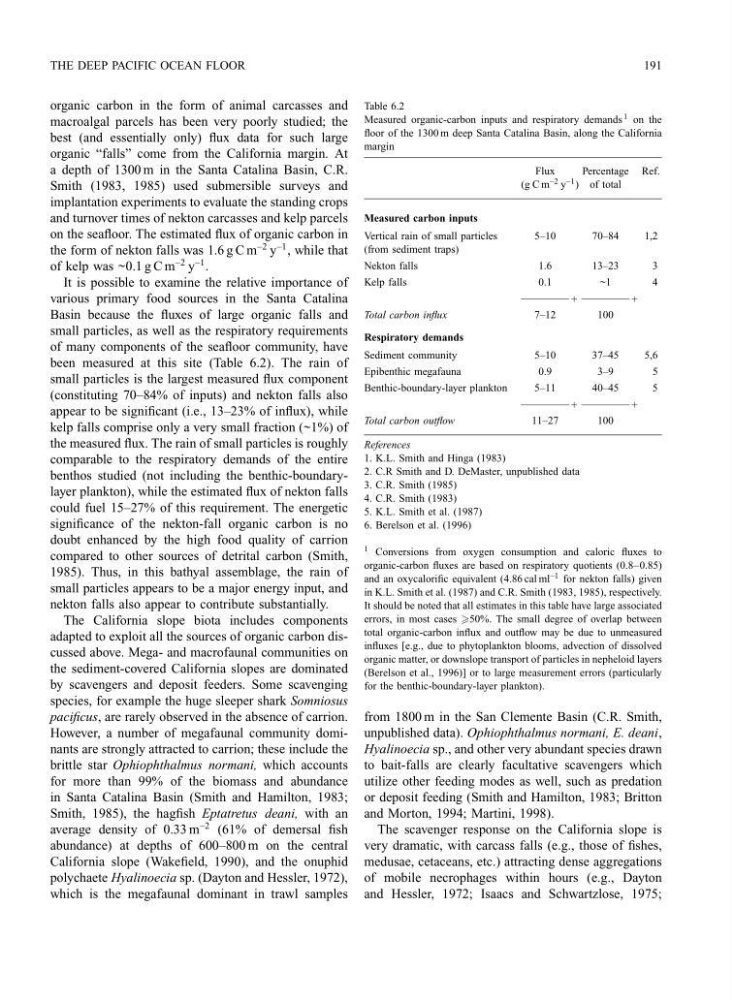
been measured at this site (Table 6.2). The rain of
small particles is the largest measured flux component
(constituting 70–84% of inputs) and nekton falls also
appear to be significant (i.e., 13–23% of influx), while
kelp falls comprise only a very small fraction (~1%) of
the measured flux. The rain of small particles is roughly
comparable to the respiratory demands of the entire
benthos studied (not including the benthic-boundarylayer plankton), while the estimated flux of nekton falls
could fuel 15–27% of this requirement. The energetic
significance of the nekton-fall organic carbon is no
doubt enhanced by the high food quality of carrion
compared to other sources of detrital carbon (Smith,
1985). Thus, in this bathyal assemblage, the rain of
small particles appears to be a major energy input, and
nekton falls also appear to contribute substantially.
The California slope biota includes components
adapted to exploit all the sources of organic carbon discussed above. Mega- and macrofaunal communities on
the sediment-covered California slopes are dominated
by scavengers and deposit feeders. Some scavenging
species, for example the huge sleeper shark Somniosus
pacificus, are rarely observed in the absence of carrion.
However, a number of megafaunal community dominants are strongly attracted to carrion; these include the
brittle star Ophiophthalmus normani, which accounts
for more than 99% of the biomass and abundance
in Santa Catalina Basin (Smith and Hamilton, 1983;
Smith, 1985), the hagfish Eptatretus deani, with an
average density of 0.33 m
−2 (61% of demersal fish
abundance) at depths of 600–800 m on the central
California slope (Wakefield, 1990), and the onuphid
polychaete Hyalinoecia sp. (Dayton and Hessler, 1972),
which is the megafaunal dominant in trawl samples
Table 6.2
Measured organic-carbon inputs and respiratory demands 1 on the
floor of the 1300 m deep Santa Catalina Basin, along the California
margin
Flux
(g C m −2 y −1 )
Percentage
of total
Ref.
Measured carbon inputs
Vertical rain of small particles
(from sediment traps)
5–10
70–84
1,2
Nekton falls
1.6
13–23
3
Kelp falls
0.1
~1
4
+
+
Total carbon influx
7–12
100
Respiratory demands
Sediment community
5–10
37–45
5,6
Epibenthic megafauna
0.9
3–9
5
Benthic-boundary-layer plankton
5–11
40–45
5
+
+
Total carbon outflow
11–27
100
References
1. K.L. Smith and Hinga (1983)
2. C.R Smith and D. DeMaster, unpublished data
3. C.R. Smith (1985)
4. C.R. Smith (1983)
5. K.L. Smith et al. (1987)
6. Berelson et al. (1996)
1 Conversions from oxygen consumption and caloric fluxes to
organic-carbon fluxes are based on respiratory quotients (0.8−0.85)
and an oxycalorific equivalent (4.86 cal ml −1 for nekton falls) given
in K.L. Smith et al. (1987) and C.R. Smith (1983, 1985), respectively.
It should be noted that all estimates in this table have large associated
errors, in most cases 50%. The small degree of overlap between
total organic-carbon influx and outflow may be due to unmeasured
influxes [e.g., due to phytoplankton blooms, advection of dissolved
organic matter, or downslope transport of particles in nepheloid layers
(Berelson et al., 1996)] or to large measurement errors (particularly
for the benthic-boundary-layer plankton).
from 1800 m in the San Clemente Basin (C.R. Smith,
unpublished data). Ophiophthalmus normani, E. deani,
Hyalinoecia sp., and other very abundant species drawn
to bait-falls are clearly facultative scavengers which
utilize other feeding modes as well, such as predation
or deposit feeding (Smith and Hamilton, 1983; Britton
and Morton, 1994; Martini, 1998).
The scavenger response on the California slope is
very dramatic, with carcass falls (e.g., those of fishes,
medusae, cetaceans, etc.) attracting dense aggregations
of mobile necrophages within hours (e.g., Dayton
and Hessler, 1972; Isaacs and Schwartzlose, 1975;
191
organic carbon in the form of animal carcasses and
macroalgal parcels has been very poorly studied; the
best (and essentially only) flux data for such large
organic “falls” come from the California margin. At
a depth of 1300 m in the Santa Catalina Basin, C.R.
Smith (1983, 1985) used submersible surveys and
implantation experiments to evaluate the standing crops
and turnover times of nekton carcasses and kelp parcels
on the seafloor. The estimated flux of organic carbon in
the form of nekton falls was 1.6 g C m
−2 y
−1 , while that
of kelp was ~0.1 g C m
−2 y
−1 .
It is possible to examine the relative importance of
various primary food sources in the Santa Catalina
Basin because the fluxes of large organic falls and
small particles, as well as the respiratory requirements
of many components of the seafloor community, have
been measured at this site (Table 6.2). The rain of
small particles is the largest measured flux component
(constituting 70–84% of inputs) and nekton falls also
appear to be significant (i.e., 13–23% of influx), while
kelp falls comprise only a very small fraction (~1%) of
the measured flux. The rain of small particles is roughly
comparable to the respiratory demands of the entire
benthos studied (not including the benthic-boundarylayer plankton), while the estimated flux of nekton falls
could fuel 15–27% of this requirement. The energetic
significance of the nekton-fall organic carbon is no
doubt enhanced by the high food quality of carrion
compared to other sources of detrital carbon (Smith,
1985). Thus, in this bathyal assemblage, the rain of
small particles appears to be a major energy input, and
nekton falls also appear to contribute substantially.
The California slope biota includes components
adapted to exploit all the sources of organic carbon discussed above. Mega- and macrofaunal communities on
the sediment-covered California slopes are dominated
by scavengers and deposit feeders. Some scavenging
species, for example the huge sleeper shark Somniosus
pacificus, are rarely observed in the absence of carrion.
However, a number of megafaunal community dominants are strongly attracted to carrion; these include the
brittle star Ophiophthalmus normani, which accounts
for more than 99% of the biomass and abundance
in Santa Catalina Basin (Smith and Hamilton, 1983;
Smith, 1985), the hagfish Eptatretus deani, with an
average density of 0.33 m
−2 (61% of demersal fish
abundance) at depths of 600–800 m on the central
California slope (Wakefield, 1990), and the onuphid
polychaete Hyalinoecia sp. (Dayton and Hessler, 1972),
which is the megafaunal dominant in trawl samples
Table 6.2
Measured organic-carbon inputs and respiratory demands 1 on the
floor of the 1300 m deep Santa Catalina Basin, along the California
margin
Flux
(g C m −2 y −1 )
Percentage
of total
Ref.
Measured carbon inputs
Vertical rain of small particles
(from sediment traps)
5–10
70–84
1,2
Nekton falls
1.6
13–23
3
Kelp falls
0.1
~1
4
+
+
Total carbon influx
7–12
100
Respiratory demands
Sediment community
5–10
37–45
5,6
Epibenthic megafauna
0.9
3–9
5
Benthic-boundary-layer plankton
5–11
40–45
5
+
+
Total carbon outflow
11–27
100
References
1. K.L. Smith and Hinga (1983)
2. C.R Smith and D. DeMaster, unpublished data
3. C.R. Smith (1985)
4. C.R. Smith (1983)
5. K.L. Smith et al. (1987)
6. Berelson et al. (1996)
1 Conversions from oxygen consumption and caloric fluxes to
organic-carbon fluxes are based on respiratory quotients (0.8−0.85)
and an oxycalorific equivalent (4.86 cal ml −1 for nekton falls) given
in K.L. Smith et al. (1987) and C.R. Smith (1983, 1985), respectively.
It should be noted that all estimates in this table have large associated
errors, in most cases 50%. The small degree of overlap between
total organic-carbon influx and outflow may be due to unmeasured
influxes [e.g., due to phytoplankton blooms, advection of dissolved
organic matter, or downslope transport of particles in nepheloid layers
(Berelson et al., 1996)] or to large measurement errors (particularly
for the benthic-boundary-layer plankton).
from 1800 m in the San Clemente Basin (C.R. Smith,
unpublished data). Ophiophthalmus normani, E. deani,
Hyalinoecia sp., and other very abundant species drawn
to bait-falls are clearly facultative scavengers which
utilize other feeding modes as well, such as predation
or deposit feeding (Smith and Hamilton, 1983; Britton
and Morton, 1994; Martini, 1998).
The scavenger response on the California slope is
very dramatic, with carcass falls (e.g., those of fishes,
medusae, cetaceans, etc.) attracting dense aggregations
of mobile necrophages within hours (e.g., Dayton
and Hessler, 1972; Isaacs and Schwartzlose, 1975;