

THE DEEP PACIFIC OCEAN FLOOR
187
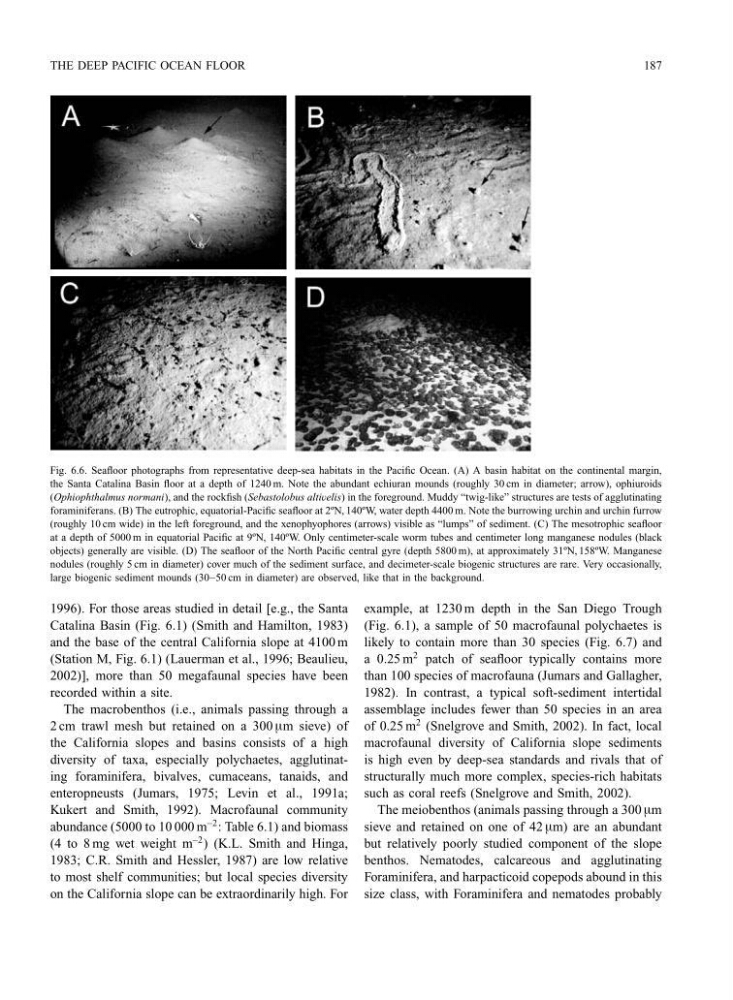
Fig. 6.6. Seafloor photographs from representative deep-sea habitats in the Pacific Ocean. (A) A basin habitat on the continental margin,
the Santa Catalina Basin floor at a depth of 1240 m. Note the abundant echiuran mounds (roughly 30 cm in diameter; arrow), ophiuroids
(Ophiophthalmus normani), and the rockfish (Sebastolobus altivelis) in the foreground. Muddy “twig-like” structures are tests of agglutinating
foraminiferans. (B) The eutrophic, equatorial-Pacific seafloor at 2ºN, 140ºW, water depth 4400 m. Note the burrowing urchin and urchin furrow
(roughly 10 cm wide) in the left foreground, and the xenophyophores (arrows) visible as “lumps” of sediment. (C) The mesotrophic seafloor
at a depth of 5000 m in equatorial Pacific at 9ºN, 140ºW. Only centimeter-scale worm tubes and centimeter long manganese nodules (black
objects) generally are visible. (D) The seafloor of the North Pacific central gyre (depth 5800 m), at approximately 31ºN, 158ºW. Manganese
nodules (roughly 5 cm in diameter) cover much of the sediment surface, and decimeter-scale biogenic structures are rare. Very occasionally,
large biogenic sediment mounds (30−50 cm in diameter) are observed, like that in the background.
1996). For those areas studied in detail [e.g., the Santa
Catalina Basin (Fig. 6.1) (Smith and Hamilton, 1983)
and the base of the central California slope at 4100 m
(Station M, Fig. 6.1) (Lauerman et al., 1996; Beaulieu,
2002)], more than 50 megafaunal species have been
recorded within a site.
The macrobenthos (i.e., animals passing through a
2 cm trawl mesh but retained on a 300 mm sieve) of
the California slopes and basins consists of a high
diversity of taxa, especially polychaetes, agglutinating foraminifera, bivalves, cumaceans, tanaids, and
enteropneusts (Jumars, 1975; Levin et al., 1991a;
Kukert and Smith, 1992). Macrofaunal community
abundance (5000 to 10 000 m
−2 : Table 6.1) and biomass
(4 to 8 mg wet weight m
−2 ) (K.L. Smith and Hinga,
1983; C.R. Smith and Hessler, 1987) are low relative
to most shelf communities; but local species diversity
on the California slope can be extraordinarily high. For
example, at 1230 m depth in the San Diego Trough
(Fig. 6.1), a sample of 50 macrofaunal polychaetes is
likely to contain more than 30 species (Fig. 6.7) and
a 0.25 m
2 patch of seafloor typically contains more
than 100 species of macrofauna (Jumars and Gallagher,
1982). In contrast, a typical soft-sediment intertidal
assemblage includes fewer than 50 species in an area
of 0.25 m
2 (Snelgrove and Smith, 2002). In fact, local
macrofaunal diversity of California slope sediments
is high even by deep-sea standards and rivals that of
structurally much more complex, species-rich habitats
such as coral reefs (Snelgrove and Smith, 2002).
The meiobenthos (animals passing through a 300 mm
sieve and retained on one of 42 mm) are an abundant
but relatively poorly studied component of the slope
benthos. Nematodes, calcareous and agglutinating
Foraminifera, and harpacticoid copepods abound in this
size class, with Foraminifera and nematodes probably
187
Fig. 6.6. Seafloor photographs from representative deep-sea habitats in the Pacific Ocean. (A) A basin habitat on the continental margin,
the Santa Catalina Basin floor at a depth of 1240 m. Note the abundant echiuran mounds (roughly 30 cm in diameter; arrow), ophiuroids
(Ophiophthalmus normani), and the rockfish (Sebastolobus altivelis) in the foreground. Muddy “twig-like” structures are tests of agglutinating
foraminiferans. (B) The eutrophic, equatorial-Pacific seafloor at 2ºN, 140ºW, water depth 4400 m. Note the burrowing urchin and urchin furrow
(roughly 10 cm wide) in the left foreground, and the xenophyophores (arrows) visible as “lumps” of sediment. (C) The mesotrophic seafloor
at a depth of 5000 m in equatorial Pacific at 9ºN, 140ºW. Only centimeter-scale worm tubes and centimeter long manganese nodules (black
objects) generally are visible. (D) The seafloor of the North Pacific central gyre (depth 5800 m), at approximately 31ºN, 158ºW. Manganese
nodules (roughly 5 cm in diameter) cover much of the sediment surface, and decimeter-scale biogenic structures are rare. Very occasionally,
large biogenic sediment mounds (30−50 cm in diameter) are observed, like that in the background.
1996). For those areas studied in detail [e.g., the Santa
Catalina Basin (Fig. 6.1) (Smith and Hamilton, 1983)
and the base of the central California slope at 4100 m
(Station M, Fig. 6.1) (Lauerman et al., 1996; Beaulieu,
2002)], more than 50 megafaunal species have been
recorded within a site.
The macrobenthos (i.e., animals passing through a
2 cm trawl mesh but retained on a 300 mm sieve) of
the California slopes and basins consists of a high
diversity of taxa, especially polychaetes, agglutinating foraminifera, bivalves, cumaceans, tanaids, and
enteropneusts (Jumars, 1975; Levin et al., 1991a;
Kukert and Smith, 1992). Macrofaunal community
abundance (5000 to 10 000 m
−2 : Table 6.1) and biomass
(4 to 8 mg wet weight m
−2 ) (K.L. Smith and Hinga,
1983; C.R. Smith and Hessler, 1987) are low relative
to most shelf communities; but local species diversity
on the California slope can be extraordinarily high. For
example, at 1230 m depth in the San Diego Trough
(Fig. 6.1), a sample of 50 macrofaunal polychaetes is
likely to contain more than 30 species (Fig. 6.7) and
a 0.25 m
2 patch of seafloor typically contains more
than 100 species of macrofauna (Jumars and Gallagher,
1982). In contrast, a typical soft-sediment intertidal
assemblage includes fewer than 50 species in an area
of 0.25 m
2 (Snelgrove and Smith, 2002). In fact, local
macrofaunal diversity of California slope sediments
is high even by deep-sea standards and rivals that of
structurally much more complex, species-rich habitats
such as coral reefs (Snelgrove and Smith, 2002).
The meiobenthos (animals passing through a 300 mm
sieve and retained on one of 42 mm) are an abundant
but relatively poorly studied component of the slope
benthos. Nematodes, calcareous and agglutinating
Foraminifera, and harpacticoid copepods abound in this
size class, with Foraminifera and nematodes probably