

THE DEEP PACIFIC OCEAN FLOOR
181
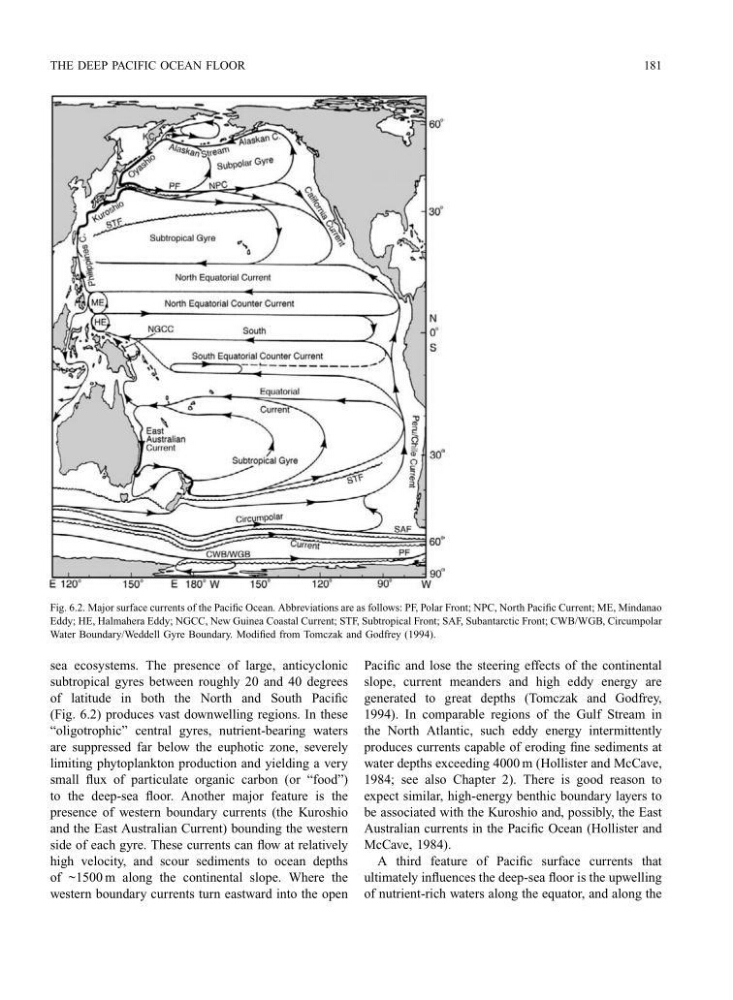
Fig. 6.2. Major surface currents of the Pacific Ocean. Abbreviations are as follows: PF, Polar Front; NPC, North Pacific Current; ME, Mindanao
Eddy; HE, Halmahera Eddy; NGCC, New Guinea Coastal Current; STF, Subtropical Front; SAF, Subantarctic Front; CWB/WGB, Circumpolar
Water Boundary/Weddell Gyre Boundary. Modified from Tomczak and Godfrey (1994).
sea ecosystems. The presence of large, anticyclonic
subtropical gyres between roughly 20 and 40 degrees
of latitude in both the North and South Pacific
(Fig. 6.2) produces vast downwelling regions. In these
“oligotrophic” central gyres, nutrient-bearing waters
are suppressed far below the euphotic zone, severely
limiting phytoplankton production and yielding a very
small flux of particulate organic carbon (or “food”)
to the deep-sea floor. Another major feature is the
presence of western boundary currents (the Kuroshio
and the East Australian Current) bounding the western
side of each gyre. These currents can flow at relatively
high velocity, and scour sediments to ocean depths
of ~1500 m along the continental slope. Where the
western boundary currents turn eastward into the open
Pacific and lose the steering effects of the continental
slope, current meanders and high eddy energy are
generated to great depths (Tomczak and Godfrey,
1994). In comparable regions of the Gulf Stream in
the North Atlantic, such eddy energy intermittently
produces currents capable of eroding fine sediments at
water depths exceeding 4000 m (Hollister and McCave,
1984; see also Chapter 2). There is good reason to
expect similar, high-energy benthic boundary layers to
be associated with the Kuroshio and, possibly, the East
Australian currents in the Pacific Ocean (Hollister and
McCave, 1984).
A third feature of Pacific surface currents that
ultimately influences the deep-sea floor is the upwelling
of nutrient-rich waters along the equator, and along the
181
Fig. 6.2. Major surface currents of the Pacific Ocean. Abbreviations are as follows: PF, Polar Front; NPC, North Pacific Current; ME, Mindanao
Eddy; HE, Halmahera Eddy; NGCC, New Guinea Coastal Current; STF, Subtropical Front; SAF, Subantarctic Front; CWB/WGB, Circumpolar
Water Boundary/Weddell Gyre Boundary. Modified from Tomczak and Godfrey (1994).
sea ecosystems. The presence of large, anticyclonic
subtropical gyres between roughly 20 and 40 degrees
of latitude in both the North and South Pacific
(Fig. 6.2) produces vast downwelling regions. In these
“oligotrophic” central gyres, nutrient-bearing waters
are suppressed far below the euphotic zone, severely
limiting phytoplankton production and yielding a very
small flux of particulate organic carbon (or “food”)
to the deep-sea floor. Another major feature is the
presence of western boundary currents (the Kuroshio
and the East Australian Current) bounding the western
side of each gyre. These currents can flow at relatively
high velocity, and scour sediments to ocean depths
of ~1500 m along the continental slope. Where the
western boundary currents turn eastward into the open
Pacific and lose the steering effects of the continental
slope, current meanders and high eddy energy are
generated to great depths (Tomczak and Godfrey,
1994). In comparable regions of the Gulf Stream in
the North Atlantic, such eddy energy intermittently
produces currents capable of eroding fine sediments at
water depths exceeding 4000 m (Hollister and McCave,
1984; see also Chapter 2). There is good reason to
expect similar, high-energy benthic boundary layers to
be associated with the Kuroshio and, possibly, the East
Australian currents in the Pacific Ocean (Hollister and
McCave, 1984).
A third feature of Pacific surface currents that
ultimately influences the deep-sea floor is the upwelling
of nutrient-rich waters along the equator, and along the