

164
Lisa A. LEVIN and Andrew J. GOODAY
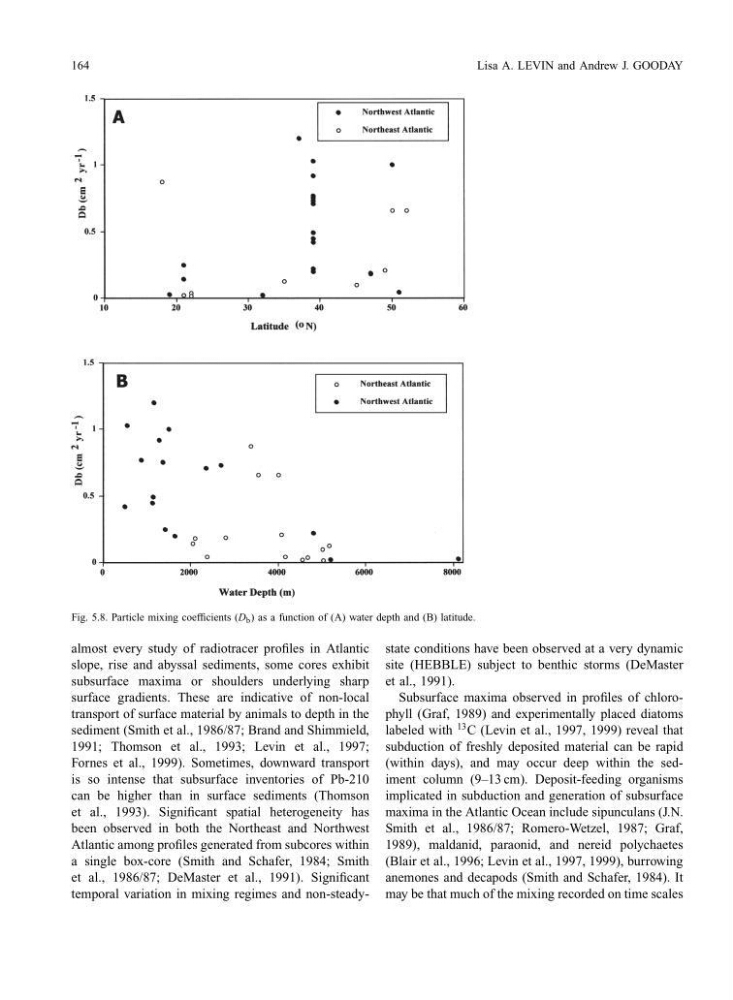
Fig. 5.8. Particle mixing coefficients (D b ) as a function of (A) water depth and (B) latitude.
almost every study of radiotracer profiles in Atlantic
slope, rise and abyssal sediments, some cores exhibit
subsurface maxima or shoulders underlying sharp
surface gradients. These are indicative of non-local
transport of surface material by animals to depth in the
sediment (Smith et al., 1986/87; Brand and Shimmield,
1991; Thomson et al., 1993; Levin et al., 1997;
Fornes et al., 1999). Sometimes, downward transport
is so intense that subsurface inventories of Pb-210
can be higher than in surface sediments (Thomson
et al., 1993). Significant spatial heterogeneity has
been observed in both the Northeast and Northwest
Atlantic among profiles generated from subcores within
a single box-core (Smith and Schafer, 1984; Smith
et al., 1986/87; DeMaster et al., 1991). Significant
temporal variation in mixing regimes and non-steadystate conditions have been observed at a very dynamic
site (HEBBLE) subject to benthic storms (DeMaster
et al., 1991).
Subsurface maxima observed in profiles of chlorophyll (Graf, 1989) and experimentally placed diatoms
labeled with
13 C (Levin et al., 1997, 1999) reveal that
subduction of freshly deposited material can be rapid
(within days), and may occur deep within the sediment column (9–13 cm). Deposit-feeding organisms
implicated in subduction and generation of subsurface
maxima in the Atlantic Ocean include sipunculans (J.N.
Smith et al., 1986/87; Romero-Wetzel, 1987; Graf,
1989), maldanid, paraonid, and nereid polychaetes
(Blair et al., 1996; Levin et al., 1997, 1999), burrowing
anemones and decapods (Smith and Schafer, 1984). It
may be that much of the mixing recorded on time scales
Lisa A. LEVIN and Andrew J. GOODAY
Fig. 5.8. Particle mixing coefficients (D b ) as a function of (A) water depth and (B) latitude.
almost every study of radiotracer profiles in Atlantic
slope, rise and abyssal sediments, some cores exhibit
subsurface maxima or shoulders underlying sharp
surface gradients. These are indicative of non-local
transport of surface material by animals to depth in the
sediment (Smith et al., 1986/87; Brand and Shimmield,
1991; Thomson et al., 1993; Levin et al., 1997;
Fornes et al., 1999). Sometimes, downward transport
is so intense that subsurface inventories of Pb-210
can be higher than in surface sediments (Thomson
et al., 1993). Significant spatial heterogeneity has
been observed in both the Northeast and Northwest
Atlantic among profiles generated from subcores within
a single box-core (Smith and Schafer, 1984; Smith
et al., 1986/87; DeMaster et al., 1991). Significant
temporal variation in mixing regimes and non-steadystate conditions have been observed at a very dynamic
site (HEBBLE) subject to benthic storms (DeMaster
et al., 1991).
Subsurface maxima observed in profiles of chlorophyll (Graf, 1989) and experimentally placed diatoms
labeled with
13 C (Levin et al., 1997, 1999) reveal that
subduction of freshly deposited material can be rapid
(within days), and may occur deep within the sediment column (9–13 cm). Deposit-feeding organisms
implicated in subduction and generation of subsurface
maxima in the Atlantic Ocean include sipunculans (J.N.
Smith et al., 1986/87; Romero-Wetzel, 1987; Graf,
1989), maldanid, paraonid, and nereid polychaetes
(Blair et al., 1996; Levin et al., 1997, 1999), burrowing
anemones and decapods (Smith and Schafer, 1984). It
may be that much of the mixing recorded on time scales