

THE DEEP ATLANTIC OCEAN
163
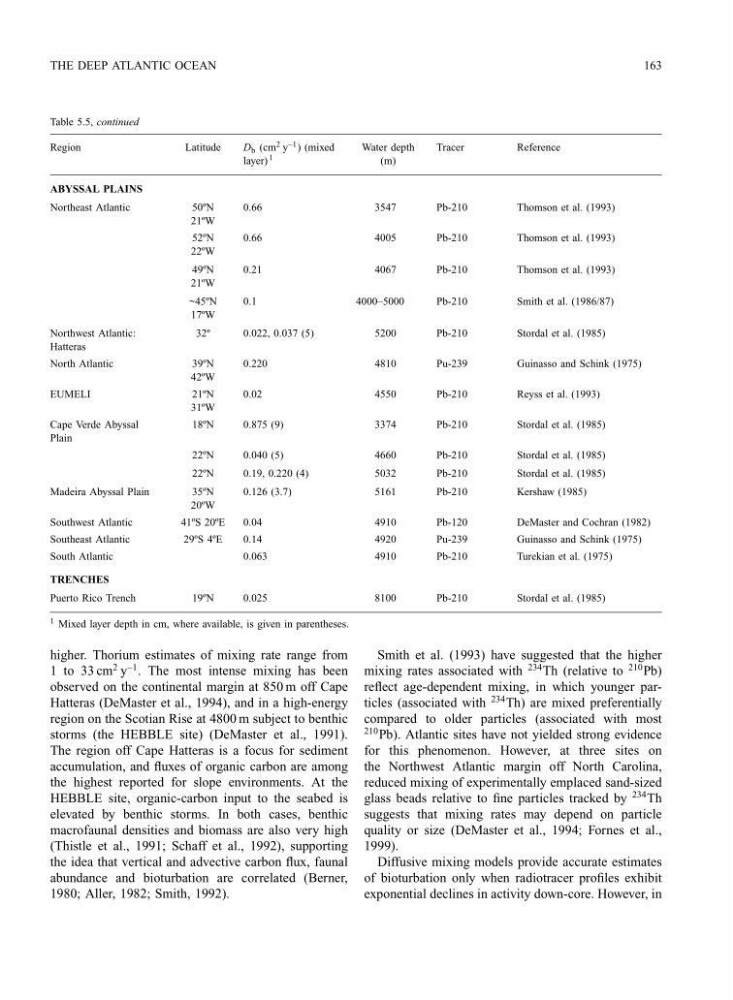
Table 5.5, continued
Region
Latitude
D b (cm 2 y −1 ) (mixed
layer) 1
Water depth
(m)
Tracer
Reference
ABYSSAL PLAINS
Northeast Atlantic
50ºN
21ºW
0.66
3547
Pb-210
Thomson et al. (1993)
52ºN
22ºW
0.66
4005
Pb-210
Thomson et al. (1993)
49ºN
21ºW
0.21
4067
Pb-210
Thomson et al. (1993)
~45ºN
17ºW
0.1
4000–5000
Pb-210
Smith et al. (1986/87)
Northwest Atlantic:
Hatteras
32º
0.022, 0.037 (5)
5200
Pb-210
Stordal et al. (1985)
North Atlantic
39ºN
42ºW
0.220
4810
Pu-239
Guinasso and Schink (1975)
EUMELI
21ºN
31ºW
0.02
4550
Pb-210
Reyss et al. (1993)
Cape Verde Abyssal
Plain
18ºN
0.875 (9)
3374
Pb-210
Stordal et al. (1985)
22ºN
0.040 (5)
4660
Pb-210
Stordal et al. (1985)
22ºN
0.19, 0.220 (4)
5032
Pb-210
Stordal et al. (1985)
Madeira Abyssal Plain
35ºN
20ºW
0.126 (3.7)
5161
Pb-210
Kershaw (1985)
Southwest Atlantic
41ºS 20ºE
0.04
4910
Pb-120
DeMaster and Cochran (1982)
Southeast Atlantic
29ºS 4ºE
0.14
4920
Pu-239
Guinasso and Schink (1975)
South Atlantic
0.063
4910
Pb-210
Turekian et al. (1975)
TRENCHES
Puerto Rico Trench
19ºN
0.025
8100
Pb-210
Stordal et al. (1985)
1 Mixed layer depth in cm, where available, is given in parentheses.
higher. Thorium estimates of mixing rate range from
1 to 33 cm
2 y
−1 . The most intense mixing has been
observed on the continental margin at 850 m off Cape
Hatteras (DeMaster et al., 1994), and in a high-energy
region on the Scotian Rise at 4800 m subject to benthic
storms (the HEBBLE site) (DeMaster et al., 1991).
The region off Cape Hatteras is a focus for sediment
accumulation, and fluxes of organic carbon are among
the highest reported for slope environments. At the
HEBBLE site, organic-carbon input to the seabed is
elevated by benthic storms. In both cases, benthic
macrofaunal densities and biomass are also very high
(Thistle et al., 1991; Schaff et al., 1992), supporting
the idea that vertical and advective carbon flux, faunal
abundance and bioturbation are correlated (Berner,
1980; Aller, 1982; Smith, 1992).
Smith et al. (1993) have suggested that the higher
mixing rates associated with
234 Th (relative to
210 Pb)
reflect age-dependent mixing, in which younger particles (associated with
234 Th) are mixed preferentially
compared to older particles (associated with most
210 Pb). Atlantic sites have not yielded strong evidence
for this phenomenon. However, at three sites on
the Northwest Atlantic margin off North Carolina,
reduced mixing of experimentally emplaced sand-sized
glass beads relative to fine particles tracked by
234 Th
suggests that mixing rates may depend on particle
quality or size (DeMaster et al., 1994; Fornes et al.,
1999).
Diffusive mixing models provide accurate estimates
of bioturbation only when radiotracer profiles exhibit
exponential declines in activity down-core. However, in
163
Table 5.5, continued
Region
Latitude
D b (cm 2 y −1 ) (mixed
layer) 1
Water depth
(m)
Tracer
Reference
ABYSSAL PLAINS
Northeast Atlantic
50ºN
21ºW
0.66
3547
Pb-210
Thomson et al. (1993)
52ºN
22ºW
0.66
4005
Pb-210
Thomson et al. (1993)
49ºN
21ºW
0.21
4067
Pb-210
Thomson et al. (1993)
~45ºN
17ºW
0.1
4000–5000
Pb-210
Smith et al. (1986/87)
Northwest Atlantic:
Hatteras
32º
0.022, 0.037 (5)
5200
Pb-210
Stordal et al. (1985)
North Atlantic
39ºN
42ºW
0.220
4810
Pu-239
Guinasso and Schink (1975)
EUMELI
21ºN
31ºW
0.02
4550
Pb-210
Reyss et al. (1993)
Cape Verde Abyssal
Plain
18ºN
0.875 (9)
3374
Pb-210
Stordal et al. (1985)
22ºN
0.040 (5)
4660
Pb-210
Stordal et al. (1985)
22ºN
0.19, 0.220 (4)
5032
Pb-210
Stordal et al. (1985)
Madeira Abyssal Plain
35ºN
20ºW
0.126 (3.7)
5161
Pb-210
Kershaw (1985)
Southwest Atlantic
41ºS 20ºE
0.04
4910
Pb-120
DeMaster and Cochran (1982)
Southeast Atlantic
29ºS 4ºE
0.14
4920
Pu-239
Guinasso and Schink (1975)
South Atlantic
0.063
4910
Pb-210
Turekian et al. (1975)
TRENCHES
Puerto Rico Trench
19ºN
0.025
8100
Pb-210
Stordal et al. (1985)
1 Mixed layer depth in cm, where available, is given in parentheses.
higher. Thorium estimates of mixing rate range from
1 to 33 cm
2 y
−1 . The most intense mixing has been
observed on the continental margin at 850 m off Cape
Hatteras (DeMaster et al., 1994), and in a high-energy
region on the Scotian Rise at 4800 m subject to benthic
storms (the HEBBLE site) (DeMaster et al., 1991).
The region off Cape Hatteras is a focus for sediment
accumulation, and fluxes of organic carbon are among
the highest reported for slope environments. At the
HEBBLE site, organic-carbon input to the seabed is
elevated by benthic storms. In both cases, benthic
macrofaunal densities and biomass are also very high
(Thistle et al., 1991; Schaff et al., 1992), supporting
the idea that vertical and advective carbon flux, faunal
abundance and bioturbation are correlated (Berner,
1980; Aller, 1982; Smith, 1992).
Smith et al. (1993) have suggested that the higher
mixing rates associated with
234 Th (relative to
210 Pb)
reflect age-dependent mixing, in which younger particles (associated with
234 Th) are mixed preferentially
compared to older particles (associated with most
210 Pb). Atlantic sites have not yielded strong evidence
for this phenomenon. However, at three sites on
the Northwest Atlantic margin off North Carolina,
reduced mixing of experimentally emplaced sand-sized
glass beads relative to fine particles tracked by
234 Th
suggests that mixing rates may depend on particle
quality or size (DeMaster et al., 1994; Fornes et al.,
1999).
Diffusive mixing models provide accurate estimates
of bioturbation only when radiotracer profiles exhibit
exponential declines in activity down-core. However, in