

REDUCING ENVIRONMENTS OF THE DEEP-SEA FLOOR
91
Table 4.2
Potential microbial metabolic processes in deep-sea reducing
habitats 1
Electron
(energy) donor
Electron
acceptor
Carbon source Metabolic
process
Aerobic conditions
H 2
O 2
CO 2
H oxidation
HS − , Sº,
S 2 O 2−
3
O 2
CO 2
S oxidation
Fe 2+
O 2
CO 2
Fe oxidation
Mn 2+
O 2
?
Fe oxidation
CH 4 (and
other C-1
compounds)
O 2
CH 4 , CO 2 ,
CO
Methane (C-1)
oxidation
Organic
compounds
O 2
Organic
compounds
Heterotrophic
metabolism
Anaerobic conditions
H 2
CO 2
CO 2
Methanogenesis
H 2
Sº, SO 2−
4
CO 2
S and sulphate
reduction
H 2
NO −
3
CO 2
H oxidation
Organic
compounds
NO 3
Organic
compounds
Denitrification
CH 4
SO 2−
4
?
Methane
oxidation
Organic
compounds
Sº, SO 2−
4
Organic
compounds
S and sulphate
reduction
Organic
compounds
Organic
compounds
Organic
compounds
Fermentation
1 Processes known to involve the chemosynthetic production of new
organic matter are given in italics. Heterotrophic metabolism also
occurs in these systems and involves the decomposition of organic
matter produced at vents or imported from the surrounding ocean.
Organisms representative of most of these forms of metabolism have
been isolated and cultured from hydrothermal vent samples but the
quantitative importance of the various electron donor and acceptor
pathways in overall ecosystem metabolism is poorly understood.
Adapted from Karl (1995).
sustained by micro-organisms that chemosynthesize organic matter from carbon dioxide and mineral nutrients;
photosynthetically-produced organic matter contributes
little. The microbes catalyze oxidation of hydrogen
sulphide and other reducing substances present in
vent fluids, and use the chemical energy released to
produce adenosine triphosphate (ATP) required for
chemosynthesis. Since hydrothermal fluids are formed
by reaction of sea water with hot rock, researchers
then understood that vent ecosystems were ultimately
powered by heat from the mantle.
Chemosynthesis is also the primary energy source
for faunal communities in continental-margin seep
environments although, in this case, the reducing
substances are derived, not from the high-temperature
reaction of rock with crustal seawater, but from
the degradation of sedimentary organic matter. In
subduction-zone settings, large-scale tectonic compression of sediments expels interstitial fluids containing
methane. These fluids migrate along faults and fractures and, as they approach the seafloor, they can mix
with near-surface pore waters which are slightly more
oxidizing and contain dissolved sulphate (Martin et al.,
1996). In these mixing zones, microbially catalyzed
oxidation of methane using sulphate as an oxidant
can then add hydrogen sulphide to seep fluids. At the
seafloor, both hydrogen sulphide and methane provide
energy for microbial chemosynthesis.
Common microbial processes
Chemosynthetic microbial growth in reducing habitats
is coupled to the oxidation of H 2 S, CH 4 , H 2 , Fe
2+ ,
Mn
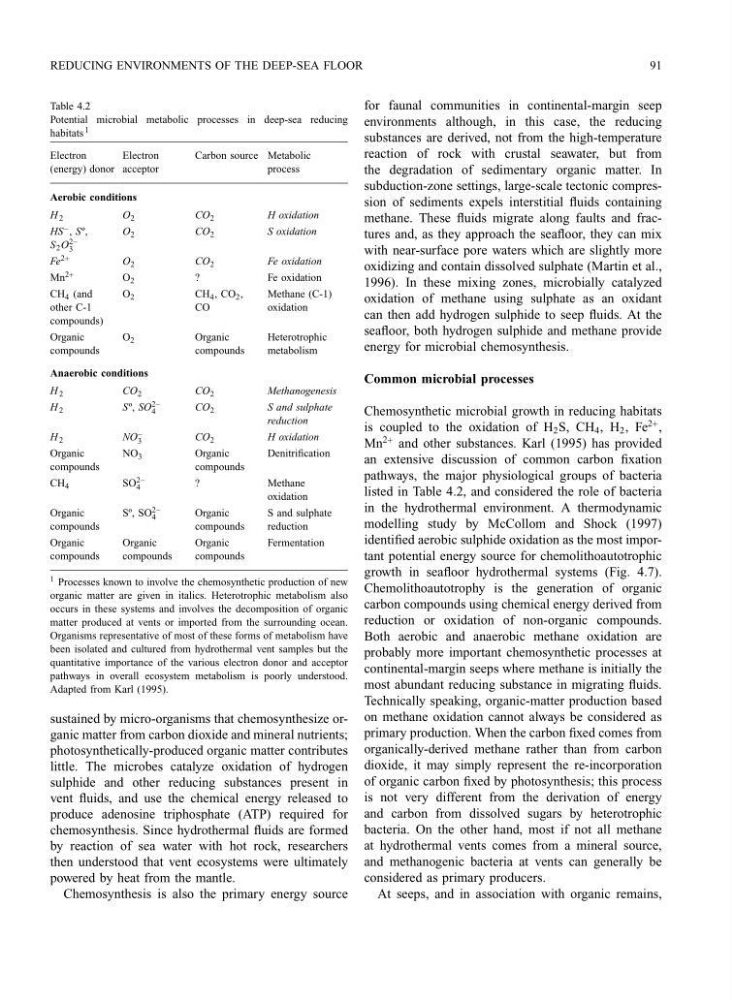
2+ and other substances. Karl (1995) has provided
an extensive discussion of common carbon fixation
pathways, the major physiological groups of bacteria
listed in Table 4.2, and considered the role of bacteria
in the hydrothermal environment. A thermodynamic
modelling study by McCollom and Shock (1997)
identified aerobic sulphide oxidation as the most important potential energy source for chemolithoautotrophic
growth in seafloor hydrothermal systems (Fig. 4.7).
Chemolithoautotrophy is the generation of organic
carbon compounds using chemical energy derived from
reduction or oxidation of non-organic compounds.
Both aerobic and anaerobic methane oxidation are
probably more important chemosynthetic processes at
continental-margin seeps where methane is initially the
most abundant reducing substance in migrating fluids.
Technically speaking, organic-matter production based
on methane oxidation cannot always be considered as
primary production. When the carbon fixed comes from
organically-derived methane rather than from carbon
dioxide, it may simply represent the re-incorporation
of organic carbon fixed by photosynthesis; this process
is not very different from the derivation of energy
and carbon from dissolved sugars by heterotrophic
bacteria. On the other hand, most if not all methane
at hydrothermal vents comes from a mineral source,
and methanogenic bacteria at vents can generally be
considered as primary producers.
At seeps, and in association with organic remains,
91
Table 4.2
Potential microbial metabolic processes in deep-sea reducing
habitats 1
Electron
(energy) donor
Electron
acceptor
Carbon source Metabolic
process
Aerobic conditions
H 2
O 2
CO 2
H oxidation
HS − , Sº,
S 2 O 2−
3
O 2
CO 2
S oxidation
Fe 2+
O 2
CO 2
Fe oxidation
Mn 2+
O 2
?
Fe oxidation
CH 4 (and
other C-1
compounds)
O 2
CH 4 , CO 2 ,
CO
Methane (C-1)
oxidation
Organic
compounds
O 2
Organic
compounds
Heterotrophic
metabolism
Anaerobic conditions
H 2
CO 2
CO 2
Methanogenesis
H 2
Sº, SO 2−
4
CO 2
S and sulphate
reduction
H 2
NO −
3
CO 2
H oxidation
Organic
compounds
NO 3
Organic
compounds
Denitrification
CH 4
SO 2−
4
?
Methane
oxidation
Organic
compounds
Sº, SO 2−
4
Organic
compounds
S and sulphate
reduction
Organic
compounds
Organic
compounds
Organic
compounds
Fermentation
1 Processes known to involve the chemosynthetic production of new
organic matter are given in italics. Heterotrophic metabolism also
occurs in these systems and involves the decomposition of organic
matter produced at vents or imported from the surrounding ocean.
Organisms representative of most of these forms of metabolism have
been isolated and cultured from hydrothermal vent samples but the
quantitative importance of the various electron donor and acceptor
pathways in overall ecosystem metabolism is poorly understood.
Adapted from Karl (1995).
sustained by micro-organisms that chemosynthesize organic matter from carbon dioxide and mineral nutrients;
photosynthetically-produced organic matter contributes
little. The microbes catalyze oxidation of hydrogen
sulphide and other reducing substances present in
vent fluids, and use the chemical energy released to
produce adenosine triphosphate (ATP) required for
chemosynthesis. Since hydrothermal fluids are formed
by reaction of sea water with hot rock, researchers
then understood that vent ecosystems were ultimately
powered by heat from the mantle.
Chemosynthesis is also the primary energy source
for faunal communities in continental-margin seep
environments although, in this case, the reducing
substances are derived, not from the high-temperature
reaction of rock with crustal seawater, but from
the degradation of sedimentary organic matter. In
subduction-zone settings, large-scale tectonic compression of sediments expels interstitial fluids containing
methane. These fluids migrate along faults and fractures and, as they approach the seafloor, they can mix
with near-surface pore waters which are slightly more
oxidizing and contain dissolved sulphate (Martin et al.,
1996). In these mixing zones, microbially catalyzed
oxidation of methane using sulphate as an oxidant
can then add hydrogen sulphide to seep fluids. At the
seafloor, both hydrogen sulphide and methane provide
energy for microbial chemosynthesis.
Common microbial processes
Chemosynthetic microbial growth in reducing habitats
is coupled to the oxidation of H 2 S, CH 4 , H 2 , Fe
2+ ,
Mn
2+ and other substances. Karl (1995) has provided
an extensive discussion of common carbon fixation
pathways, the major physiological groups of bacteria
listed in Table 4.2, and considered the role of bacteria
in the hydrothermal environment. A thermodynamic
modelling study by McCollom and Shock (1997)
identified aerobic sulphide oxidation as the most important potential energy source for chemolithoautotrophic
growth in seafloor hydrothermal systems (Fig. 4.7).
Chemolithoautotrophy is the generation of organic
carbon compounds using chemical energy derived from
reduction or oxidation of non-organic compounds.
Both aerobic and anaerobic methane oxidation are
probably more important chemosynthetic processes at
continental-margin seeps where methane is initially the
most abundant reducing substance in migrating fluids.
Technically speaking, organic-matter production based
on methane oxidation cannot always be considered as
primary production. When the carbon fixed comes from
organically-derived methane rather than from carbon
dioxide, it may simply represent the re-incorporation
of organic carbon fixed by photosynthesis; this process
is not very different from the derivation of energy
and carbon from dissolved sugars by heterotrophic
bacteria. On the other hand, most if not all methane
at hydrothermal vents comes from a mineral source,
and methanogenic bacteria at vents can generally be
considered as primary producers.
At seeps, and in association with organic remains,