

Glacial erosion
83
deposits of different origins. These data are fundamental for a correct interpretation of the
profile evolution.
The analysis of a longitudinal profile reveals a great number of irregularities produced
by basins and thresholds differentiating it from a fluvial valley profile. The basins, once ice
is removed, become lakes and, in other cases, are silted by sediments. Frequently
thresholds present certain signs of glacial erosion. If the excavation of a main glacial
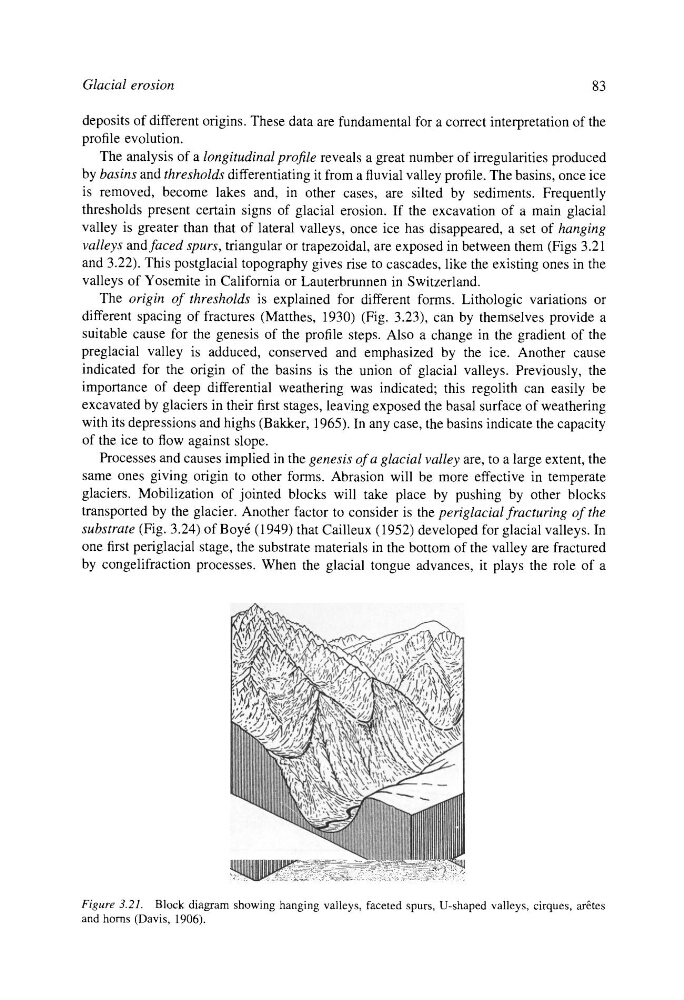
valley is greater than that of lateral valleys, once ice has disappeared, a set of hanging
valleys and faced spurs, triangular or trapezoidal, are exposed in between them (Figs 3.21
and 3.22). This postglacial topography gives rise to cascades, like the existing ones in the
valleys of Yosemite in California or Lauterbrunnen in Switzerland.
The origin of thresholds is explained for different forms. Lithologic variations or
different spacing of fractures (Matthes, 1930) (Fig. 3.23), can by themselves provide a
suitable cause for the genesis of the profile steps. Also a change in the gradient of the
preglacial valley is adduced, conserved and emphasized by the ice. Another cause
indicated for the origin of the basins is the union of glacial valleys. Previously, the
importance of deep differential weathering was indicated; this regolith can easily be
excavated by glaciers in their first stages, leaving exposed the basal surface of weathering
with its depressions and highs (Bakker, 1965). In any case, the basins indicate the capacity
of the ice to flow against slope.
Processes and causes implied in the genesis of a glacial valley are, to a large extent, the
same ones giving origin to other forms. Abrasion will be more effective in temperate
glaciers. Mobilization of jointed blocks will take place by pushing by other blocks
transported by the glacier. Another factor to consider is the periglacial fracturing of the
substrate (Fig. 3.24) of Boy6 (1949) that Cailleux (1952) developed for glacial valleys. In
one first periglacial stage, the substrate materials in the bottom of the valley are fractured
by congelifraction processes. When the glacial tongue advances, it plays the role of a
Figure 3.21. Block diagram showing hanging valleys, faceted spurs, U-shaped valleys, cirques, ar~tes
and horns (Davis, 1906).
83
deposits of different origins. These data are fundamental for a correct interpretation of the
profile evolution.
The analysis of a longitudinal profile reveals a great number of irregularities produced
by basins and thresholds differentiating it from a fluvial valley profile. The basins, once ice
is removed, become lakes and, in other cases, are silted by sediments. Frequently
thresholds present certain signs of glacial erosion. If the excavation of a main glacial
valley is greater than that of lateral valleys, once ice has disappeared, a set of hanging
valleys and faced spurs, triangular or trapezoidal, are exposed in between them (Figs 3.21
and 3.22). This postglacial topography gives rise to cascades, like the existing ones in the
valleys of Yosemite in California or Lauterbrunnen in Switzerland.
The origin of thresholds is explained for different forms. Lithologic variations or
different spacing of fractures (Matthes, 1930) (Fig. 3.23), can by themselves provide a
suitable cause for the genesis of the profile steps. Also a change in the gradient of the
preglacial valley is adduced, conserved and emphasized by the ice. Another cause
indicated for the origin of the basins is the union of glacial valleys. Previously, the
importance of deep differential weathering was indicated; this regolith can easily be
excavated by glaciers in their first stages, leaving exposed the basal surface of weathering
with its depressions and highs (Bakker, 1965). In any case, the basins indicate the capacity
of the ice to flow against slope.
Processes and causes implied in the genesis of a glacial valley are, to a large extent, the
same ones giving origin to other forms. Abrasion will be more effective in temperate
glaciers. Mobilization of jointed blocks will take place by pushing by other blocks
transported by the glacier. Another factor to consider is the periglacial fracturing of the
substrate (Fig. 3.24) of Boy6 (1949) that Cailleux (1952) developed for glacial valleys. In
one first periglacial stage, the substrate materials in the bottom of the valley are fractured
by congelifraction processes. When the glacial tongue advances, it plays the role of a
Figure 3.21. Block diagram showing hanging valleys, faceted spurs, U-shaped valleys, cirques, ar~tes
and horns (Davis, 1906).