

82
Climatic Geomorphology
from a superposition of a preglacial valley with others developed from the partial or
complete destruction of preglacial watersheds. Finally, in the intrusive or inverse type, the
ice flows up into the reverse-slope of a preglacial valley. They occur mainly in areas of
little relief.
Glacial valleys are characterized by the peculiarities of their cross-sectional and
longitudinal profiles. The cross-sectional profile results from the erosive action of the ice
on old fluvial valleys (in most cases) producing a widening and deepening. Generally they
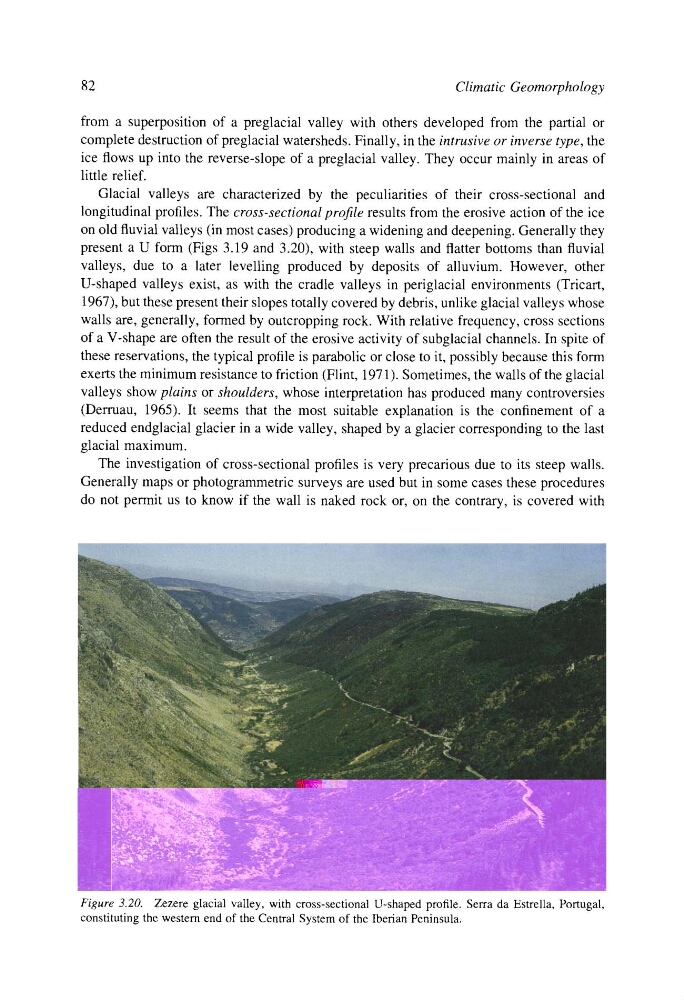
present a U form (Figs 3.19 and 3.20), with steep walls and flatter bottoms than fluvial
valleys, due to a later levelling produced by deposits of alluvium. However, other
U-shaped valleys exist, as with the cradle valleys in periglacial environments (Tricart,
1967), but these present their slopes totally covered by debris, unlike glacial valleys whose
walls are, generally, formed by outcropping rock. With relative frequency, cross sections
of a V-shape are often the result of the erosive activity of subglacial channels. In spite of
these reservations, the typical profile is parabolic or close to it, possibly because this form
exerts the minimum resistance to friction (Flint, 1971). Sometimes, the walls of the glacial
valleys show plains or shoulders, whose interpretation has produced many controversies
(Derruau, 1965). It seems that the most suitable explanation is the confinement of a
reduced endglacial glacier in a wide valley, shaped by a glacier corresponding to the last
glacial maximum.
The investigation of cross-sectional profiles is very precarious due to its steep walls.
Generally maps or photogrammetric surveys are used but in some cases these procedures
do not permit us to know if the wall is naked rock or, on the contrary, is covered with
Figure 3.20. Zezere glacial valley, with cross-sectional U-shaped profile. Serra da Estrella, Portugal,
constituting the western end of the Central System of the Iberian Peninsula.
Climatic Geomorphology
from a superposition of a preglacial valley with others developed from the partial or
complete destruction of preglacial watersheds. Finally, in the intrusive or inverse type, the
ice flows up into the reverse-slope of a preglacial valley. They occur mainly in areas of
little relief.
Glacial valleys are characterized by the peculiarities of their cross-sectional and
longitudinal profiles. The cross-sectional profile results from the erosive action of the ice
on old fluvial valleys (in most cases) producing a widening and deepening. Generally they
present a U form (Figs 3.19 and 3.20), with steep walls and flatter bottoms than fluvial
valleys, due to a later levelling produced by deposits of alluvium. However, other
U-shaped valleys exist, as with the cradle valleys in periglacial environments (Tricart,
1967), but these present their slopes totally covered by debris, unlike glacial valleys whose
walls are, generally, formed by outcropping rock. With relative frequency, cross sections
of a V-shape are often the result of the erosive activity of subglacial channels. In spite of
these reservations, the typical profile is parabolic or close to it, possibly because this form
exerts the minimum resistance to friction (Flint, 1971). Sometimes, the walls of the glacial
valleys show plains or shoulders, whose interpretation has produced many controversies
(Derruau, 1965). It seems that the most suitable explanation is the confinement of a
reduced endglacial glacier in a wide valley, shaped by a glacier corresponding to the last
glacial maximum.
The investigation of cross-sectional profiles is very precarious due to its steep walls.
Generally maps or photogrammetric surveys are used but in some cases these procedures
do not permit us to know if the wall is naked rock or, on the contrary, is covered with
Figure 3.20. Zezere glacial valley, with cross-sectional U-shaped profile. Serra da Estrella, Portugal,
constituting the western end of the Central System of the Iberian Peninsula.