

Glacial erosion
65
considerable influence on the glacial fracturing process. In the case of polar glaciers great
shear stresses are required, because the ice-rock contact remains as a unit due to its frozen
state.
A factor of undoubted importance is the state of the material before ice advances on it.
Thus the periglacial breaking of the bottom indicates the incidence of periglacial
processes on the preparation of easily exportable material with the later advance of the ice
(Boy6, 1949).
In the classic work carried out in the Yosemite Valley of California (Matthes, 1930) the
importance of sheeting in the evacuation of material by extraction was analysed. They
indicated that the optimal joint spacing for glacier mobilization ranges between 1.5 and
7.5 m. Sometimes it is difficult to determine if the origin of this topographic jointing is
preglacial or if it has been generated by load loss after the disappearance of an important
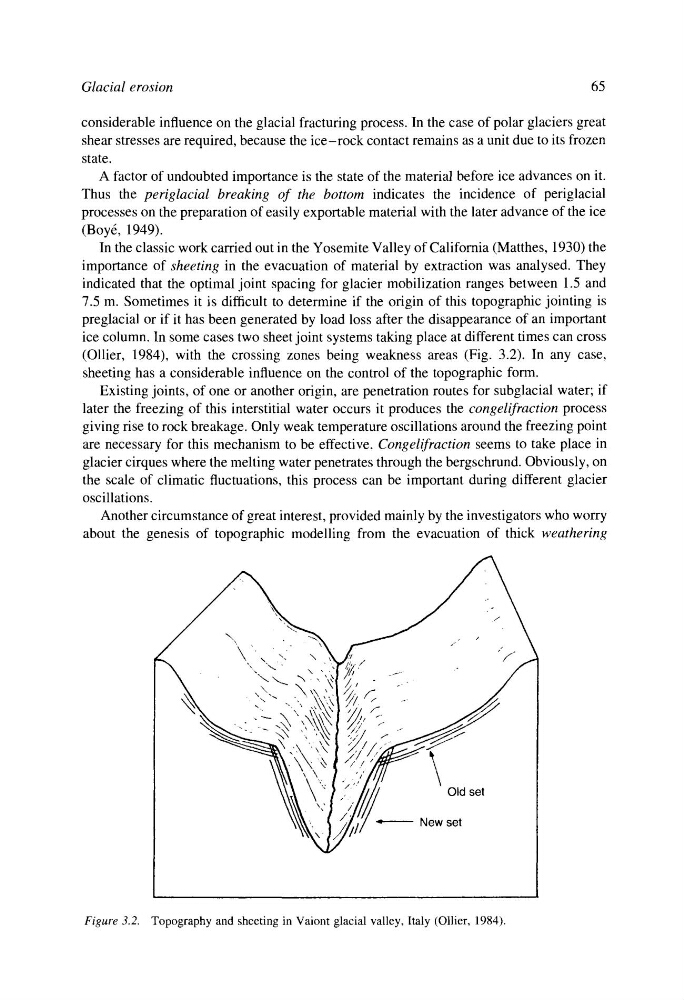
ice column. In some cases two sheet joint systems taking place at different times can cross
(Ollier, 1984), with the crossing zones being weakness areas (Fig. 3.2). In any case,
sheeting has a considerable influence on the control of the topographic form.
Existing joints, of one or another origin, are penetration routes for subglacial water; if
later the freezing of this interstitial water occurs it produces the congelifraction process
giving rise to rock breakage. Only weak temperature oscillations around the freezing point
are necessary for this mechanism to be effective. Congelifraction seems to take place in
glacier cirques where the melting water penetrates through the bergschrund. Obviously, on
the scale of climatic fluctuations, this process can be important during different glacier
oscillations.
Another circumstance of great interest, provided mainly by the investigators who worry
about the genesis of topographic modelling from the evacuation of thick weathering
Figure 3.2. Topography and sheeting in Vaiont glacial valley, Italy (Ollier, 1984).
65
considerable influence on the glacial fracturing process. In the case of polar glaciers great
shear stresses are required, because the ice-rock contact remains as a unit due to its frozen
state.
A factor of undoubted importance is the state of the material before ice advances on it.
Thus the periglacial breaking of the bottom indicates the incidence of periglacial
processes on the preparation of easily exportable material with the later advance of the ice
(Boy6, 1949).
In the classic work carried out in the Yosemite Valley of California (Matthes, 1930) the
importance of sheeting in the evacuation of material by extraction was analysed. They
indicated that the optimal joint spacing for glacier mobilization ranges between 1.5 and
7.5 m. Sometimes it is difficult to determine if the origin of this topographic jointing is
preglacial or if it has been generated by load loss after the disappearance of an important
ice column. In some cases two sheet joint systems taking place at different times can cross
(Ollier, 1984), with the crossing zones being weakness areas (Fig. 3.2). In any case,
sheeting has a considerable influence on the control of the topographic form.
Existing joints, of one or another origin, are penetration routes for subglacial water; if
later the freezing of this interstitial water occurs it produces the congelifraction process
giving rise to rock breakage. Only weak temperature oscillations around the freezing point
are necessary for this mechanism to be effective. Congelifraction seems to take place in
glacier cirques where the melting water penetrates through the bergschrund. Obviously, on
the scale of climatic fluctuations, this process can be important during different glacier
oscillations.
Another circumstance of great interest, provided mainly by the investigators who worry
about the genesis of topographic modelling from the evacuation of thick weathering
Figure 3.2. Topography and sheeting in Vaiont glacial valley, Italy (Ollier, 1984).