

64
Climatic Geomorphology
x 1000-I
E
E
,o
t-0
-~ 100-.Q
<
10
!
o
50
/
Zone A
/
v = 100m yr -1 t
Zone B
/
/
/
1
/
/
I
I
I
I
10
20
30
40
Effective normal pressure (bar)
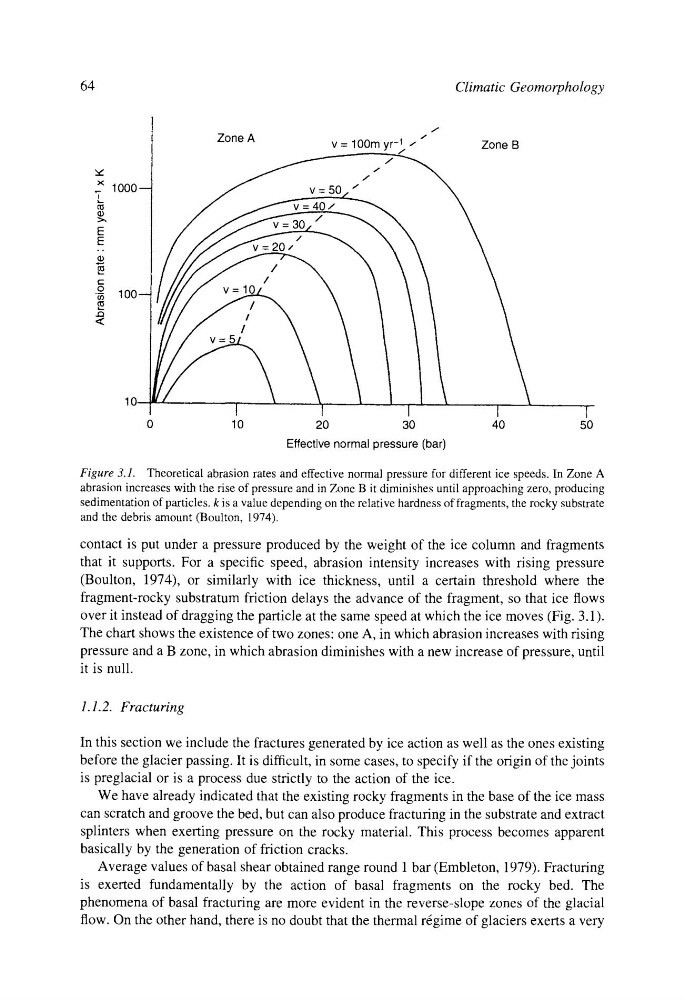
Figure 3.1. Theoretical abrasion rates and effective normal pressure for different ice speeds. In Zone A
abrasion increases with the rise of pressure and in Zone B it diminishes until approaching zero, producing
sedimentation of particles, k is a value depending on the relative hardness of fragments, the rocky substrate
and the debris amount (Boulton, 1974).
contact is put under a pressure produced by the weight of the ice column and fragments
that it supports. For a specific speed, abrasion intensity increases with rising pressure
(Boulton, 1974), or similarly with ice thickness, until a certain threshold where the
fragment-rocky substratum friction delays the advance of the fragment, so that ice flows
over it instead of dragging the particle at the same speed at which the ice moves (Fig. 3.1).
The chart shows the existence of two zones: one A, in which abrasion increases with rising
pressure and a B zone, in which abrasion diminishes with a new increase of pressure, until
it is null.
1.1.2. Fracturing
In this section we include the fractures generated by ice action as well as the ones existing
before the glacier passing. It is difficult, in some cases, to specify if the origin of the joints
is preglacial or is a process due strictly to the action of the ice.
We have already indicated that the existing rocky fragments in the base of the ice mass
can scratch and groove the bed, but can also produce fracturing in the substrate and extract
splinters when exerting pressure on the rocky material. This process becomes apparent
basically by the generation of friction cracks.
Average values of basal shear obtained range round 1 bar (Embleton, 1979). Fracturing
is exerted fundamentally by the action of basal fragments on the rocky bed. The
phenomena of basal fracturing are more evident in the reverse-slope zones of the glacial
flow. On the other hand, there is no doubt that the thermal rrgime of glaciers exerts a very
Climatic Geomorphology
x 1000-I
E
E
,o
t-0
-~ 100-.Q
<
10
!
o
50
/
Zone A
/
v = 100m yr -1 t
Zone B
/
/
/
1
/
/
I
I
I
I
10
20
30
40
Effective normal pressure (bar)
Figure 3.1. Theoretical abrasion rates and effective normal pressure for different ice speeds. In Zone A
abrasion increases with the rise of pressure and in Zone B it diminishes until approaching zero, producing
sedimentation of particles, k is a value depending on the relative hardness of fragments, the rocky substrate
and the debris amount (Boulton, 1974).
contact is put under a pressure produced by the weight of the ice column and fragments
that it supports. For a specific speed, abrasion intensity increases with rising pressure
(Boulton, 1974), or similarly with ice thickness, until a certain threshold where the
fragment-rocky substratum friction delays the advance of the fragment, so that ice flows
over it instead of dragging the particle at the same speed at which the ice moves (Fig. 3.1).
The chart shows the existence of two zones: one A, in which abrasion increases with rising
pressure and a B zone, in which abrasion diminishes with a new increase of pressure, until
it is null.
1.1.2. Fracturing
In this section we include the fractures generated by ice action as well as the ones existing
before the glacier passing. It is difficult, in some cases, to specify if the origin of the joints
is preglacial or is a process due strictly to the action of the ice.
We have already indicated that the existing rocky fragments in the base of the ice mass
can scratch and groove the bed, but can also produce fracturing in the substrate and extract
splinters when exerting pressure on the rocky material. This process becomes apparent
basically by the generation of friction cracks.
Average values of basal shear obtained range round 1 bar (Embleton, 1979). Fracturing
is exerted fundamentally by the action of basal fragments on the rocky bed. The
phenomena of basal fracturing are more evident in the reverse-slope zones of the glacial
flow. On the other hand, there is no doubt that the thermal rrgime of glaciers exerts a very