

686
Climatic Geomorphology
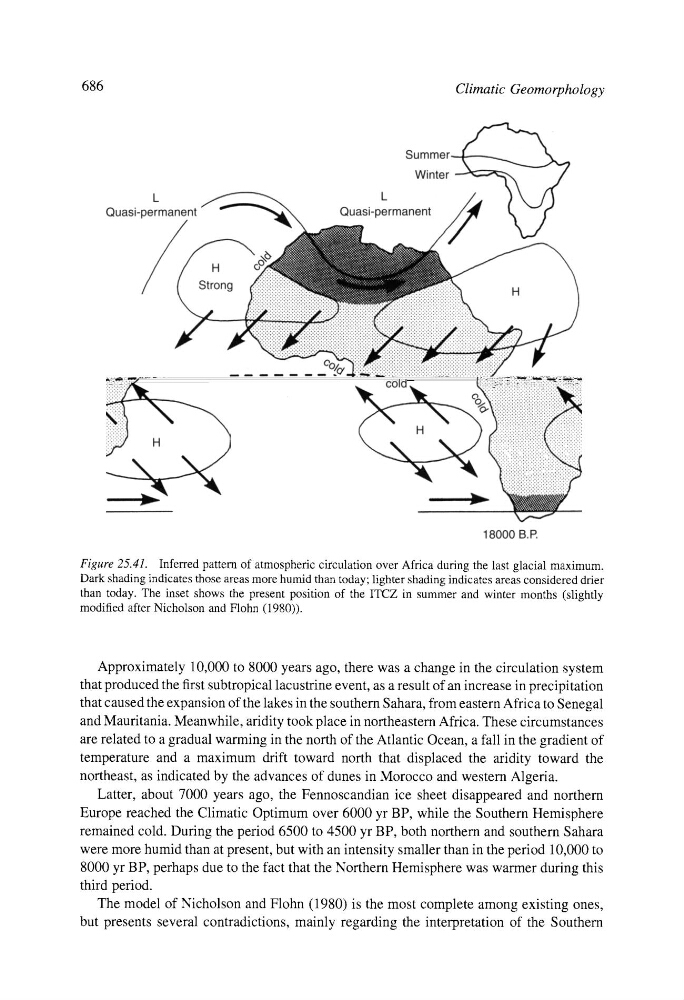
Figure 25.41. Inferred pattern of atmospheric circulation over Africa during the last glacial maximum.
Dark shading indicates those areas more humid than today; lighter shading indicates areas considered drier
than today. The inset shows the present position of the ITCZ in summer and winter months (slightly
modified after Nicholson and Flohn (1980)).
Approximately 10,000 to 8000 years ago, there was a change in the circulation system
that produced the first subtropical lacustrine event, as a result of an increase in precipitation
that caused the expansion of the lakes in the southern Sahara, from eastern Africa to Senegal
and Mauritania. Meanwhile, aridity took place in northeastern Africa. These circumstances
are related to a gradual warming in the north of the Atlantic Ocean, a fall in the gradient of
temperature and a maximum drift toward north that displaced the aridity toward the
northeast, as indicated by the advances of dunes in Morocco and western Algeria.
Latter, about 7000 years ago, the Fennoscandian ice sheet disappeared and northern
Europe reached the Climatic Optimum over 6000 yr BP, while the Southern Hemisphere
remained cold. During the period 6500 to 4500 yr BP, both northern and southern Sahara
were more humid than at present, but with an intensity smaller than in the period 10,000 to
8000 yr BP, perhaps due to the fact that the Northern Hemisphere was warmer during this
third period.
The model of Nicholson and Flohn (1980) is the most complete among existing ones,
but presents several contradictions, mainly regarding the interpretation of the Southern