

Climate change in arid and tropical humid regions
685
stages, the higher supply of the watercourse made it possible to cross the aeolian
accumulations, transforming the fluvial basin from endorheic into exorheic. All lakes in this
area expand during "pluvial" stages, while in dry periods increase the salinity by
evaporation, becoming even desiccated, as occurred in 1957 to Lake Fagnibine (Tricart,
1979). The present climate allows the Niger to flow into the Gulf of Guinea, which indicates
that actual precipitation is higher than that of the past, when the river was endorheic.
1.4. Causes of the paleoclimate fluctuations during the late Quaternary period
This is one of the subjects that has most fascinated experts on arid zones and has been
restricted mainly to the African continent, probably because it is the most well known by
many geomorphologists in different countries. According to Tricart (1969), however, the
reconstructions of the mechanisms that produce paleoclimate oscillations are different.
Areas located within tropical high pressure zones generate zonal deserts, whereas
extrazonal deserts are formed under specific geographic configurations, such as
continentality, orographic effect, and cold oceanic currents. The latter are normally
more sensitive to variations in the heat balance of the Earth and their evolution is
determined by local factors.
Theories on general circulation during the Pleistocene are presented in the excellent work
of Nicholson and Flohn (1980), in which the numerous authors theorize about the trajectory of
cyclones in middle latitudes, on the heat contrast imposed by the presence of large ice masses
with respect to the glacial-pluvial synchronism, and so forth. Nicholson and Flohn (1980)
have carried out the most relevant and synthetic work with regard to climate and
environmental changes in Africa and the general atmospheric circulation in the Pleistocene
and Holocene periods. During the biggest extension of the ice (18,000 yr BP) in the Northern
Hemisphere, the seasonal variations were minimal. Therefore, there was a displacement of the
cyclonic zones toward the south and an increase in the temperature gradient. On the other
hand, the Southern Hemisphere showed characteristics close to present ones.
For these authors, in this epoch and during the greater part of the interval from 20,000 to
12,000 yr BP, the aridity increased in the regions located in the southern Sahara and eastern
Africa. This contradicts the data of Sarnthein (1978), who held that the period of aridity was
about 2000 to 3000 years, around 18,000 years ago. But this supposition does not explain
that, from that date to 12,000 years, wet conditions occurred in northern Africa, in the
massifs of the interior Sahara and in southern Egypt. Nicholson and Flohn (1980) pointed
out that the biggest environmental changes in tropical Africa coincided with the accelerated
growth of the ice sheets (previous to 22,000 yr BP). Circulation systems meant, for most of
the period, aridity in tropical Africa and relatively wet conditions in northern Africa
(Figure 25.41), as a result of the displacement toward the south of the atmospheric
circulation systems.
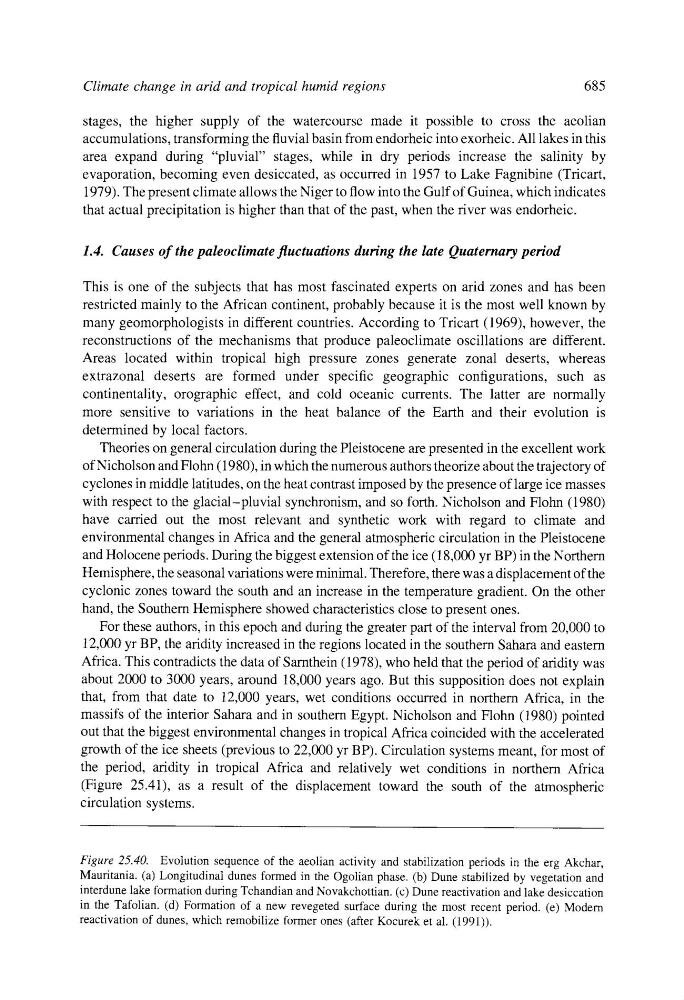
Figure 25.40. Evolution sequence of the aeolian activity and stabilization periods in the erg Akchar,
Mauritania. (a) Longitudinal dunes formed in the Ogolian phase. (b) Dune stabilized by vegetation and
interdune lake formation during Tchandian and Novakchottian. (c) Dune reactivation and lake desiccation
in the Tafolian. (d) Formation of a new revegeted surface during the most recent period. (e) Modem
reactivation of dunes, which remobilize former ones (after Kocurek et al. (1991)).