

682
Climatic Geomorphology
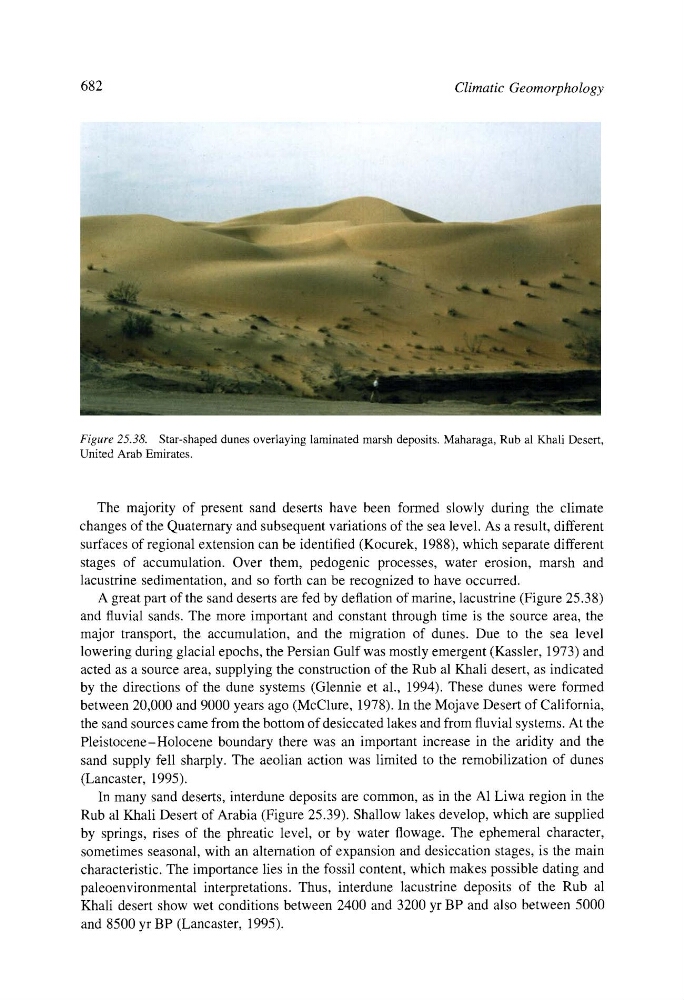
Figure 25.38. Star-shaped dunes overlaying laminated marsh deposits. Maharaga, Rub al Khali Desert,
United Arab Emirates.
The majority of present sand deserts have been formed slowly during the climate
changes of the Quaternary and subsequent variations of the sea level. As a result, different
surfaces of regional extension can be identified (Kocurek, 1988), which separate different
stages of accumulation. Over them, pedogenic processes, water erosion, marsh and
lacustrine sedimentation, and so forth can be recognized to have occurred.
A great part of the sand deserts are fed by deflation of marine, lacustrine (Figure 25.38)
and fluvial sands. The more important and constant through time is the source area, the
major transport, the accumulation, and the migration of dunes. Due to the sea level
lowering during glacial epochs, the Persian Gulf was mostly emergent (Kassler, 1973) and
acted as a source area, supplying the construction of the Rub al Khali desert, as indicated
by the directions of the dune systems (Glennie et al., 1994). These dunes were formed
between 20,000 and 9000 years ago (McClure, 1978). In the Mojave Desert of California,
the sand sources came from the bottom of desiccated lakes and from fluvial systems. At the
Pleistocene-Holocene boundary there was an important increase in the aridity and the
sand supply fell sharply. The aeolian action was limited to the remobilization of dunes
(Lancaster, 1995).
In many sand deserts, interdune deposits are common, as in the A1 Liwa region in the
Rub al Khali Desert of Arabia (Figure 25.39). Shallow lakes develop, which are supplied
by springs, rises of the phreatic level, or by water flowage. The ephemeral character,
sometimes seasonal, with an alternation of expansion and desiccation stages, is the main
characteristic. The importance lies in the fossil content, which makes possible dating and
paleoenvironmental interpretations. Thus, interdune lacustrine deposits of the Rub al
Khali desert show wet conditions between 2400 and 3200 yr BP and also between 5000
and 8500 yr BP (Lancaster, 1995).