

Climate change in arid and tropical humid regions
669
chronology of the lake phases. They established a period of expansion between 24,000 and
14,000 yr BP; another between 14,000 and 10,000 yr BP with wide fluctuations that can be
synchronous or not. Finally, between 10,000 and 5000 yr BP, an arid or dry phase can be
recognized, with a fall of the lake levels. Recently, Oviatt (1997) pointed out that the
different stages of lake-level fall have ages of 21, 18.5 to 19, 17.5, 16 to 15.5, 14 to 13, and
10 kyr, all of them obtained by means of C-14. They are synchronous with the end of the
Heinrich H1 and H2 events and with other smaller stages of iceberg drift (a, b, c, and
Younger Dryas) in the northern Atlantic, suggesting a global change.
The study of shorelines and their interpretation in deep lakes is complicated due to the
fact that they have been deformed because of the hydrostatic unloading. The study of lake
levels is crucial, however, to determine the magnitude of the subsidence in particular areas
of the Earth's surface, as a result of the load due to the water volume and the subsequent
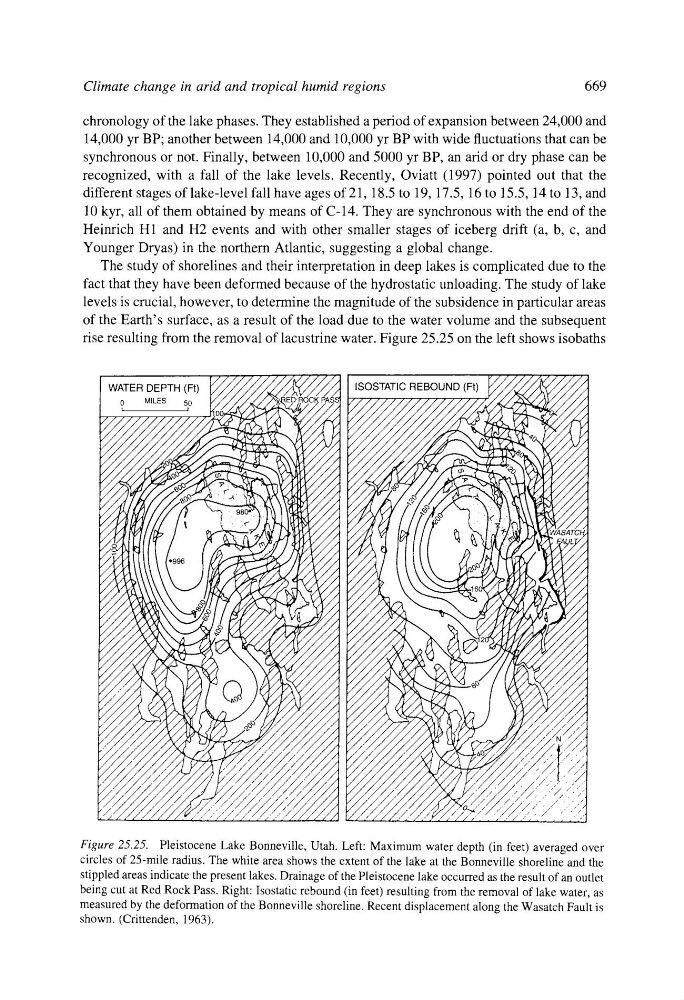
rise resulting from the removal of lacustrine water. Figure 25.25 on the left shows isobaths
Figure 25.25. Pleistocene Lake Bonneville, Utah. Left: Maximum water depth (in feet) averaged over
circles of 25-mile radius. The white area shows the extent of the lake at the Bonneville shoreline and the
stippled areas indicate the present lakes. Drainage of the Pleistocene lake occurred as the result of an outlet
being cut at Red Rock Pass. Right: Isostatic rebound (in feet) resulting from the removal of lake water, as
measured by the deformation of the Bonneville shoreline. Recent displacement along the Wasatch Fault is
shown. (Crittenden, 1963).