

656
Climatic Geomorphology
(a)
(b)
(c)
,:
I_
13_,'!
", /
(d)
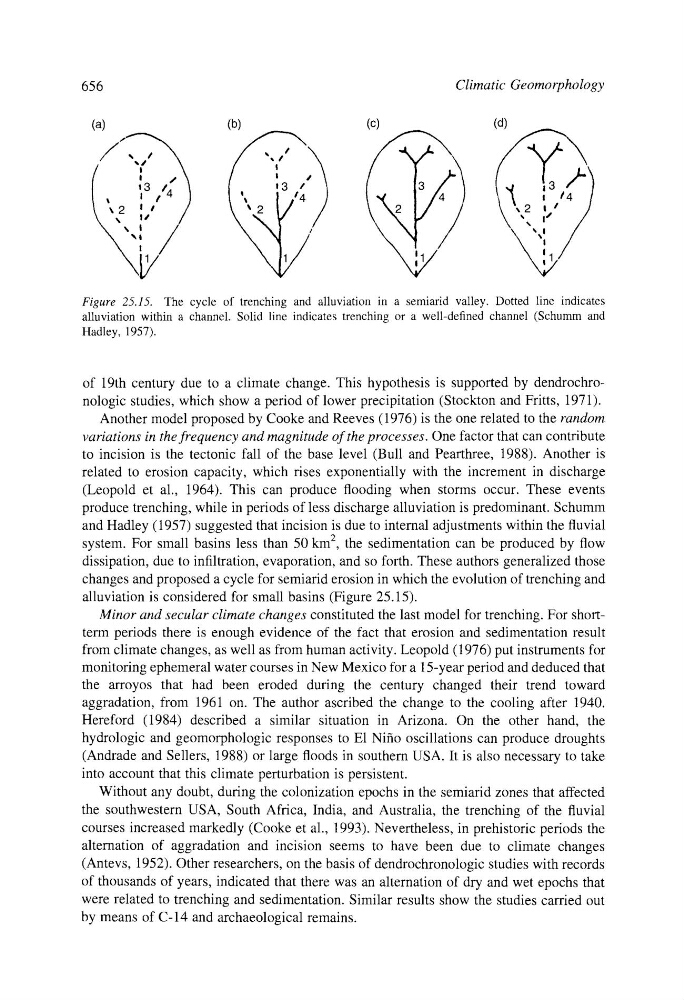
Figure 25.15. The cycle of trenching and alluviation in a semiarid valley. Dotted line indicates
alluviation within a channel. Solid line indicates trenching or a well-defined channel (Schumm and
Hadley, 1957).
of 19th century due to a climate change. This hypothesis is supported by dendrochronologic studies, which show a period of lower precipitation (Stockton and Fritts, 1971).
Another model proposed by Cooke and Reeves (1976) is the one related to the random
variations in the frequency and magnitude of the processes. One factor that can contribute
to incision is the tectonic fall of the base level (Bull and Pearthree, 1988). Another is
related to erosion capacity, which rises exponentially with the increment in discharge
(Leopold et al., 1964). This can produce flooding when storms occur. These events
produce trenching, while in periods of less discharge alluviation is predominant. Schumm
and Hadley (1957) suggested that incision is due to internal adjustments within the fluvial
system. For small basins less than 50 km 2, the sedimentation can be produced by flow
dissipation, due to infiltration, evaporation, and so forth. These authors generalized those
changes and proposed a cycle for semiarid erosion in which the evolution of trenching and
alluviation is considered for small basins (Figure 25.15).
Minor and secular climate changes constituted the last model for trenching. For shortterm periods there is enough evidence of the fact that erosion and sedimentation result
from climate changes, as well as from human activity. Leopold (1976) put instruments for
monitoring ephemeral water courses in New Mexico for a 15-year period and deduced that
the arroyos that had been eroded during the century changed their trend toward
aggradation, from 1961 on. The author ascribed the change to the cooling after 1940.
Hereford (1984) described a similar situation in Arizona. On the other hand, the
hydrologic and geomorphologic responses to E1 Nifio oscillations can produce droughts
(Andrade and Sellers, 1988) or large floods in southern USA. It is also necessary to take
into account that this climate perturbation is persistent.
Without any doubt, during the colonization epochs in the semiarid zones that affected
the southwestern USA, South Africa, India, and Australia, the trenching of the fluvial
courses increased markedly (Cooke et al., 1993). Nevertheless, in prehistoric periods the
alternation of aggradation and incision seems to have been due to climate changes
(Antevs, 1952). Other researchers, on the basis of dendrochronologic studies with records
of thousands of years, indicated that there was an alternation of dry and wet epochs that
were related to trenching and sedimentation. Similar results show the studies carried out
by means of C-14 and archaeological remains.